
‘Extinction is Forever’
Conservationists concerned about the Trump administration’s attacks on the Endangered Species Act
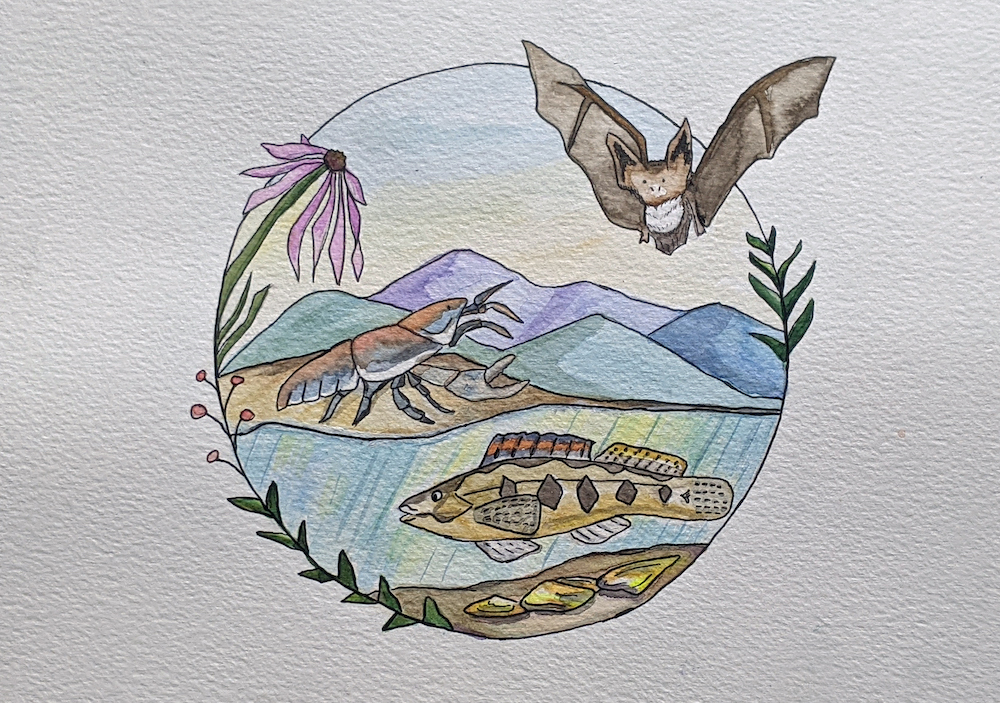
From the Eastern hellbender to the Carolina northern flying squirrel, many of Appalachia’s most beloved creatures and plants could be at increased risk due to proposed changes to the Endangered Species Act by the Trump administration.
In November, the U.S. Fish and Wildlife Service announced four proposed rules to change how the ESA works. They largely return to the 2019 and 2020 rules from the first Trump administration, which were subsequently reversed during the Biden administration.
“We had a pretty good idea that this was coming again,” says Hardy Kern, director of government relations at the American Bird Conservancy, an international nonprofit.
According to the Fish and Wildlife Service’s announcement, these actions “advance President Donald J. Trump’s directives to strengthen American energy independence, improve regulatory predictability and ensure federal actions align with the best reading of the law.”
If finalized, conservation advocates believe these rules would undermine the ESA’s effectiveness and prioritize industry interests, along with mining and drilling, over biodiversity. The ramifications of these actions would be far-reaching — removing automatic protections for species newly added to the endangered or threatened lists, limiting what areas can be protected as critical habitat and weakening federal oversight overall.
“It’s just introducing a lot more subjectivity and uncertainty into the whole [ESA] process,” Kern says. “And at the end of it, what it’s going to mean is it’s going to be harder to protect the species that need protection the most.”
Endangered Species Act: Popular, effective law when ‘implemented correctly’
In 1973, former President Richard Nixon signed the ESA into law. The goal, Hardy shares, was to create a process and outline a series of protections for species that were most likely to go extinct. And these species are not protected “willy nilly,” Hardy says. The process to give species ESA protections can take years, even decades.
Over the last 52 years, the ESA has also received bipartisan support, Hardy explains, with both Democratic and Republican politicians introducing new measures to strengthen the ESA and ensure its longevity.
“The Endangered Species Act is widely supported in the United States,” says Kern. A 2023 Defenders of Wildlife poll conducted by RealClearPolitics found 84% of participants expressed support for the ESA.
The same poll found that 73% of respondents saw biodiversity as important to their everyday lives.
“All around the country, people take pride in the species that define where they live, because it’s based on the habitat characteristics that provide … for those species,” says Andrew Young, vice president for federal affairs at the nonprofit West Virginia Highlands Conservancy and staff attorney for the Allegheny-Blue Ridge Alliance.
“There’s a huge interconnectedness between the species’ existence and our own existence and fulfillment,” he continues.
But beyond its appeal, the ESA has also been highly effective. Since its passage, it is estimated to have saved over 99% of the species under its protection, according to a 2019 study by the Center for Biological Diversity.
“It’s an excellent law, and it works when it’s implemented correctly, but the key words there are ‘when it’s implemented correctly,’ and the regulations spell out how federal agencies are going to do that,” says Deirdre Dlugoleski, staff attorney at Defenders of Wildlife, a national conservation organization. “So if the regulations are bad, then having a good law doesn’t really mean much, because it’s not being pursued on the ground. It’s not being implemented in the way that Congress intended when it wrote the ESA.”
New ESA proposals introduce economic considerations, narrow protections

The Fish and Wildlife Service’s proposals seek to remove “really key provisions” of the regulations and implementation guidelines of the ESA, Hardy explains. The rules specifically target Section 4 — how species are listed and delisted — and Section 7 — the process for government agencies to work together to protect species.
“All of the changes that are being proposed would make it much harder to designate critical habitat, and would make it much easier to establish projects or to go into threatened and endangered species habitat, and extract resources, conduct new business — things like that — in a way that might harm the species,” Kern says.
Under the ESA, a threatened species is “any species which is likely to become an endangered species within the foreseeable future throughout all or a significant portion of its range.” The Trump administration is seeking to narrow the definition of “foreseeable future,” which would mean threatened species would get far closer to being endangered before they could be listed and protected.
“If a threatened species is almost endangered when it gets listed, then you’ve lost all of those benefits that were intentionally built into [the ESA],” says Daniel Franz, staff attorney at Defenders of Wildlife.
Additionally, the Trump administration seeks to eliminate the so-called “blanket rule,” which automatically gives endangered species protections to threatened species, in favor of implementing species-specific rules. Advocates of the original policy consider it one of the fastest and most effective tools for providing immediate protection to threatened species. Its removal could delay protections when species are most vulnerable.
Currently, ESA decisions about adding, removing or changing the status of protected species are made based on “the best scientific and commercial data available” and “without reference to possible economic or other impacts of such determination.” The Trump administration wants to remove the latter phrasing, thus reintroducing economic considerations into the evaluation process. Another proposal would revive a 2020 rule and clarify “how economic, national security and other relevant impacts are weighed when determining whether to exclude areas from critical habitat,” according to the agency announcement.
“What is an economic consideration?” Kern says. He finds the language “concerning” because of its broad scope. “Does that mean that if there’s any potential impact to business, that’s going to weigh in a species listing?”
In Appalachia, Young sees this as an “age-old reinforcement of the extractive industry.”
“The new proposed regulations are going to allow for a lot of discretion in the hands of people that serve specific industries,” Young says. “In West Virginia, that’s coal, that’s natural gas, that’s building highways and pipelines, and it’s cutting trees.”
A fourth proposed rule would significantly alter the consultation process for how federal agencies ensure their actions, such as building a highway or methane gas pipeline, don’t put listed species at risk or negatively alter or destroy critical habitats. Broadly, this change would make it easier for agencies to overlook harmful project impacts in their analysis, even to the point of limiting what they consider a consequence at all, according to Dlugoleski.
“Consultation is basically the opportunity to identify how an action is going to affect listed species and critical habitat and figure out how to mitigate or avoid those effects,” Dlugoleski says. “And you can’t plan for effects that you don’t consider in that process.”
Young is particularly concerned about how this proposal defines the ideal health of the species as whatever its status is at the time the project is proposed. For species already in decline, such as the Eastern hellbender, the revised definition would treat their current, damaged state as the starting point for assessment of how future projects would affect them, he explains, instead of looking at the hellbender’s traditional historic range.
“It can make additional harm seem minor if the species is already on a downward trajectory,” Young continues.
Franz, with Defenders of Wildlife, explains that the existing consultation process “doesn’t actually stop or slow down many projects.” Instead, it usually improves them with “reasonable mitigation measures” that allow projects to move forward while reducing harm to vulnerable species.
“Some of this is just to get the ‘win’ of deregulation, independent of either the conservation reality or even the business reality of how much it’s impacting folks,” Franz continues.
‘A multi-pronged attack’

Beyond these rules in question, there has been a much broader push to roll back environmental protections across all three branches of government, Franz explains. Members of Congress have introduced bills to change the core law itself, while interest groups are bringing cases to the courts to undercut key protections.
“This is a multi-pronged attack,” Franz says.
These new rules are also in addition to an earlier proposed ESA rule. In April, the Fish and Wildlife Service issued a proposed rule to remove the definition of “harm” from how the ESA prohibits the “take” of an endangered species. Currently, the ESA outlines “take” as “to harass, harm, pursue, hunt, shoot, wound, kill, trap, capture, or collect, or to attempt to engage in any such conduct.”
“We wish that the Trump administration would know what we all know: that harm means harm,” says Jewel Tomasula, national policy director of the Endangered Species Coalition, a network of over 400 organizations.
Public comments on the “take” rule wrapped in May — over 357,000 were submitted — and the public comment period for these four newly proposed rules ended Dec. 22.
“[The ESA] is truly that safety net that’s making sure that we don’t lose wildlife forever,” Tomasula says. “Extinction is forever.”
Related Articles
Latest News
More Stories


Leave a comment
Your email address will not be published. Required fields are marked *
Leave a Comment