
In Montgomery County, Virginia, Seasoned Mountain Valley Pipeline Fighters Prepare for Another Battle
MVP Boost expansion plans call for a new compressor station in Elliston
“Here we go again,” is what Crystal Mello, an organizer for the Protect Our Water, Heritage, Rights Coalition, says she said to herself when she learned that Mountain Valley Pipeline was planning a new compressor station in Elliston, Virginia, as part of a project to send even more gas through the massive 42-inch pipeline.
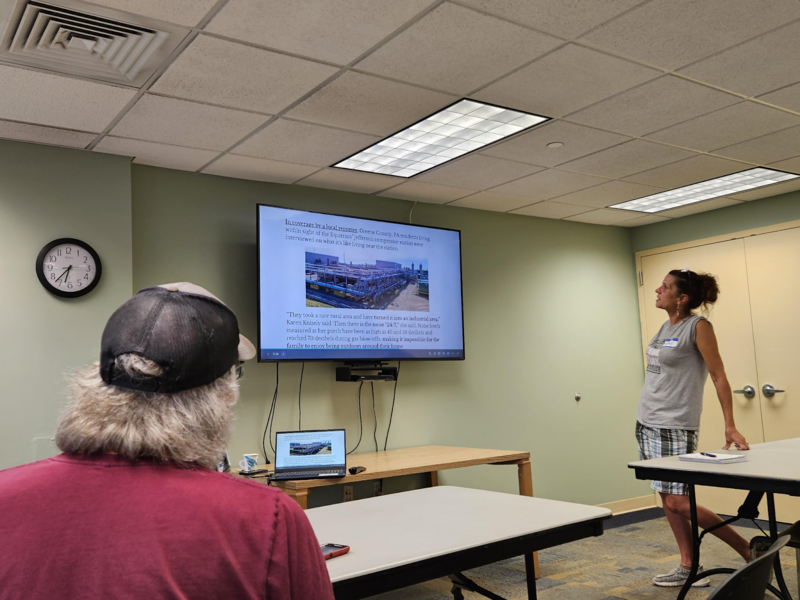
“I knew it,” she says, sitting outside the Eastmont Community Garden she helped establish next to Dale’s Food Pantry and a thrift store in Elliston. “We’ve been waiting for this announcement.”
MVP Boost would upgrade three compressor stations in West Virginia and add the new station, called the Swann Compressor Station, in Montgomery County, Virginia, to increase MVP’s gas capacity by half a billion cubic feet per day, according to EQT Corporation, the pipeline’s developer.
On Oct. 23, MVP applied for a Certificate of Public Convenience and Necessity from the Federal Energy Regulatory Commission, the first step in obtaining the necessary approval to begin construction, which will also include a public comment period.
The idea of a compressor station in Elliston concerns Mello on several levels.
Noise and air pollution concerns
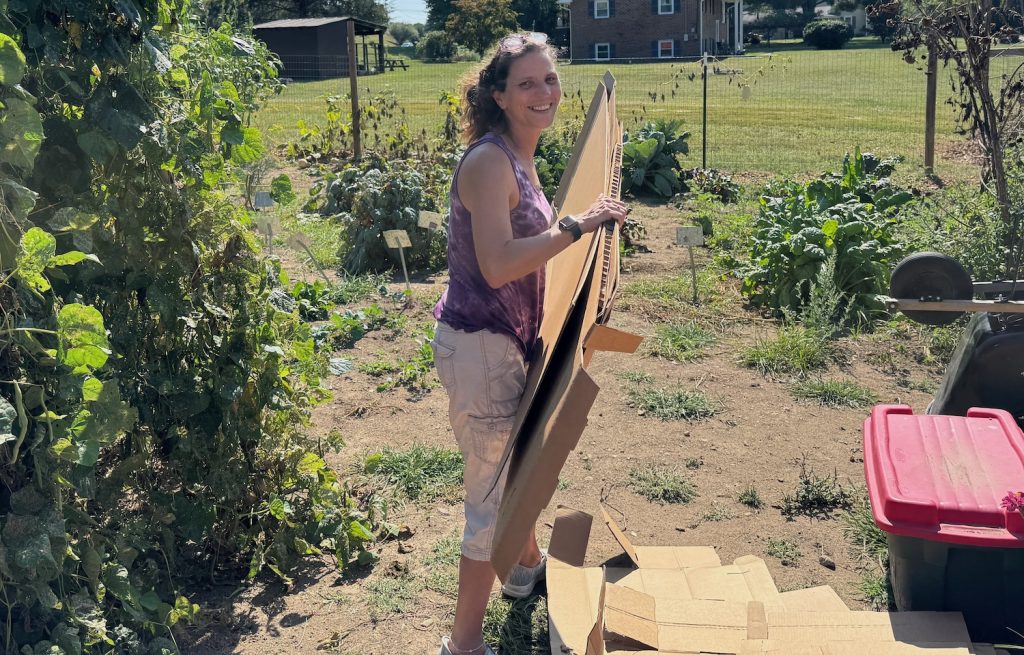
“I’m no expert on compressor stations, but I’m learning the specifics,” she says. “There’s noise and air pollution, especially when they have to do blow-downs.”
Blow-downs happen when compressor stations are depressurized for maintenance. These events release large amounts of gas into the air.
A 2023 study by members of the Virginia Scientist-Community Interface, including doctoral and master’s students from the University of Virginia and Virginia Tech, found that compressor stations emit many harmful pollutants. Still, there has been little study or monitoring of them, or assessment of the impact on nearby communities — especially after blow-downs for scheduled maintenance.
“While some individual health and environmental effects from the stations are known, combinations of different impacts are often not considered together and have the potential to create devastating outcomes,” wrote the study’s authors.
Mello is not alone in her concern about the compressor station.
“I’m very disappointed, but not surprised,” says Cletus Bohon, who lives around two miles from the proposed compressor station and has been involved in litigation against Mountain Valley Pipeline. “Early on, something indicated they might need a compressor station later. We kind of knew it all along, but were hoping not.”
‘That’s our only way in and out’
Like Mello, Bohon is concerned about pollution. But he also has other worries.
“There’s a railroad track that comes down right beside U.S. 460 near the property adjoining the land the compressor station is going to be on,” he says. “Trains often stop in front of the only crossing in and out of [the road the compressor station would be on].”
Not long ago, a train blocked the crossing for three hours, according to Bohon.
“That’s our only way in and out,” he says. “If something happens over there, how is anyone going to get over to do anything? If something happens, I can’t get out, and first responders can’t get in.”
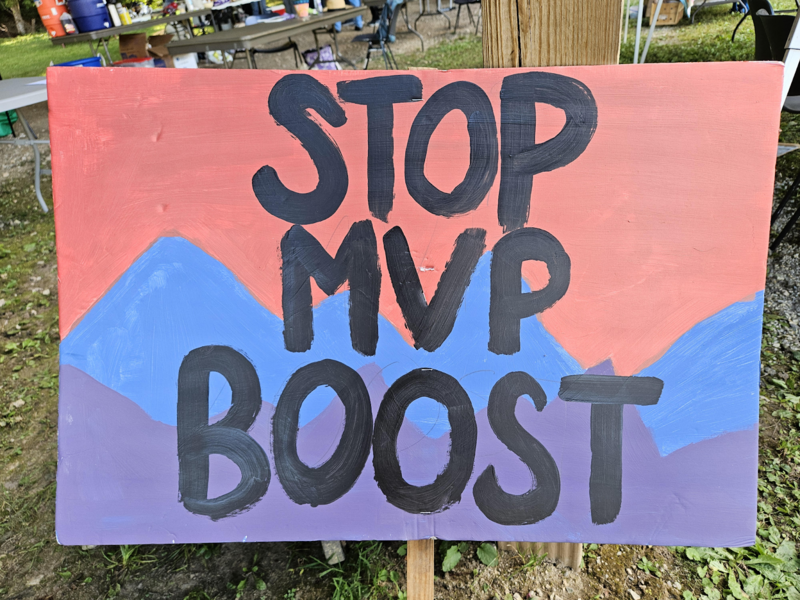
Mello and others have started to organize, canvassing the area and holding community meetings. Another meeting has been scheduled for Nov. 24 from 5:30 to 7:30 p.m. at the community room in the Meadowbrook Public Library. Residents interested in attending meetings or assisting in organizing against the project can sign up with POWHR for updates.
It feels like an uphill battle to Mello and Bohon.
“I’ve been talking to everyday people,” says Mello, but most are not aware of the proposal.
“A lot of people just feel like there’s nothing they can do about it,” says Bohon. “The pipe is in the ground, and it’s out of sight. Some people didn’t even know it was finished. Something above ground, even if it’s not visible to most people, is a little more intimidating.”
In addition, Appalachian Voices, the organization that produces this publication, and Virginia Tech’s Appalachian Studies department installed three air monitors — two within half a mile of the proposed station and the third about a mile away — which will help establish a baseline for air pollution in the community prior to the compressor station going online if the project moves forward.
MVP has been doing some community outreach about the project, posting flyers and holding meetings, but that outreach has been imperfect. At one recent poorly attended meeting, an MVP representative said they sent out 1,500 flyers, but not many community members said they got them, according to Mello.
‘Not only am I in a blast zone, but now you’re going to poison me?’
Penny Artis was not surprised by MVP’s announcement, either. Artis, who lives on the pipeline’s path and is less than a mile from the proposed compressor station, monitors the pipeline route.
“They had already bought the property in 2021,” Artis says. “You’re not buying anything if you’re not planning on using it. When they laid in this big bed of concrete with two valves, I knew what it was going to be. As soon as they put that in, I knew they were going to bring the compressor station out.”
Artis isn’t convinced of the necessity for the compressor station or the added capacity.
“I don’t see where they need it,” she says. “They never released the horsepower they plan on running it, which is very important. The higher the horsepower, the higher the emissions, and the bigger the flare when they need to off-gas.”
Like Bowen, Artis also worries about trains blocking the way out during an emergency.
“The whole place that I live in is an evacuation zone, and there’s no plan for it,” she says. “No one can get in if a train blocks them without a helicopter. That’s a huge problem here.”
She’s also concerned about the emissions from the compressor station.
“Not only am I in a blast zone, but now you’re going to poison me?” she says.
Related Articles
Latest News



Leave a comment
Your email address will not be published. Required fields are marked *
Leave a Comment