
‘Next Time, We’ll Be Ready:’ Community Resilience Hubs Take Root in Western North Carolina
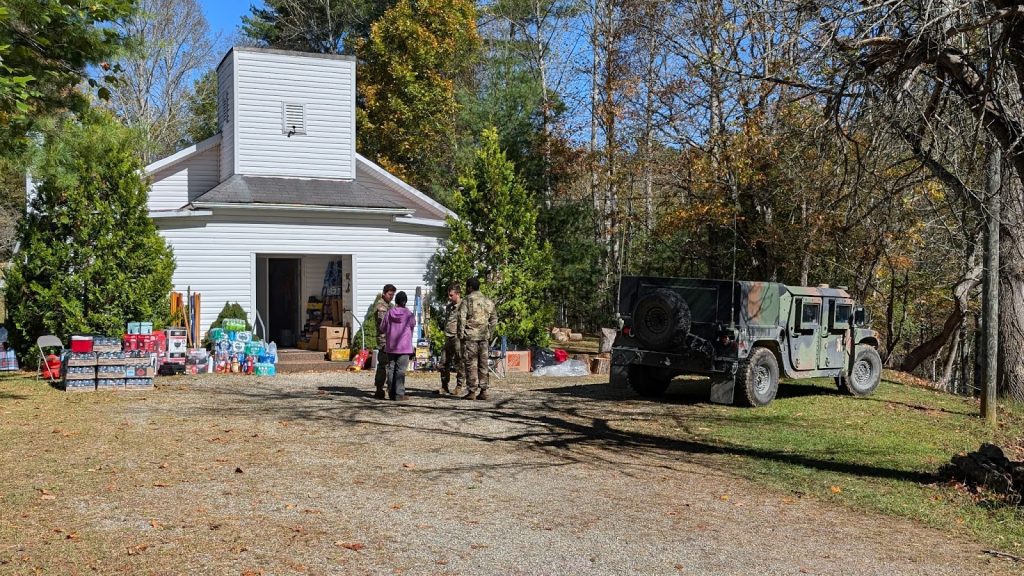
Mira Brown was working as an assistant engineer on a tugboat off the coast of Puerto Rico when Hurricane Helene hit her small community in Yancey County, North Carolina.
For a couple of days, she couldn’t get in contact with her family, dialing every phone number she knew in the area but getting the same disconnected error message. Finally, a stranger, an amateur radio operator in Statesville, called her to say that he received a message that her family was safe.
“I was relieved, but that’s when I really started to worry,” Mira Brown says about realizing how bad the situation was.
Less than a week after the storm, she was able to reach the area, bringing medications and other necessary supplies. Mira Brown and her neighbors set up a relief hub out of Piney Hill Baptist Church. From the church, they were able to distribute food, water and gasoline.
Initially, the hub relied on gas-powered generators, but the cost and limited fuel availability became a cause for concern. Mira Brown and others connected with the team at Footprint Project, a natural disaster recovery nonprofit based in New Orleans, who supplied them with solar-powered generators.
“We used [them to power] the community Starlink for the duration of the time the power was out, which was huge,” she says, emphasizing that having reliable communication access with the outside world powered by solar was not only important but life-saving.
Even after the power grid came back online, the church continued to use a backup solar generator to provide power redundancy in the event of more outages. When one of Mira Brown’s neighbors suffered a heart attack, he was able to use the hub’s Starlink to call for air medical services.
“Having that communication here was critical,” she says, adding, “If every road had their own little community center, that would be — that would be ideal, that would be amazing. With a reliable communication hub, with some kind of [power] backup — like, that’s security.”
Neighbors as first responders in times of crisis
The people of Central and Southern Appalachia are no strangers to the devastation caused by flooding. However, for many, the widespread severity of Hurricane Helene was a wake-up call, as it was the first time so many critical lifelines failed simultaneously, from the loss of roads to communications due to grid vulnerabilities that had previously been untested at this magnitude.
After a disaster, “we think that people are going to come for us,” explains Will Heegaard, founding director at Footprint Project, about how many hope that federal agencies will be “rappelling off ropes” to come to their aid. Even though Heegaard’s team was one of the early external aid organizations to arrive after the storm, he explains that in those first 48 to 72 hours, neighbors are generally a community’s primary first responders.
“The biggest resource you have in a terrible time is your neighbor,” says Catherine Hebson, recovery program manager at Footprint Project. “There is a chunk of time before anyone is there, where it is you and your neighbors and the things you had in your house prior to the storm.”
For communities to become more resilient in the wake of future storms, Heegaard and Hebson emphasize that it’s critical to identify strong, local organizations and leaders and outfit them with tools — like sustainable technologies — they need to be successful.
“The more we can get resources down to the grassroots level, the more likely they’ll be well utilized and more people will be saved in future storms,” Heegaard says.
Equipping neighbors with sustainable technologies
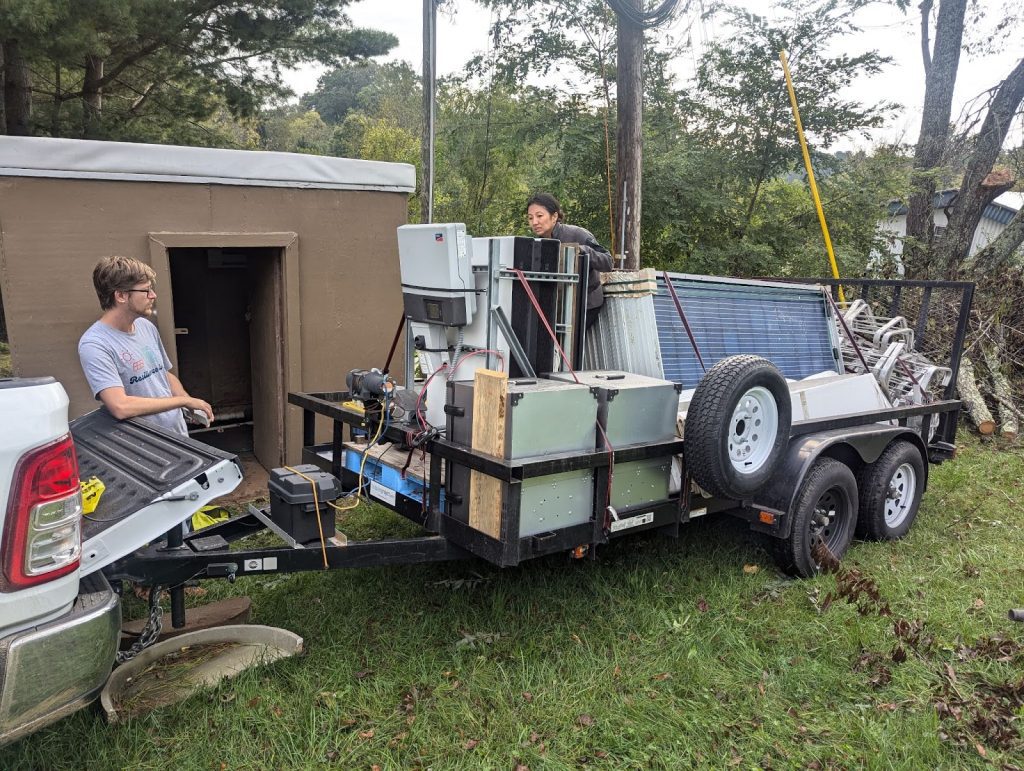
Founded in 2018, Footprint Project deploys sustainable technologies to address rapid response and long-term recovery needs. These technologies include small portable solar power stations for charging mobile devices and larger solar and battery storage-powered microgrids that generate and store energy, operating independently from a centralized electrical grid.
Since Hurricane Helene, the nonprofit has raised and committed over $1 million in funding and renewable response equipment for areas impacted by the storm, with 95% of its support dedicated to North Carolina. As of April 2025, the nonprofit had provided more than 400 portable solar generators, 25 mobile solar microgrid trailers, 40 palletized solar microgrid systems and other necessary technologies.
Additionally, through its WNC Free Store, Footprint has donated over 14 kilowatts of solar panels and nearly $30,000 in renewable technology components in the region. Overall, Footprint Project estimates it has directly supported hundreds of individuals and community hubs and thousands of people indirectly.
Footprint Project distributed this renewable equipment to fire departments, mutual aid distribution hubs, faith-based institutions, community centers, nonprofit organizations and displaced individuals. In the crucial first few weeks after the storm, these systems improved communication and quality of life, and saved money.
One recipient of Footprint Project’s generosity in Western North Carolina was WAMY Community Action, a nonprofit that provides home weatherization and family development services to low-income individuals and families in Watauga, Avery, Mitchell and Yancey counties. Melanie Jirka, lead energy auditor at its Spruce Pine office, explains that many of the people they serve were suffering long before the hurricane hit, which only exacerbated existing systemic issues. Jirka was able to distribute several small and large solar systems to people who had lost power and struggled to cover the costs associated with running gasoline-powered generators.
“Having to get gas and fill up those generators was hard on a lot of people,” explains Jirka. “I would love to see more of these [solar] generators out in the general public.”
In Boone, North Carolina, donated solar-powered generators were a “godsend” for elderly clients supported by High Country Caregivers, a nonprofit with a mission to help kinship caregivers and their families, according to Nathan Brown of the organization. Many of these caregivers need steady, affordable sources of power for oxygen and CPAP machines or to keep certain medications refrigerated.
“When the power goes out in the middle of the night, and you’ve got someone who’s in their 70s on an oxygen machine and has mobility issues, trying to get to a gas-powered motor outside is going to be detrimental,” Nathan Brown says. “The goal was to find the easiest way to keep these families going until the power did return.”
In Pensacola, North Carolina, a distribution hub called Camp Miller was established in response to the storm’s devastation. The hub distributed 60,000 meals and 50,000 gallons of fuel in its first 100 days. Camp Miller was able to power much of its operations with solar panels loaned by Footprint Project, eliminating the need to run generators 24/7.
“It was an elegantly simple solution to an endlessly complex problem,” says Brian Delaney, a member of the leadership team for CAMP NAONE, an organization formed out of Camp Miller. “We didn’t need a lot of resources to run the camp, so we could then deploy those resources to the community that we’re serving.”
At Piney Hill Baptist Church, Mira Brown was able to secure dozens more solar generators from an international aid organization after the initial donation from Footprint Project prompted the community’s interest in renewable power. Before the storm, solar wasn’t something many of Brown’s neighbors considered investing in as an energy source.
“I had so many conversations with people who were just really excited about [solar],” says Mira Brown, highlighting widespread concern not to be “caught” again without power for an extended period of time. “While those [initial] resources provided a really important stop-gap after the storm, it’s also provided really good information for people about what solar can do and what role it might play in their lives.”
The need for long-term community resilience hubs
Countless community disaster relief hubs, such as Camp Miller or Piney Hill Baptist Church, sprang up in the wake of Hurricane Helene. But after rapid aid has been delivered and the long, arduous process of rebuilding has begun, the question remains of how Western North Carolina and other regions of the country can better prepare for future disasters. Some organizations are looking to establish long-term community resilience hubs to serve as safety nets for residents in both good times and bad.
In an ideal scenario, these hubs would be equipped with renewable infrastructure, such as solar microgrids, to maintain reliable access to electricity in the event of grid outages. This power reliability would ensure continued access to critical communications equipment, electric well pumps or filtration devices for clean drinking water, as well as provide safe spaces to distribute food, hygiene products, clothing and medical supplies.
“I think the storm certainly drove home the need for more resilience in our energy system and more localized energy resilience to respond to large-scale disasters that impact the grid on such a broad level,” says Autumn Long, director of the Appalachian Solar Finance Fund. Appalachian Voices, the nonprofit organization that publishes The Appalachian Voice, serves as the fiscal sponsor for the fund.
The Appalachian Solar Finance Fund and Appalachian Voices are collaborating with Footprint Project, Invest Appalachia and other partners to promote long-term recovery and community resilience in Western North Carolina. This partnership includes financing support for the deployment and installation of permanent solar and battery-powered microgrids. Additionally, Appalachian Voices is working to help individuals and local leaders improve their disaster preparedness.
“Whenever we talk to local community partners about building an energy-resilient emergency hub for their community, they are like, ‘Yes, we need that, we want that, we see the value in that,’” explains Long.
Despite regional support, outfitting existing buildings as resilience hubs faces numerous challenges. Rural leaders often have a lot on their plates with limited capacity to undertake these projects, and there can be a lack of on-the-ground technical expertise. But most notably, the work requires funding. Looming federal cuts and changes to federal tax credits for solar projects could make cost barriers even more prohibitive.
“It takes a lot of money to build these projects,” says Long, highlighting the need for creative funding solutions that don’t leave communities with undue financial burdens. “That’s why we’re helping communities combine grant funding with low-cost repayable capital and federal, state and local incentives to build projects that provide long-term cost savings while strengthening local resilience.”
‘If we have another outage, we’ll be ready’
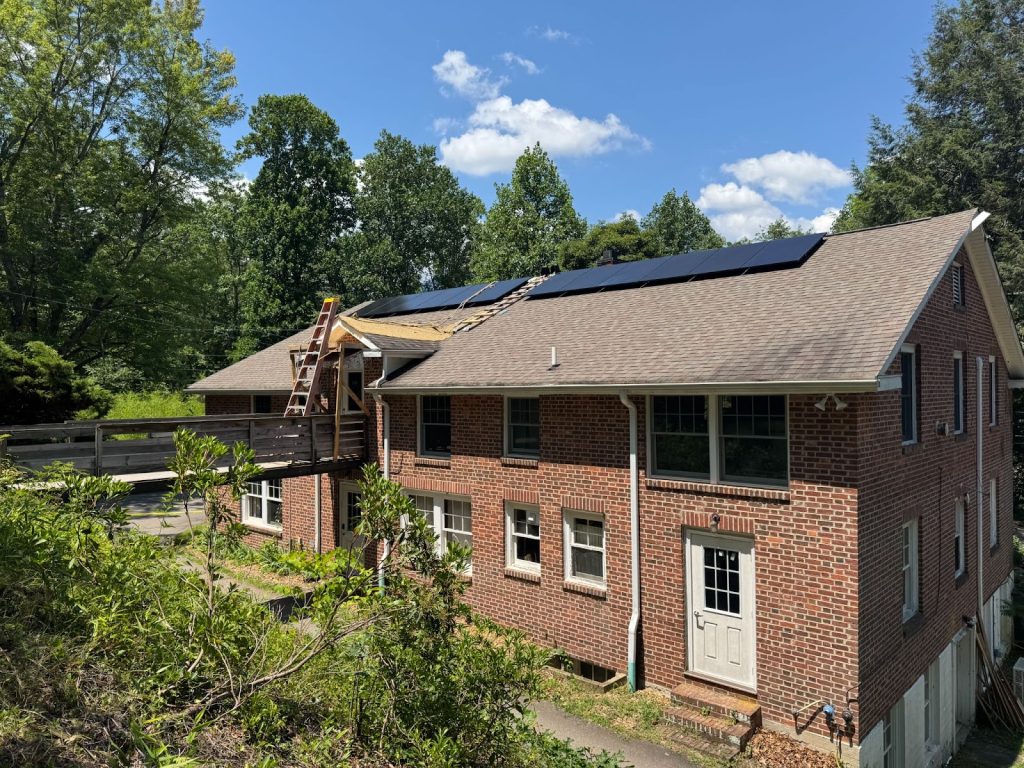
In Green Mountain, North Carolina, Double Island Volunteer Fire Department deals with frequent power outages during the winter months, and it lost power for several weeks following Hurricane Helene. Footprint Project donated a mobile solar microgrid to support the station in providing long-term housing for out-of-state volunteers who assisted with rebuilding efforts for three months.
“In these rural communities, the fire stations were doing all the hard, gruesome labor required of them after Helene,” explains Footprint Project’s Hebson.
To serve as a future community resilience hub, the fire station is now planning to install a 10- to 12-kilowatt solar microgrid with 20 kilowatt-hours of battery storage. The hope is not only to provide steady power in times of crisis but also to enhance the fire station’s efficiency and lower its electricity costs during normal operations.
Footprint Project is providing the majority of the equipment through donations from manufacturers and distributors within its network. To avoid dipping into internal savings for the upfront cost of the installation, the fire station is pursuing a 0% unsecured bridge loan from Invest Appalachia. The station will repay the loan monthly but with no additional interest or fees.
Another North Carolina resilience hub project is located in Celo, a rural cooperative settlement in Yancey County. Celo suffered significant flooding and lost many community-owned spaces, including its food co-op. In addition to other sustainable resources, Footprint equipped the Celo Community Center with a solar microgrid trailer to lessen its dependence on gasoline-powered generators. They used the system for over a month until grid power was restored.
Now, the Celo Community Center is collaborating with Footprint, a local solar developer and other partners to install a 9.6-kilowatt solar array and 20 kilowatt-hours of battery storage. Much of the solar equipment is donated, and the future resilience hub is receiving a grant from the Appalachia Funders Network’s Appalachian Helene Response Fund. The Appalachian Solar Finance Fund is a member of the funders network.
“I think it probably will more or less zero out our electrical loads — that’ll save us quite a bit of money over the course of the year,” says Gred Gross, building manager of the Celo Community Center. “And, of course, if we have another outage, we’ll be ready.”
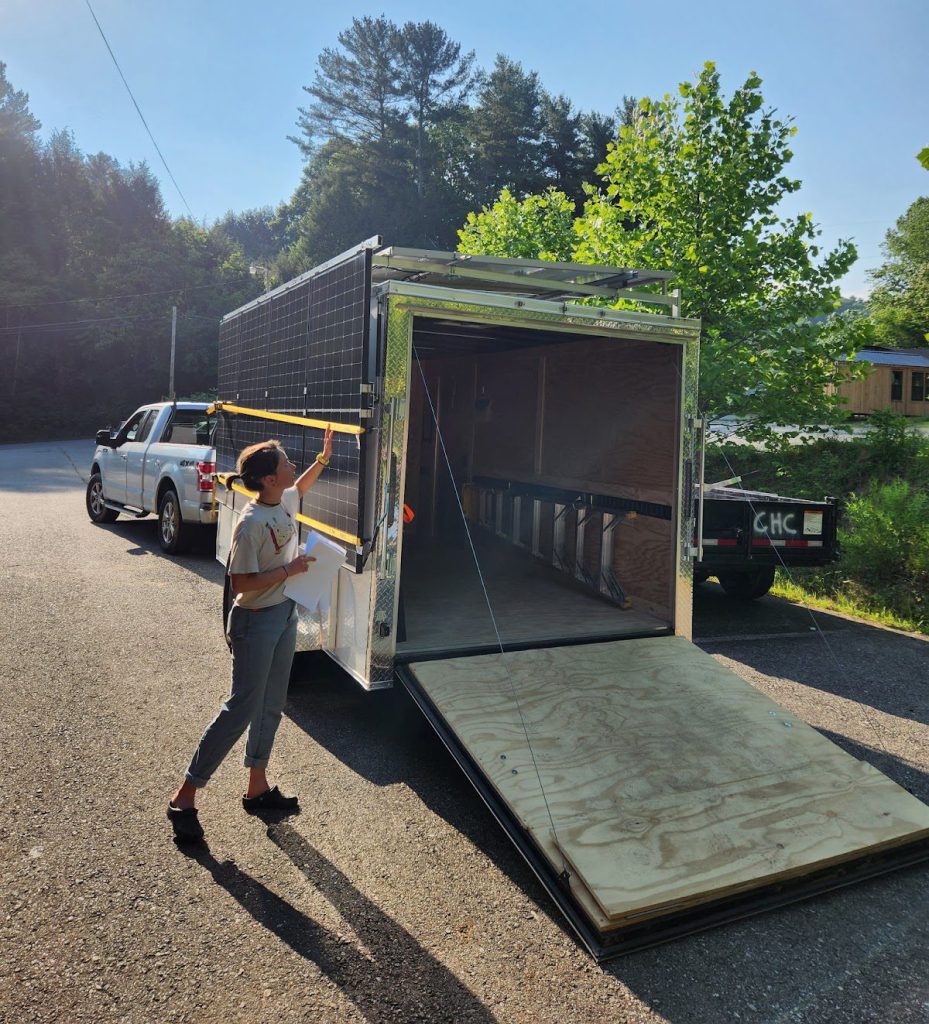
Another project funded through the Appalachia Funders Network is a solar microgrid trailer for Rural Organizing and Resilience, or ROAR, a mutual aid organization in Madison County. The trailer features 3 kilowatts of mounted solar generation and 18 kilowatt-hours of battery storage, with the option for an additional 1.2 kilowatts via an auxiliary ground-mounted array.
ROAR is still exploring the best uses for the microgrid trailer. Currently, the trailer includes a small refrigerator that enables it to operate as a small mobile kitchen, and there is space to store tools, medical equipment and other items used in both emergency and non-emergency situations.
In regular times, Matt Wallace, a member of ROAR, explains that the trailer could be used to power a speaker system for outdoor concerts or rallies, or to charge power tools on community workdays. Additionally, ROAR hopes to utilize the trailer to support other regional mutual aid organizations in the event of future crises.
“Hopefully, we don’t have another Helene-like situation for a very long time,” says Wallace, but he and his community want to be ready.

Related Articles
Latest News

Leave a comment
Your email address will not be published. Required fields are marked *
Leave a Comment