Follow Us on Twitter: Appalachian Voices | iLoveMountains.org

Posts Tagged ‘Hidden Treasures’

Hidden Treasures – Ohio

Wednesday, August 8th, 2012 - posted by meghan

Gorge Trail

Gorge Trail

Photo by Larry Beers

East Gorge Walk and West Gorge Trail create a two-mile loop along Mill Creek in Northeast Ohio. The part boardwalk, part footpath trail takes visitors by huge sandstone rock formations, a suspension bridge, and one of Mill Creek Metroparks’ most impressive landmarks: Lanterman’s Falls and Mill.

The waterfall’s 15-foot free fall into a deep, rocky pool is made even more amazing by its location adjacent to the nearly seven-story mill made of stone and wood. Depending on the water level, the creek is still used to operate the grist mill, which functions today as it did in the 1800s, grinding corn, wheat and buckwheat.

To add length to the Gorge Trail, jump onto another trail through Mill Creek Metroparks, which cover more than 4,400 acres of land in Mahoning County. Mill Creek Park was the first park district in Ohio, opening in 1893. — JK

More Info: Located near Youngstown, Ohio. Visit: millcreekmetroparks.org.

Hidden Treasures – North Carolina

Wednesday, August 8th, 2012 - posted by meghan

Mills River Trails

Mills River

Photo by Jeff Clark, Meanderthals: A Hiking Blog at internetbrothers.org

If you’re looking for a hike to cool down but don’t feel like fully submerging yourself, the network of trails in the Mills River area of Pisgah National Forest is the perfect place.

Hikes here are lined with babbling brooks that welcome visitors who make it to the less popular and more remote area of the park. The trails meander near and through the North and South Mills rivers and ford crisp mountain streams numerous times. Many of the stream crossings require hikers to wade instead of rock hop, so be sure to wear shoes that you don’t mind getting wet.

At the beginning of the South Mills River Trail, a suspension bridge with a rope handrail provides one of the only dry river crossings. Multiple trails in this area of the park allow visitors to create a hike of any length — do a short out-and-back hike or grab a trail map to create a longer loop. If you’re looking for a relaxing overnight trip, check out the campsite at Wolf Ford, four miles from Forest Service Road 476.

Before you dig out your water shoes, make sure to check the weather; some river crossings are impossible to wade through in high water from heavy rainfall. Many of the trails in this area allow mountain bikers and horseback riders as well. — JK

More Info: Located in Pisgah National Forest at the Turkeypen Gap Trailhead. Visit: hikewnc.info/trailheads/pisgah/pisgah/mills.html

Fontana Lake

Fontana Lake

Photo by Dwight Stephenson

At 29 miles long with 240 miles of shoreline, Fontana Lake stretches in many directions to create coves that feel like your own pocket of paradise.

The lake was built by the Tennessee Valley Authority and sits beneath the Great Smoky Mountains National Park. At some places on the water, the view is unobstructed from lake level to the top of Clingman’s Dome, the highest peak in the park.

Despite its size of 11,700 acres, Fontana Lake is secluded and quiet, offering the perfect place to disconnect from contemporary concerns and appreciate nature. The lake never gets very wide, and since more than 90 percent of the land surrounding Fontana Lake is owned by the National Park Service or the U.S. Forest Service, your visit will be entirely your own.

Visitors to Fontana Lake can boat, water ski, swim, fish or check out the surrounding area, which is home to the Nantahala River as well as Tsali hiking and biking trails that overlook the lake. Because of its deep, cold waters, swimming is crisp and refreshing on a hot day, while fishing is prime; muskie and walleye of record sizes have been caught here. — JK

More Info: Located in Bryson City, N.C. Visit: greatsmokies.com/fontana.php

Hidden Treasures – Georgia

Wednesday, August 8th, 2012 - posted by meghan

Wildcat Creek
Wildcat Creek

Photo by John Cothron


Wildcat Creek is a brilliant creek with an inviting swimming hole nestled among the trees in the Lake Burton Wildlife Management area. A major attraction at Wildcat is the “sliding rock,” where water flows down a flat stone, creating a natural waterslide. Trout fishing is also popular, during trout season in the spring the creek is heavily packed with rainbow and brown trout from the nearby Lake Burton Fish Hatchery. There are two campgrounds close-by, and the creek provides activities for all ages with plenty of room for relaxation. — AN

More Info: Located between Helen and Clayton in the Lake Burton area. Visit: northgeorgiamountainfreak.blogspot.com/2008/09/wildcat-creek-has-lot-to-offer.html

Appalachian Blueways

Wednesday, August 8th, 2012 - posted by meghan

Conservation on Paddle Trails


By Anna Norwood

Imagine floating down a river, soaking up the beauty of your surroundings while the only sounds you hear are birds chirping and the splash of your paddle. The Appalachian Mountains are decorated with a multitude of rivers, and exploring them by canoe or kayak can range from a peaceful to an exhilarating experience.

The age-old concept of water travel and navigation has evolved into an ecological education tool, a paddle trails that encourage people to experience a river while learning to protect and appreciate it.

A paddle trail, or “blueway,” consists of multiple launch points, camping locations and points of interest for canoeists, paddle boarders and kayakers. These trails can be everything a hiking trail can be, short or long, historic or scenic, challenging or laid-back. These perfect prospects for paddle trails are the reason various blueways are scattered throughout Appalachia.

The French Broad Paddle Trail

The French Broad Paddle Trail. Photo by Tom Taylor, randomconnections.com

In June, a nine-day grand opening float was held on the French Broad River, where participants paddled the entire length of the trail in North Carolina, camping at the seven new campsites along the way. Close to 30 people joined French Broad Riverkeeper Hartwell Carson on the trip.

The Western North Carolina Alliance and RiverLink, a non-profit devoted to the economic and environmental revitalization of the French Broad River, worked hard to create this paddle trail, spanning more than 120 miles of the river. The French Broad River runs through Asheville, N.C. and popular tourist destinations such as the Biltmore Estate and Pisgah National Forest.

Carson paddled the entire French Broad with a small group a number of years ago and it sparked an interest in others who wanted to paddle and camp along the way. At the time, there was no public camping along the river but Hartwell began daydreaming about the idea.

Now that idea has become reality. Carson envisions that when “folks start paddling the river, they will become more interested in seeing it protected.”

The first part of the French Broad trail is simple, with no real rapids or obstacles, a more family-friendly section of the river. The second part has some class II rapids, a few class III and one section is a class III or IV and attracts more skilled kayakers.

This trail will bring economic benefits as well as positive environmental impacts. WNCA reports that a 2001 economic impact study of eastern North Carolina indicated the Coastal Plain water trail system produced a significant $103.9 million for the local economy.

“One thing I like about it is that it’s a great overnight recreation option within minutes of Asheville,” Carson says.
“I like it from the local’s perspective too though, having this amenity in the backyard.”

If you’re interested in paddling the French Broad, visit: wnca.org/paddle

The Etowah River Trail

Etowah River

Photo by Gail Des Jardin

The Etowah River in northern Georgia is considered one of the country’s most biologically diverse river systems. The idea for the Etowah River Trail came from a group of students at the University of Georgia who wanted to create a blueway with multiple launch points, camping locations and points of interest for canoeists, paddle boarders and kayakers.

They took the idea to Matthew Pate, the manager of the Outdoor Division of Forsyth County Parks and Recreation, who has a passion for paddling. He researched the idea and, recognizing the growing trend, thought, “Why don’t we try that?”

Following Pate’s initiative, Forsyth and Cherokee counties as well as the city of Canton are working with Coosa River Basin Initiative, the Upper Etowah River Alliance and Mountain Stewards to build the trail. Forsyth, the county with the smallest portion of the river trail, purchased property adjoining the trail in 2008, and is planning a 226-acre park along the river that will accommodate campers and paddlers on overnight trips. In total, there are 40-plus nautical miles of river and the trail will eventually have seven- to ten-mile stretches of public launch access.

Pate explains that one of the key components of this blueway is using the Etowah as an educational opportunity as well as a recreational one.

“The more people are outdoors, the more they appreciate it. Having something like this helps us take out groups, educate them about litter, about trees that are down, even about substances leaking from people’s property.” The idea, Pate says, is to “educate the public in being good stewards.”

The troubled economy slowed construction on the Etowah River Trail in 2009, but it has recently picked back up and organizers hope the trail will be complete in the next year.

For more information about the Etowah River Trail, visit etowahriver.org.

Hidden Treasures – Pennsylvania

Wednesday, August 8th, 2012 - posted by meghan

Miners Run Falls

Photo by Michelle C. Kehler

Miners Run is a tranquil area nestled in lower Lycoming County, Penn. A path follows the course of a creek deep in McIntyre Wild Area, a forest region preserved by the state for “hiking, hunting, fishing and the pursuit of peace and solitude.” As the trail emerges from the trees, you can look down into the ravine formed by Miners Run and over a breathtaking scene of jumbled boulders and waterfall after waterfall cascading over a very narrow and steep gorge. Anglers enjoy fly fishing at Miners Run, and the creek also flows into Rock Run, a popular fishing and swimming spot. Experienced boaters will even paddle a short section of Miners Run. For others, simply enjoying the scenery is enough. — AN

More Info: Located in Lycoming County. Visit: trails.com/tcatalog_trail.aspx?trailid=HGN197-039

Hidden Treasures – Virginia

Wednesday, August 8th, 2012 - posted by meghan

Arnold Valley Pool

Photo by Kyle Green

Off a dusty gravel road, Arnold Valley Pool is located near Devil’s Marbleyard in Natural Bridge, Va. This spring-fed swimming hole is perfect for the summer months, but be prepared for a shock when you hit the cold water. Massive boulders surround the pool on three sides, and a natural slide leads into the deepest part — almost 12 feet. Sometimes you can find a rope to swing on from one of the surrounding trees into the pool. However, be cautious if jumping — rocks lurk beneath the surface.

A nearby campground at Cave Mountain Lake in Jefferson National Forest provides overnight opportunities. Some describe Arnold Valley as nature’s amusement park, and one of its best features is that it’s kid and family-friendly. — AN

More Info: Located in Greenlee, Va. Visit: blueridgeoutdoors.com/outdoor-sports/hiking/swimmers’-guide-to-the-blue-ridge-parkway

Little Stoney Falls

Photo by Dennis Mott

The 2.8-mile Little Stony National Recreation Trail, located in the Jefferson National Forest, follows Little Stony Creek and passes by three waterfalls. A fairly easy hike, this trail is a good alternative to the more strenuous Devils Fork Loop nearby. Little Stony Falls, a 24-foot vertical waterfall cascading into a 10-foot pool below, offers many scenic views and is a whitewater kayaking destination for very advanced boaters. A bridge stretches across the top of the falls, allowing hikers to stand directly above the rushing water. The pool below is also a great spot to cool down in the late summer months. For hikers seeking a more challenging trip, the trail connects to the Chief Benge Scout Trail, an 18.7-mile trail that encompases seven different trailheads including High Knob, an iconic Appalachian lookout. — AN

More Info: Located near Dungannon, Va. Visit: waterfall-picture-guide.com/upper-little-stoney-falls.html

Hidden Treasures – South Carolina

Wednesday, August 8th, 2012 - posted by meghan

Brasstown Falls

Photo by Jeff Hammond

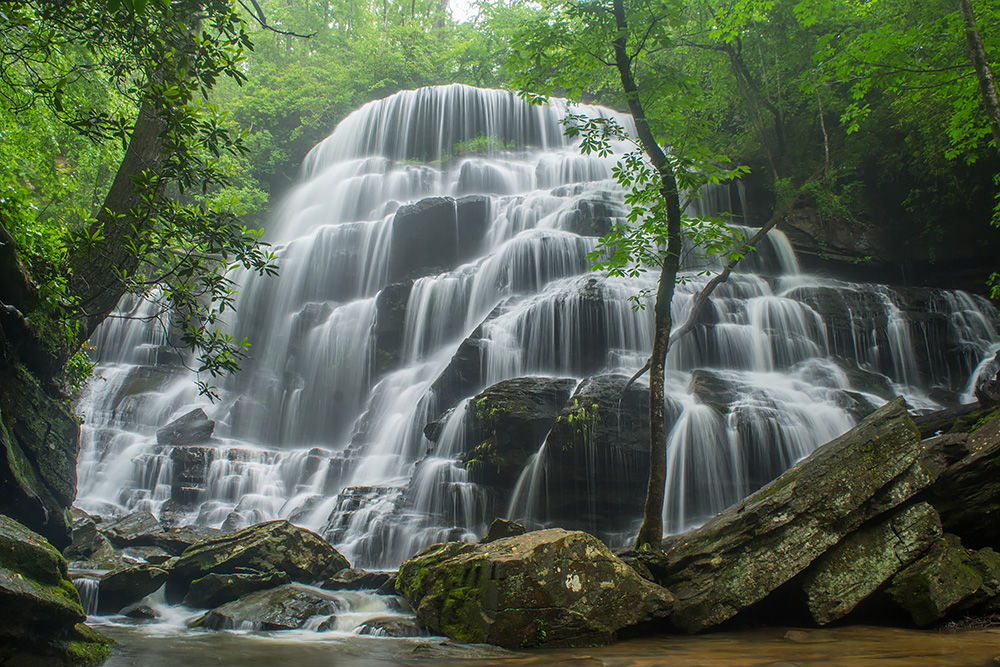
Sumter National Forest in South Carolina is home to a collection of stunning waterfalls, four of which are accessible from the parking area off Forest Service Road 751. An easy quarter-mile trail leads you to the first breathtaking waterfall known as Brasstown Cascades, a humbling 50-foot drop. If you’re feeling adventurous, continue downstream and clamber down the narrow, steep, rocky trail to Brasstown Veil, a wide and steep waterfall that dramatically free-falls about 20 feet into a shallow pool.

Adventure a little farther on the trail to reach the Brasstown Sluice, a long chute of water pouring into another picturesque pool. Little Brasstown Falls can be accessed from the same parking area, but you’ll have to wade through Brasstown Creek to reach it. — JK

More Info: Located in Oconee County, S.C. Visit: sctrails.net

Hidden Treasures – West Virginia

Wednesday, August 8th, 2012 - posted by meghan

Smoke Hole Canyon

Photo Jim Hopkins

Tucked away in the Monongahela National Forest, Smoke Hole Canyon is unlike any place you’ve ever visited. The South Branch of the Potomac River is sandwiched between North Mountain and Cave Mountain, creating a half-mile deep canyon with nearly vertical walls.

No one is certain where Smoke Hole got its name. Some say that Native Americans used the canyon for smoking meat, while others assume the name comes from the misty fog that frequently lies on the river. Smoke Hole Canyon’s long and varied history involves Native Americans, the American Revolution, Civil War and rumors of moonshine distilleries.

Boaters might argue that the best way to experience this astonishing place is to paddle the river. Kayaking and whitewater canoeing provide the best options to see sections that are set aside for non-motorized recreation and wildlife habitat. The Big Bend Campground is located nearby, where the stream is gentler and more popular for tubers and less experienced paddlers.
For those able to make the journey, however, Smoke Hole Canyon is a must-see. Whether you prefer fishing, hunting, hiking, canoeing or camping, Smoke Hole has it all. — AN

More Info: Located in the Monongahela National Forest. Visit: fs.usda.gov/recarea/mnf/recreation/hikingrecarea/?recid=9916&actid=50

Cranberry River

Photo by Thomas R. Fletcher

The Cranberry River stretches for 24 miles through Pocahontas, Greenbrier, Webster and Nicholas counties. The waters of this river were poisoned a few short decades ago due to acid rain, which killed the native and self-sustaining trout and many other forms of local aquatic life. Despite the serious acid rain damage, Cranberry River was brought back to health thanks to the West Virginia Department of Natural Resources, Trout Unlimited and the building of two crushed-lime treatment sites.

An 18.9-mile trail follows the banks of the Cranberry River, and striking leaf displays and cool temperatures make for a perfect backpacking trip in autumn. Today, Cranberry River ranks as a top fishery, surrounded by serene and elegant forest. This river is a great location for trout fishing, hiking, swimming and camping, and it reminds us that there is hope for unhealthy streams and rivers. — AN

More Info: Located in Pocahontas County. Visit: troutu.com/streams/cranberry_river_west_virginia

Hidden Treasures – Kentucky

Wednesday, August 8th, 2012 - posted by meghan

Welcome to the third installment of our exploration of some of the most beautiful, off-the-beaten-path places in the Central and Southern Appalachian Mountains. In this issue, we hand picked some water-related hot spots perfect for late summer days: hikes, waterfalls, swimming holes and everything in between. Hang on to this pull-out section as a guide to areas that are perfect for dipping your toes, or your whole self, into the water. By Jessica Kennedy and Anna Norwood

Kentucky

Dog Slaughter Falls

Photo by William Fultz II of flickr.com/photos/williamfultz

Photo by William Fultz II of flickr.com/photos/williamfultz

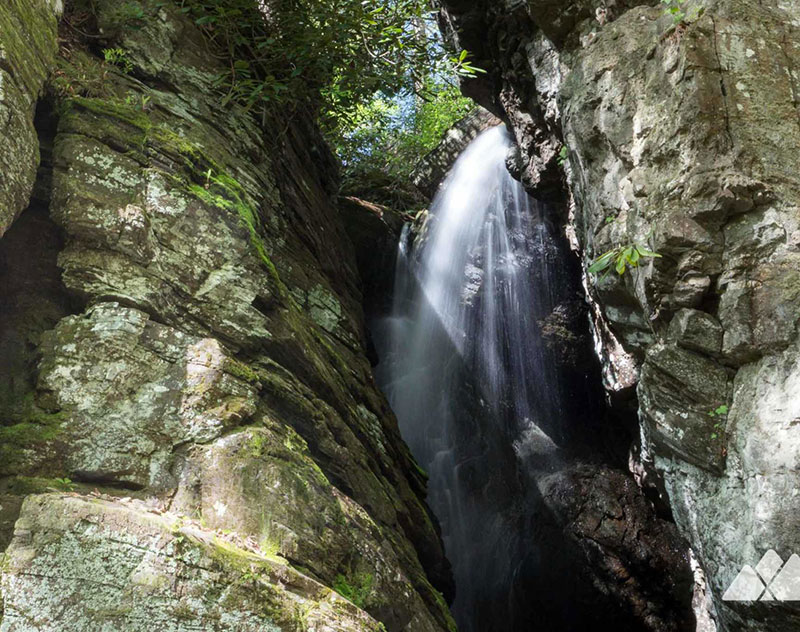
Located in the southern part of Daniel Boone National Forest, this waterfall is much more beautiful than its name implies. Slip away from the crowds and concrete of the popular Cumberland Falls and find yourself walking through forests of rhododendrons and wildflowers to the smaller but equally gorgeous 15-foot Dog Slaughter Falls. You might even find yourself alone, as the trail is not for beginning hikers. Depending on the season and water level, Dog Slaughter Falls pools into a small swimming hole at the bottom.

The falls itself is located amidst cliffs and boulders, and if you’re not afraid of getting wet you can walk behind the waterfall. But be careful, the trails around the waterfall are strenuous and not for people with weak ankles or knees. Anglers may be able to make a catch on the same hike, as the stream is stocked each year with rainbow trout. In addition to the Cumberland Falls access, the falls can be accessed from a trailhead off Forest Service Road 195. — JK

More Info: Located near Corbin, Ky. Visit: fs.usda.gov/recarea/dbnf/recreation/recarea/?recid=39652

Red River

Photo by Phillip Riggins

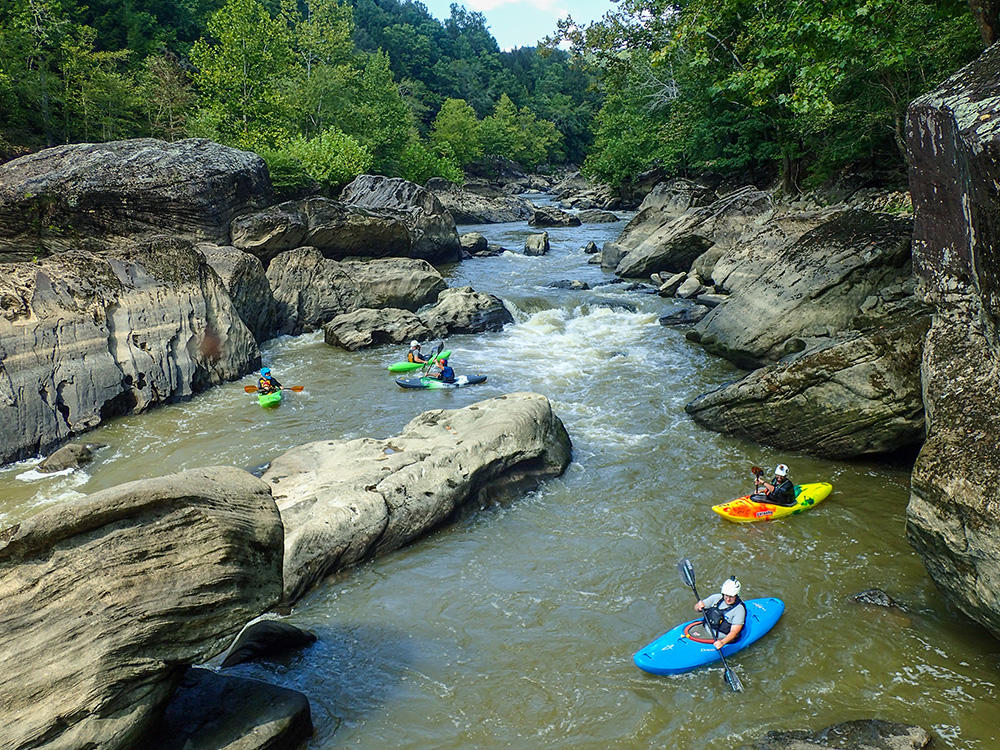
At a length of 97 miles, the Red River has something for everyone; the upper portion is perfect for intermediate and advanced paddlers with stretches of class II and III rapids, while the gentler middle section provides a scenic class I paddle or a beautiful place to fish. The best water levels are in spring and fall.

Both sections of the river offer floaters impressive views of Kentucky’s Red River Gorge, so allow plenty of time to enjoy a riverside perspective of the mountains. The Gorge is known for its boulders, sandstone cliffs and unusual rock formations. Camping is allowed on the Daniel Boone National Forest land on the south side of the river.

A battle to “Save the Red River Gorge” began in the 1960s and lasted for several decades. The Red River Gorge was the star of Wendell Berry’s novel “The Unforeseen Wilderness,” published in 1971 to deter the Army Corps of Engineers from damming it to create a lake. In 1993, a section of the river was designated as National Wild and Scenic River, the first in Kentucky. The gorge is home to many species of birds, plants and wildlife, and floating down the river can provide a rare glimpse at some of these fascinating plants and animals. — JK

More Info: Located in Daniel Boone National Forest, Ky. Visit: byways.org/stories/74560

Changing Currents

Wednesday, August 8th, 2012 - posted by meghan

Climate Change, Extreme Weather, and Our Relationship to Water

By Brian Sewell

A majority of Americans believe that climate change has contributed to recent extreme weather, such as the destructive wind storm known as a “derecho” in June (above). Understanding the links between climate change, extreme weather and the threats they pose to freshwater is essential to developing a responsible relationship with our most valuable resource.  Photo courtesy National Weather Service

A majority of Americans believe that climate change has contributed to recent extreme weather, such as the destructive wind storm known as a “derecho” in June (above). Understanding the links between climate change, extreme weather and the threats they pose to freshwater is essential to developing a responsible relationship with our most valuable resource. Photo courtesy National Weather Service

There is no doubt that we are worried about water. We accept that, as both a human right and requirement, any threat to this precious but limited liquid deserves our attention.

Last year, when Gallup conducted its annual poll to gauge Americans’ foremost environmental fears, nearly 80 percent responded that they are “greatly concerned” with the pollution of rivers, lakes and reservoirs, the pollution of drinking water, and the maintenance of the nation’s supply of freshwater for household needs, compared to only half responding with concern about global warming. But after years of increasingly extreme weather, it’s becoming clear how related the two really are.

Consider one of the many recent anecdotes of inaction on global warming. Just days after the North Carolina state legislature passed a widely mocked bill that outlaws the science used to predict future sea level rise, the U.S. Geological Survey announced that the Atlantic coast is disappearing three to four times faster than the rest of the world’s coastlines. State lawmakers, and the coastal developers that backed the blatantly anti-science bill, may have missed the memo.

But as the seas rise, so does the nation’s concern for the future of the climate. More than 70 percent of Americans peg climate change as the culprit that has contributed to extreme weather in the past month, including wildfires that redefine “wild,” a devastating drought and a record-breaking heatwave. NBC meteorologist Doug Kammerer himself made the news by saying bluntly during a forecast, “If we did not have global warming, we wouldn’t see this.”

Don’t want to take the weatherman’s word for it? The data presented in the National Oceanic and Atmospheric Administration’s Climatic Data Center’s “State of the Climate” report speaks for itself. According to the report, in June of this year, 170 all-time high temperature records were broken or tied — some topping 110F. By the beginning of July, 56 percent of the United States was suffering from drought and more than a dozen states, including Kentucky, Tennessee and West Virginia continued to see significantly below average rainfalls.

All in all, the first half of 2012 was hotter and drier than any year since weather data was first recorded in 1895. Even if the heat hasn’t kept you indoors, the abrupt storms are likely to.

Take the wind storm known as a “derecho” that wreaked hurricane-like havoc on several states in the Midwest and mid-Atlantic. The storm arrived without the typical warning signs as families prepared to celebrate the Fourth of July. It left millions without power and, especially in parts of West Virginia, without clean water.

As it is with all life, water is at the center of these extremes.

The worst conditions of the widespread drought remain concentrated in the Midwest Corn Belt, where a large percentage of the world’s corn is grown. Stunted crops have caused the U.S. Department of Agriculture to slash projections by 12 percent, which in turn has spiked prices.

Farmers aren’t the only ones after water. In some parts of the U.S., privatized water rights are going to the highest bidder. Earlier this year in Colorado, companies that provide water for hydraulic fracturing outbid farmers for water rights traditionally used to irrigate their fields. As drilling operations and drought-induced demands increase, there is just not enough to go around.

Climate change and threats to water are two sides of one coin that’s spinning out of control. The side effects of burning fossil fuels tend to render drinking water undrinkable. Sea level rise leads to saltwater intrusion that threatens low-lying aquifers. Hotter, drier summers deplete rivers, and warm winters suppress the snow.

Despite the challenges to creating a responsible relationship to water, there is a bright side. Every day, more people wake up and face the need to address our water woes. They come to realize that by understanding and respecting the the resource we have, businesses, farmers and families position themselves to succeed in a water-stressed world.

The scourge of the energy and extractive industries has undoubtedly taken a toll. But Appalachia’s abundant waters — emerging modestly from the mountains and harboring aquatic ecosystems galore — remain a resource to be revered. From the foothills to the highest peaks, the sound of rushing water is never far away. Listen closely and you’ll hear reminders of water’s worth.

In This Issue

We recognize and respect water’s role in our lives, and this issue of The Appalachian Voice is dedicated to just that. Beginning on the following page, read about the impact energy production and extractive industries have on water. Travel to Kentucky on p. 11 and meet Rick Handshoe, who has taught himself how to fight for water quality in his community. Learn how Guille Yearwood is incorporating water protection into his cattle farming style on p. 12. Hear how one group uses fly-fishing as a way to heal physically and psychologically wounded veterans on p. 13. And on p. 14-15, survey the economic impact of our region’s mighty rivers.

If you’re like us, your favorite swimming holes, rivers and spots beckon during the summer. In our special center-spread pullout we explore some of our region’s opportunities for water-centric recreation. Don’t miss the special feature on Appalachia’s picturesque paddle trails, a refreshing way to enjoy our waterways while educating a new generation about protecting them.