Follow Us on Twitter: Appalachian Voices | iLoveMountains.org

Posts Tagged ‘Coal’

Asheville’s Call to Action: The Beginning of the End for Toxic Coal Ash

Friday, March 30th, 2012 - posted by cavanaughpd

It’s hard to miss the Asheville coal-fired power plant as you drive into Lake Julian Park in Arden, N.C. The smokestacks and discolored water surrounding the plant scream of environmental abuse and disfigurement. Our mission was the hidden abuses this plant perpetrates on nearby residents that brought us together specifically to discuss the threat of toxic coal ash.

Thursday, March 22, was more than just a warm welcome to spring, it marked the nineteenth annual World Water Day, a day to focus international attention on the impacts of rapid urban development, industrial consumption and climate change threatening our precious resources.

The “Clean Water Not Coal Ash” rally, hosted by Appalachian Voices, the Western North Carolina Alliance along with several organizations, called attention to the threat posed by coal ash to drinking water and the nation’s rivers. The rally brought out more than 200 residents of all ages from Asheville and surrounding areas demanding something be done about the threat of toxic coal ash to North Carolina’s waterways.

Our message was simple: Keep our precious water clean for current and future generations. (more…)

TN Legislators Miss Another Opportunity to Protect State’s Mountains

Tuesday, March 27th, 2012 - posted by molly

House Subcommittee Kills Mountaintop Removal Ban
With Delay Tactic

In yet another act of political cowardice on the issue of mountaintop removal coal mining, a Tennessee House subcommittee voted to kill the Scenic Vistas Protection Act and for the second time to send it to summer study.

Despite a passionate plea by bill sponsor Rep. Michael Ray McDonald, the Conservation and Environment Subcommittee voted 6 to 4 to avoid a direct vote and instead condemn the bill to a summer study session which has no authority to vote on legislation. Representatives Richard Floyd, David Hawk, Ron Lollar, Pat Marsh, Frank Niceley and John C. Tidwell all cast pro-mountaintop removal votes. Representatives who voted to hear the bill were Charles Curtiss, Brenda Gilmore, Mike Kernell and Art Swann.

“When this bill was introduced in 2008 there were 5 mountains permitted for surface coal mining above two thousand feet in Tennessee. Now there are 13,” Rep. McDonald said to the subcommittee. “We have lost eight mountains since 2008 by delaying. If we don’t vote this year, we will lose more mountains. Without our mountains, Tennessee is not Tennessee.”
(more…)

Appalachian Treasures on tour out West!

Friday, March 23rd, 2012 - posted by Kate Finneran

The Appalachian Treasures Tour is out West right now! Our own Lenny Kohm is out on the road in Arizona currently and headed to Las Vegas, Los Angeles, Fullerton, and then Northern California! Click here for upcoming tour dates.

In order to bring the country together to protect the region from the ravages of mountaintop removal, we created the Appalachian Treasures slideshow, with images and voices from the region. Along with directly impacted residents, we travel with this presentation to key Congressional districts across the country to build a national base to gain support for the Clean Water Protection Act and the Appalachia Restoration Act. Along the way, we have traveled to over 20 states and talked to over 7,000 people directly.

Click here to listen to Lenny’s radio interview in Santa Fe!

Beverly Walkup joins us on tour in LA this month, hailing from Southern West Virginia where her community has been affected by mountaintop removal.

Beverly Walkup joins us on tour this weekend in Southern California to speak about how mountaintop removal has affected her community and what folks in Southern California can do to end it.

Is Appalachian Treasures coming to a venue near you? Check our schedule.

Stay tuned for more updates from the road!

Kentucky Surface Water: The Good, the Bad, and the Ugly

Thursday, March 22nd, 2012 - posted by Erin

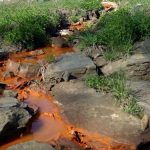
Depending on what you have heard about eastern Kentucky, or your own experiences there, you may have different impressions of Appalachian streams around the area. Some may envision picturesque creeks running through green valleys, while others may think of bright orange “streams” running over rip-rock.

Unfortunately, bright orange streams are commonplace in eastern Kentucky. The color is indicative of acid mine drainage, which is characterized by the oxidation of sulfide metals — in Appalachia, the compound is usually iron (II) disulfide, also known as pyrite. Fortunately not all streams in eastern Kentucky are contaminated from coal mining; however, if we do not address the main source of surface water contamination in the area — coal mining — in a few years, there may not be clean streams to protect. We must find better ways to address existing acid mine drainage and other water contamination in the area.

Photo credit: KFTC

Last week, I traveled around eastern Kentucky to meet with some of the volunteers for Appalachian Water Watch, a program created in the spring of 2011 to train and equip coal-impacted citizens to test surface water throughout their community. Through surface water testing around coal mines, citizens become better informed about threats to their water and their health, and are empowered to address water pollution issues.

My first stop was in Benham, Ky., to meet with several members of Kentuckians for the Commonwealth who live in the area. Many of them were born in the area, and several have worked as coal miners. They have all worked for many years to protect their communities against threats related to surface mining. While there has been some historical underground mining around Benham and Lynch, the immediate area is currently free of surface mines.

The result of this somewhat unique circumstance in eastern Kentucky is that rivers around Benham and Lynch have unusually high water quality, allowing the two towns to use the local rivers for municipal water. The city of Lynch receives its water from a reservoir supplied by Gap Branch and Looney Creek watersheds, which requires minimal treatment costs. The city of Benham receives its water from Kellioka coal seam to the south of Looney Creek. This source provides economic opportunities through the proposal of a water bottling operation. The water sources for both cities are all located immediately downstream of two proposed surface mines on Looney Ridge, making city-wide water contamination from future mining activities a very real threat. (more…)

Close Calls as Congress Defeats Rollbacks to EPA Boiler Rule and Speed-up of Keystone XL Pipeline

Wednesday, March 14th, 2012 - posted by brian

"Expect Political Attacks" -- Narrowly successful votes on the Boiler MACT standards and Keystone XL pipeline may ramp up attacks on the EPA, again.

Get ready, because a hostile hive of lobbyists echoing industry cries that the U.S. Environmental Protection Agency is no more than big government, job-killing, mean, green machine may have just been shaken up again.

On Thurs., March 8, Congress narrowly defeated an amendment to a transportation funding bill authored by Sen. Susan Collins (R-Maine) that would delay the EPA’s proposed Boiler MACT regulations, receiving 52 of the 60 votes it needed to pass. An amendment to the bill to push through the controversial Keystone XL pipeline was also considered but fell just four votes short.

The Boiler MACT, or “maximum achievable control technology,” rule, will set new standards for more than 200,000 industrial boilers and incinerators by requiring technology that reduces harmful air pollutants such as mercury, arsenic and lead. The EPA maintains that the standards will offer major public health benefits, preventing 8,100 premature deaths and 5,100 heart attacks a year starting in 2015 and estimates that Americans would receive $12 to $30 in health benefits for every dollar spent to meet the proposed standards. But as expected, opponents and industry groups are crying foul. What about the jobs!? (more…)

Big Coal’s Assault on Property Rights

Tuesday, March 13th, 2012 - posted by Tom

Big Coal’s audacity can be astounding. For years, the coal company Consol has been dumping toxic wastewater into mined-out underground mines in Buchanan County, Virginia, without the consent of the owners of the property where these old mines are located. In 2008, the Virginia Supreme Court ruled that this is an illegal trespass against the landowners’ basic property rights. In other words, the Court affirmed what should have been obvious to Consol: landowners have a right to say “NO” to the dumping of waste on their property.

In one publicly disclosed 2010 settlement, Consol paid $75 million in damages resulting from this practice. Clearly, the Supreme Court’s recognition of landowners’ basic property rights was getting to be a major inconvenience for the company. And when following the law is inconvenient, the coal industry’s response is often to try to rewrite the law. Most well-known are the industry’s continuing attempts in Congress to gut the Clean Water Act and other environmental laws now that these laws are being better-enforced. But to change Virginia’s longstanding property rights law, Consol had to go to Richmond.

During the 2012 General Assembly session, the Virginia Coal Association and Consol worked hard to advance House Bill (HB) 710 – a bill that, in its original form, would have given coal companies a carte blanche right to do whatever they wanted with empty underground mines on other people’s property – without obtaining consent from the landowners.
(more…)

Coal-fired Generation Falls to 40 Percent

Monday, March 12th, 2012 - posted by Madison

This just in: Despite the coal industry’s misleading commercials, coal no longer provides 50 percent of all energy in the U.S.!

The U.S. Energy Information Administration recently released data showing that coal’s share of total monthly generation fell below 40 percent in November and December 2011 and the combination of a mild winter and a decrease in natural gas prices might be the leading contributors.

Photo Credit: U.S. Energy Information Administration

Due to the warm trend in this year’s winter, natural gas prices have significantly dropped, which is allowing generators in many states to increase the share of natural gas-fired generation and cut coal’s share of electricity generation.

(more…)

AV Testifies in Congress

Tuesday, March 6th, 2012 - posted by molly

Today, Appalachian Voices’ Director of Programs, Dr. Matt Wasson, is testifying before the Congressional Subcommittee on Energy and Mineral Resources.

The hearing begins at 10 a.m. EST, and you can view the hearing homepage and watch the LIVE video feed here.

The majority of this committee has been pushing a coal-industry agenda this session, and we don’t expect this hearing to be much different. The topic is “Effect of the President’s FY 2013 Budget and Legislative Proposals for the Office of Surface Mining on Private Sector Job Creation, Domestic Energy Production, State Programs and Deficit Reduction,” and discussion will center around the Stream Protection Rule.

Matt Wasson will submit testimony as to why a strong Stream Protection Rule is necessary, and will counter industry disinformation about its effect on jobs and domestic energy protection. Rather, he will show data supporting the fact that previous oversight by the U.S. Department of Environmental Protection and the Office of Surface Mining have had no negative impact on jobs or domestic energy prices.

His testimony argues that pro-industry predictions of the impact of the Stream Protection Rule are based on faulty assumptions and non-existent data.

Stay tuned to our twitter feed (visible on our homepage) for more!

URGENT: Don’t Let Big Coal Poison Virginia’s Groundwater!

Monday, March 5th, 2012 - posted by molly


A dirty bill in the Virginia General Assembly is bad news for the health of Virginia’s groundwater. We urgently need to show state senators that clean water for the Commonwealth is more important than cost-cutting measures for the coal industry!

A bill, HB 710, has been introduced into the Virginia General Assembly that would allow the coal industry to dispose of toxic mining waste in empty underground mines in Virginia – without the consent of the surface landowners.

From there, the waste can leach into groundwater, wells and streams – a major threat to the health of Virginia groundwater. Because of your support we almost stopped this bill last week in committee, but unfortunately it passed by one vote.

HB 710 will be voted on in the Virginia State Senate either today or tomorrow!

Virginians, we need you to take a moment to call your senator’s office and urge him or her to vote against HB 710.

Look up your senator’s phone number at this link and then you can follow the script below.

(more…)

The Unhealthy Culture of Coal

Tuesday, February 21st, 2012 - posted by jamie

The latest in a round of studies on health and well-being in the coal-bearing regions of Appalachia was released in mid-February, with the puzzling conclusion that, while coal mining may not directly contribute to health problems in Appalachia, it still plays a significant role in the health problems in Appalachia.

Borak’s study claims that the direct impact of coal mining on the physical environment does not significantly affect mortality, cancer or other illness rates among residents living in mining counties. Yet the study also says that the coal industry fosters a mono-economy with a social and cultural environment that lacks quality healthcare and suffers from lower incomes due to lack of job diversity — and that this coal-dependent mono-economy does have a significant impact on the health of people in these counties.

The peer-reviewed study, by Dr. Jonathan Borak of Yale University and others, was paid for by the National Mining Association, though the study’s authors were quick to point out in their summary that their funders had no bearing on their findings. We believe them — or, at least, we want to.

When a preliminary analysis of the study was fed through the coal industry’s PR machine, it churned out a line about the study “debunking previous studies” on mountaintop removal mining’s health impacts, referring to research by Dr. Michael Hendryx that found strong correlations between mountaintop removal and illness. Borak denied that claim for what it is — nonsense.

Borak’s study not only doesn’t debunk Hendryx’s studies, it provides perspective on the truly pervasive, fundamentally damaging nature of the coal industry on the health of Appalachian communities.

Muddying the waters further, after essentially saying coal mining did not seem to have a direct effect on health in Appalachia, the study goes on to report, “Our analyses do not rule out the possibility [our emphasis] that some specific mining methods may have greater adverse effects than others on the physical environment.”

Although labor rights and regulations brought better pay and safer mining conditions, it seems that the underlying culture of the coal industry has not changed much over the years. Big Coal dangles the proverbial job carrot just past the noses of working-age residents in Appalachia while the rest of Appalachia suffers, and they do it extremely well.

By maintaining a mono-economy and spoon-feeding the community with whispers about how environmental regulations are going to “steal your jobs,” many residents in turn defend the very industry that is likely poisoning their community and steering their proud culture astray.

It’s time for those who benefit most from extracting Appalachia to look in the mirror and accept responsibility for the damages to human health from coal mining.