Follow Us on Twitter: Appalachian Voices | iLoveMountains.org

Archive for the ‘This Green House’ Category

Home Energy Tips

Wednesday, April 17th, 2013 - posted by molly

Making your home more energy efficient can sound like an expensive and complicated task, but in reality there are many easy steps homeowners and renters can take to convert a dwelling from an energy waster to a sustainable homestead. Below we have outlined ways to help you pay less and reduce your home’s carbon footprint.

[ Click on image for larger versionDownload PDF ]

Home Energy Savings Tips - Download PDF for ADA version

Two School Districts Go Green to Save Green

Friday, October 19th, 2012 - posted by molly

By Toby MacDermott

North Adams Elementary is one of the greenest schools in southeast Ohio. With solar panels on the roof, wild turkeys roaming the grounds, and a design based on LEED, or Leadership in Energy and Environmental Design, standards, this school exemplifies sustainability in action. But this building is not alone. The entire Adams County/Ohio Valley school district has gone green. With solar panels on several school buildings, and the school board’s pursuit of energy efficiency helping the their bottom line, the students get a real world education in the benefits of going green.

All this has taken place in the past five years, without a large out-of-pocket expense. Located in the Ohio Valley, this rural, somewhat impoverished area has one of the highest unemployment rates in the state. Despite these hurdles, the school district has transformed itself into “one of the greener districts around here,” according to Facilities Manager Steve Wolfe.

Through a partnership with the Ohio School Facilities Commission, Adams County schools were able to fund several new schools for seven cents on the dollar. Geothermal heating and cooling systems at several new schools were installed as part of the district’s energy conservation strategy. Similarly, solar panels were installed on the roof through a partnership with Kastle Solar LLC.

They own and installed the panels at no cost to the district, allowing the school to buy electricity at a greatly reduced rate when the sun is out.

Similarly, by going through older schools with a fine-toothed comb to improve efficiency, the school district was able to save quite a bit of money. Through another partnership, they were able to replace old inefficient bulbs with modern low-energy bulbs.

By improving efficiency and switching to renewable power sources such as solar panels and geothermal heating and cooling, the Adams County/Ohio Valley school district saved over $100,000 in utility costs at three older high schools. Photo courtesy of Kastle Solar LLC

“Twelve months later we had shaved over $100,000 off the utilities [at three older high schools],” says Wolfe.

With all these solar panels and savings from efficiency, the schools have been able to share the learning experience with their students. A website shows the energy production from the solar panels in real time, so that the students can see when the lights and computers in their classrooms are running off the sun.

With the children learning these valuable lessons at school, the entire community sees the benefits. Jim McClanahan, energy manager for Scott County Schools in Kentucky, took a different approach to keeping the lights off. Rather than spending money on occupancy sensing switches to turn off the lights when the room is empty, he empowered the students. Now they have Student Energy Teams that turn off unused lights and remind others to do the same, helping to change the culture of the schools. The students take this education home, spreading the benefits from school into the community.

In Adams County, Ohio, Wolfe’s search for energy inefficiencies in their old schools led them to the biggest energy user in the building, the HVAC system. Rather than buying new, Wolfe’s team went through the existing system and made sure that everything was running smoothly, then took a close look at how they used it. Instead of heating or cooling the building in case someone needs to use it, now there is a reservation system. If someone needs to use the building after hours, a quick reservation is all they need to do, otherwise the system turns off when the school day ends.

Similarly, the classroom temperature is now limited to a couple of degrees up or down. No longer could “people get their rooms like a freezer, or like a sauna,” says Wolfe. Changing the way that the HVAC system runs was one of their most effective energy saving measures.

In order to upgrade the lighting systems, the school district looked at rebates and incentives offered by their local electric utility. With very little cash outlay, they replaced the metal halide bulbs in the schools’ gyms with much more efficient fluorescent bulbs.

Once educators began to see the benefits of having more efficient systems, they also began to envision new ways to teach their students. Efficiency and energy savings tie right into teaching children about basic science and economics. Continuing their environmental stewardship work, the school board has recently begun a robust recycling program for the district: A new solar-powered recycling compactor lets students see the power of the sun in action, and saves transportation costs by reducing the amount of recycling truck traffic.

With all the economic, educational and environmental benefits of green building and energy efficiency, Wolfe says,”It’s win, win, win all the way around.”

Recycling the Rain Brings a Barrel of Savings

Wednesday, August 8th, 2012 - posted by brian

By Paige Campbell

Tom McMullen may be the most water-wise homeowner in the neighborhood.

McMullen, his wife Amanda and their two sons live on six-tenths of an acre inside the town limits of Abingdon, Va. A small front lawn and the house itself take up a third of the lot. But walk out the back door and you’re greeted by four-tenths of an acre with a job to do. Vegetable gardens, a chicken coop, rabbit hutches, berry bushes and newly-planted fig and mulberry trees fill nearly every patch of ground with a specific purpose.

All that functionality demands water. Lots of it. But this summer, even with dry spells and record heat, not a drop of city water has been spilled in the McMullens’ backyard. That’s because over the past six years, McMullen has constructed an elaborate rain barrel system that stores 740 gallons of rainwater diverted from the gutters on the family’s modest home and a single outbuilding.

Using their 740-gallon rainwater catchment system, the water-wise McMullen family has fostered a thriving micro-farm. Even the simplest system can collect enough rainwater to water plants, fill birdbaths or wash a car. “It’s a no brainer,” says Carol Doss, who teaching rain barrel building workshops. Photo by Paige Campbell

That water has helped them transform a small backyard into a wildly productive micro-farm to feed their family; it has allowed them to practice diligent conservation while keeping their water bill — and sewer bill, as it turns out — quite low.

Here’s something you might not know about your sewer bill: it’s probably not determined by how much sewage you generate. Most municipal systems calculate residents’ sewer bills based on estimates derived from their water usage.

“They figure that what’s coming in is going out,” McMullen says. It’s a reasonable assumption for many people using city water, whose consumption takes place almost entirely indoors — showering, cooking, cleaning, flushing toilets. But what about outdoor usage?

Around 2006, “rain barrels kind of became a big thing in this region,” McMullen says. “Several groups started putting on workshops to teach people how to put them together.” With that community interest as a kickstart, McMullen got to work on his own system. And as a member of Abingdon’s Go Green Committee, he also helped organize and present a series of helping to offer rain barrel workshops at community events.

Workshops typically demonstrate the concept using a thick-walled, food-grade lidded barrel made from a type of plastic that will not break down in sunlight. “You can’t use any that have contained anything toxic,” McMullen says, “so a good place to look is a local bottling company.” Carol Doss, coordinator and workshop facilitator for the Upper Tennessee River Roundtable, a nonprofit that works to improve water quality in that river’s watershed, also suggests contacting companies that make pickles.

Once you get your hands on this type of barrel, the rest is simple: cut three holes. First, cut the lid so a plastic colander can be nested in securely. Your gutter’s downspout should land inside the colander, which will catch debris. Next, buy a half-inch spigot and drill a hole near the bottom of the barrel wall. Coat the spigot’s threads with a sealant (like silicone or Gorilla Glue), and fit it snugly into the hole. The last hole, near the top, is for overflow. Fit this hole with two simple half-inch plumbing couplings — one straight, one elbow — to position a flexible tube so it points down and away from your house or into another barrel.

Of course, rain can be collected in just about anything. Large plastic storage bins and trash cans work too, though they may crack and buckle over time. McMullen began with a 250-gallon tank that once contained a non-toxic substance used for wastewater treatment. He fitted a hose onto the tank and propped it up on cinder blocks at a height just slightly above the high end of his vegetable garden to allow gravity to bring the water through the hose, like a siphon, to the entire garden. “The higher you store your water, the easier it is to get it where you need it,” he says.

One piece of advice Carol Doss gives every workshop participant is how to keep mosquitoes out. Standing water can quickly turn into a mosquito breeding ground if the water is not treated with a product to kill larvae, usually made from bacteria called Bacillus thuringiensis israelensis.

Doss also suggests using the water within two weeks to prevent algae, avoiding moss-killing products on your roof (they can taint the water and harm your garden), and bringing barrels indoors over the winter. “One winter we left ours out and it froze into one humongous chunk of ice,” she says. “It didn’t pop the faucet off, but it could have. And I swear it didn’t melt until late spring.”

When the water is flowing, it can be used to water plants and lawns, fill birdbaths, and wash cars. From a conservation perspective, the benefits are clear. “Just a tiny bit of rain, and you have a ton of water,” Doss says. “It’s a no-brainer. That water would just run off your property. Why not put it to use instead?”

These Green Houses:
Green Building 101

Thursday, October 13th, 2011 - posted by brian

By Jeff Deal

Green building might just be the world’s oldest construction style. Caves, lean-tos, waddle and daub, mud brick, stone pyramids and temples, wooden post and beam, Devonshire Cob; all are green building styles, some dating back more than 5,000 years. While there’s not much new under the sun, the resurgent appreciation of these artisan building techniques is not surprising — they’ve been sorely missed. Below are just a few of these nature-inspired approaches. Though brief, it’s a great jumping-off point into the staggering possibilities these construction techniques present.

Straw-bale

Photo by Rrechtschaffen

Materials: baled waste straw, wheat, rice, rye, or oats covered with a lime- and sand-based plaster.
Advantages: Employs readily available natural and/or recycled materials that provide excellent inherent insulation.

Be Mindful of… A low humidity of the bales must be carefully maintained during construction. Walls must be completely plastered for the life of the house; water should never enter bale walls.

Cob

Photo by Gerry Thomasen Nanaimo

Materials: compact mixture of clay, sand, straw, water and earth
Advantages: Uses readily available materials that are easy to produce and work with. Provides excellent passive cooling and “thermal momentum” for hotter regions.

Be Mindful of… May not be as good for colder climes as the walls must “breathe” and thus do not provide a high level of insulation. Running water must be kept out of walls.


Earthship/Rammed Earth

Materials: reclaimed tires or bags filled with earth or dense reclaimed materials
Advantages: Utilizes readily available materials that can be easily recovered from local waste streams.

Be Mindful of… As with all buildings, water must be kept out of structural earth walls.

Shipping Container

Materials: Shipping containers with batted, blown or sprayed foam, or foam board insulation
Advantages: Excellent structural integrity and durability. Abandoned containers can often be used.

Be Mindful of… Might need to insulate interior walls with a sprayed-on insulation to avoid condensation in humid climes. Materials are often more industrial and less repurposed than other green systems.

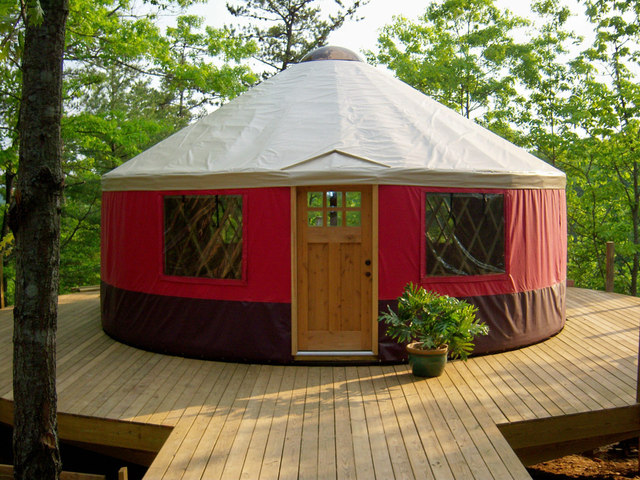
Yurt

Materials: a durable, nimble tent-like frame with a water-shedding outer shell
Advantages: Inexpensive to build and operate.

Be Mindful of… Exterior walls are not as strong as other green building system and are harder to insulate for colder climes.

Structural Insulated Panels (SIPS)

Materials: a dense structural material such as concrete, plywood, OSB or sheet metal with an insulated infill (often foam)
Advantages: Excellent structural integrity, insulation and “thermal momentum” for heating and cooling.

Be Mindful of… Materials are often more industrial and less re-purposed than other green building systems.

Eco-friendly Living in Outdoor Spaces

Thursday, October 13th, 2011 - posted by brian

By David Pferdekamper and Brian Sewell

Considering the changing colors and the crisp air, autumn is as good a time as any to spend outdoors. If you don’t have an “outdoor living space” yet, it may be time to create that welcoming, comfortable and eco-friendly addition to your home.

Humans have long incorporated garden spaces, porches and gazebos into their daily lives. Tea in the English garden, meditation on a stone bench and cookouts on the deck present idyllic pictures of days spent at home and outside. But only recently has the awareness of expanding outside rather than inside become a popular way to increase a home’s square-footage.

First, consider a patio or terrace instead of a porch. Use low-maintenance materials that are also environmentally friendly, such as local stone or scrap marble from a quarry.

If a porch is part of the plan, carefully consider your building materials. Natural wood is eco-friendly if it comes from a properly managed forest but naturally rot-resistant wood is expensive. Composite decking uses recycled materials and waste wood and lasts a long time with little maintenance. Add an an awning or roof to create the spatial impression of another “room” on your home.

Let There Be Light:
Use solar garden lights with LED bulbs and rechargeable, solar-powered batteries to light up the night with minimal electricity. If you prefer natural lighting, candles are the way to go. Not only do they provide just the right amount of light for intimate get-togethers, but some repel bugs and eliminate the need for a costly patio screen or an energy wasting bug zapper.

Dinner Time: Cooking with an infrared gas grill uses about a quarter less gas than a conventional grill. If charcoal is a necessity, get a ceramic, fuel-efficient kamado grill. Kamado grills cost more, but because they use less charcoal over time, they save money while helping save the Earth.

Keeping It Warm: Everyone loves sitting around a fire. Use firebowls or clay ovens on patios and porches to extend the season of your outdoor “living room.” Build a rustic fire pit next to your patio by clearing grass and leaves and assembling a rock border to contain the flames. For a more permanent structure, simply cement the stones together.

Create a space you love and you’ll quickly find that your unconditioned addition is the place to be, saving you, your friends and family money while conserving energy.

Recycling Reaches New Heights

Photo by Michael Oppenheim

At Burton Street Community Peace Garden in Asheville, N.C., a new outdoor community gathering space uses salvaged and repurposed materials and employs a passive solar design. Coordinated by Asheville Design Center and Appalachian State University adjunct instructor Luke Perry, students from ASU, North Carolina State University and Virginia Tech cooperatively designed and constructed the 300 square-foot pavilion during summer 2011.

“If you look right to left, there’s a sequence of wood, metal, plastic then glass,” says Oscar Sorcia, a junior at ASU. “[The pavilion] tells a story of that place, a transition from chaos to order. There was a lot of found trash the owner collected from the area. Now there’s landscaping, gardens and a structure.”

A Rush of Clean Energy at Pine Root Creek

Monday, August 1st, 2011 - posted by meghan

Spinnin’ the meter with flowing water

By Jesse Wood

Just as kayakers and farmers love rain during a drought, so does Richard Cobb.

“I just constantly hope for rain,” Cobb said.

Cobb installed a 5-kilowatt microhydro system on his Mitchell County property in Buladean, N.C. in the late 1990s. Though he is environmentally conscious—green construction is his day job—Cobb’s primary motivation was creating a source of power in case the Y2K prophecies proved true.

The microhydro system’s energy production varies and correlates to the amount of water in Pine Root Creek. The creek is about six feet wide; the watershed consists of two to three acres and includes several waterfalls. Cobb’s system involves 800 feet of pipe, called the penstock. The penstock starts upstream at the intake and continues to the turbine, which turns the rushing water into electricity. The water then flows back into the stream. During that span, the water drops 170 feet in elevation.

A deck leads to a shed housing a turbine and generator of Richard Cobb's microhydro system. Photo by Richard Cobb.

A deck leads to a shed housing a turbine and generator of Richard Cobb's microhydro system. Photo by Richard Cobb.

Winter and spring are the most productive seasons for Cobb’s microhydro system. When the water level is at its highest—around 1000 gallons per minute (gpm)—Cobb says he could triple the energy production if he had three systems. A flow of 100 gpm is enough for his energy usage, though much more is needed for heat in the winter.

“When I am running full blast in the winter, I can pretty much not only run electricity but heat my house too,” Cobb said. “In a really good year, if the creek stays up, I basically run a zero-energy house.”

Pine Root Creek is not always rushing, though. Cobb said a few years back the river was flowing at 10 to 15 gpm, and the system shut down automatically. When Cobb was interviewed for this article in July of this year, the river was flowing at 25 gpm and the system was producing 500W—about 10 percent of its maximum output.

Cobb said his system needs a bit more than an inch of rain a week to stay running. In the summer, thunderstorms help increase the flow of the creek, but the creek subsides soon—especially after a spell of dry weather.

“The best thing, of course, is an all-day, steady rain,” he said.

Cobb’s microhydro system cost $20,000, and he purchased the materials from Sundance Power Systems in Weaverville, N.C. His system is different from others because it includes a battery bank and is connected to the electricity grid. Cobb said the battery bank doubled the cost of his system.

Except for some technical advice from Sundance Power Systems, Cobb installed the system himself. Maintenance work includes switching nozzles as water levels change, replacing parts in the turbine and cleaning the intake screen that filters out silt.

“You just have to be a tinkerer to have a hydro system,” he said.

According to Cobb, the system paid for itself within five years.

“It’s a pretty big investment, but a quick recovery,” Cobb said. He recovered 60 percent of his total cost with federal and state tax credits and the rest he saved by making his own electricity.

According to the U.S. Energy Information Agency, the average American household uses 920kWhrs per month. Cobb’s passive solar home, which also has solar hot water and insulated concrete forms, uses about 600kWhrs per month, one-third lower than the national average.

Microhydro is less versatile than other renewable energy options because it requires a steady source of running water, but there are benefits to this.

“The thing about hydro is it runs nonstop 24 hours a day,” Cobb said. “You’d have to install a PV (solar panel) system about four times as big to produce the same amount of power.”

But for homes that fulfill the requirements, a microhydro system is a valuable long-term investment in sustainable energy and a sustainable future.

The Crash Pad

Monday, June 13th, 2011 - posted by meghan

Bunkbeds Never Looked So Good

By Julie Johnson

Hosteleers, your green dream is about to arrive. This June, The Crash Pad, the country’s first LEED certified hostel, will open in Chattanooga, Tenn. Forget the usual rickety bunk beds with questionable linens, crammed five or six to a room. The Crash Pad is a green-minded traveler’s dream hostel.

When Dan Rose and business partner Max Poppel bought an acre of land in Chattanooga’s Southside district, it was a trashed lot with two condemned houses. Rose and Poppel, both avid climbers, saw the potential for a hostel that catered to folks coming for the numerous outdoor adventuring opportunities in the Chattanooga area.

The outside of the new Chattanooga hostel, the Crash Pad

The outside of the new Chattanooga hostel, the Crash Pad

“We want to help further establish Chattanooga as an ultimate outdoor destination,” said Rose. “This sustainably built and operated establishment will provide a base camp and community hub for adventurous travelers.”

The Crash Pad features sleek bunks crafted by Chattanooga’s Haskel Sears Design. A bed in one of the bunks is $27 per night and there are only two bunk beds per room. Each of the four beds sports a privacy curtain, reading light, personal fan and electrical outlet. Private rooms feature a queen bed, constructed of reclaimed lumber, and an in-room sink and run $70 per night.

“We salvaged all the lumber after demolishing the old houses on the property, gave it to Matt Sears, and he used it to create all the beds in the hostel,” said Rose.

Forget the watery coffee and stale bagel tray. “We’re collaborating with our neighbor Niedlov’s, a family-owned organic bakery just down the street,” said Poppel. “Fresh breakfast is included in your cost and coffee from a local roaster is available for free all day.”

The kitchen common area features a recycling center and a custom concrete island inlaid with old climbing and biking gear made by Chattanooga artisans Set in Stone. The company also made sinks for the bathrooms crafted from glass salvaged from broken bottles that littered the property. Each bathroom has a low-flow toilet and shower.

“We decided to construct the building itself out of precast concrete because it’s ideal for both energy efficiency and quiet,” said Poppel.

A green screen on one side of the building will allow vines to crawl up the exterior walls, providing more plant-powered insulation. The roof is a living one, covered with native plants that help absorb sunlight and naturally cool the interior in summer. Natural lighting is used as much as possible and is minimally supplemented by LED and compact fluorescent bulbs

“Though it’s right in the heart of downtown, we’ve managed to provide a full acre of green space,” said Rose.

You can hammock, slack line and picnic to your heart’s content on small hills that have been built up of dirt excavated from the property and sown with native plants and grasses. An outdoor pavilion, made of salvaged bricks and lumber, and wired for light, heat and sound, stands on the foundation of one of the demolished houses.

“We’ve got a huge database of information on outdoor activities,” said Rose. Chattanooga sits in the lush Tennessee River Valley, just between the Appalachian Mountains to the east and the Cumberland Plateau to the west, and is quickly becoming established nationally as a prime location for whitewater boating, climbing, hiking and biking.

When Rose and Poppel decided they wanted the Crash Pad to be as green as possible, they contacted Green Spaces, a non-profit organization that provides incentive funding for area businesses to build sustainably. Green Spaces paid for their LEED certification and part of their living roof.

“We have to give them major credit, as well as all the incredible local craftspeople and builders that made the place come to life,” said Rose.

The Crash Pad will celebrate its grand opening with a ribbon cutting on Friday, June 3. The hostel will officially open for business on June 8th. Visit crashpadchattanooga.com to book reservations.

Acme McCrary: Shaping legs and sustainability in the textile industry

Friday, April 1st, 2011 - posted by jillian

“A successful merchandise lineup hangs on the right products…and the right partner. Coincidentally, we offer both.” – Acme McCrary –Story by Kyle Wolff


Textile plant Acme McCrary is out to prove that big industries can make a big impact. The company’s Pritchard Street facility in Asheboro, N.C., is home to one of the country’s largest solar thermal systems in the country. At the end of 2010, the plant transferred from the age-old steam boiler to solar thermal energy to heat the water they use to produce the 110,000 dozen pairs of hosiery per week.

Traditionally, the textile industry relies heavily on fossil fuels for energy. Industry giant, Acme McCrary, who employs 600, is setting new standards for manufacturing plants nationwide.

Rooftop solar panels adorn the top of Acme McCrary. The panels are projected to reduce the building's carbon emissions by 249,000 pounds each year.

“We are pleased to be a leader in sustainability and to be a responsible corporate citizen for our community, our employees and our customers,” said Bill Redding, CEO of the corporation. Redding credits his employees on the company’s Green Committee as a major initiator of the project.

“There was a need from the customers and the company to make the corporation more sustainable,” explains Bruce Williams, an Acme McCrary employee and member of the Green Committee. “The idea of solar power came up, and we went with it.”

The Green Committee started researching the prospect of solar energy and found that solar thermal would be the most efficient resource.

Acme McCrary credits one of its major customers, Walmart, as an inspiration, due to environmental standards that Walmart has imposed on its vendors. “Walmart’s sustainability requirements drove us to form our own,” Williams stated. Acme McCrary joined Walmart’s Sustainable Council in 2010.

Acme McCrary found FLS Energy, based in Asheville, N.C. The company specializes in solar energy systems that provide hot water and electricity to their clients. FLS Energy designed and installed the solar thermal system at no cost. In turn, the company is selling the thermal energy back to Acme McCrary at a lower price than the cost of traditional fossil fuel energy.

The system includes 200 solar panels, manufactured by Alternate Energy Technologies based in Jacksonville, Fla. The panels capture heat from sunlight to generate 10,000 gallons of hot water a day at 180° F. Annually, the implementation of solar thermal ultimately will reduce the corporation’s carbon emissions by 249,000 pounds and cut energy costs by more than $20,000.

The project was partly supported by a grant under the American Recovery and Reinvestment Act.

On January 18th, Acme McCrary held a press conference introducing the solar thermal system to the public. North Carolina State Senator Kay Hagan was present for the ceremony and praised Acme McCrary’s leadership and initiative. “The installation of these next-generation solar panels represents a partnership between our state’s textile sector and emerging clean energy sector,” Hagan stated.
The partnership between Acme McCrary and FLS Energy provides an essential link for the future of the textile industry; proving big corporations can make a positive impact on the environment.

Visit: acme-mccrary.com and flsenergy.com.

Two Women Working on Sustaina-Builda-bility

Friday, February 4th, 2011 - posted by jillian

Chris McCurry of Highland Craftsmen, Inc.

By Alli Marshall

Chris McCurry is a green building entreprenuer, working to develop ethical business practices.

It was the old chestnut-bark siding that provided the inspiration. Though the chestnut blight has destroyed mature American chestnut trees, Chris McCurry wondered why the once-popular shingles couldn’t be duplicated in poplar.

“We wanted to reintroduce something indigenous and match the culture; we wanted the buildings to fit the area,” she explains. So, McCurry and her husband Marty co-founded Highland Craftsmen, Inc. in Spruce Pine, N.C.

Highland Craftsmen has been manufacturing Bark House Shingles since 1990, and today the company offers reclaimed white pine panels, bark laminates, natural moldings, handrails and wooden slabs.

Highland Craftsmen has two criteria for the materials they use: they must be sourced locally and must be a waste product of the forestry industry.

“If people have a tree that needs to be removed [due to disease or because of construction], they know they can bring it to us,” says McCurry.

Her company has the expertise to properly dry and treat such wood so that an unsuspecting homeowner won’t later face shrinkage, rot, or worse, insects. “We know which products will fit into a certain application — there’s a lot of thought and service behind that.”

There is a lot of thought behind Highland Craftsmen’s pledge to environmentalism, evidenced by a B Corporation Cradle to Cradle gold certification— a multi-faceted green designation that evaluates a product’s safety to human beings and the environment, as well as to future life.

McCurry isn’t just about making and selling bark shingles, she is about economic revitalization and building a strong local community. McCurry is Vice President of the Spruce Pine Main Street board, which fosters economic restructuring. The board has involved the University of North Carolina’s Kenan-Flagler STAR (Student Teams Achieving Results) program to evaluate potential business opportunities; McCurry herself has a background in group facilitation and collaborative efforts.

“We’ve suffered a lot through fire and job loss,” she says of the town. “Facilitating so other people can have their voice: There’s huge hope in that.”

Jennifer Woodruff of Build it Naturally

By Alli Marshall

Jennifer Woodruff (center), pictured with two employees of Build it Naturally.

Build It Naturally owner Jennifer Woodruff developed an environmental mindset early in life. Her parents recycled before recycling was fashionable. Woodruff grew up composting, organic gardening, canning food and dyeing wool from the sheep on her family farm.

The seeds for an Asheville-based green building store were planted when, as an MBA student in a California-based Environmental Entrepreneurship program, Woodruff landed a job at the Natural Home Design Center in Santa Rosa. Woodruff was impressed by both the growing green building supplies market and by the business practice of her employer “based upon a triple bottom-line that considers people, the planet, as well as profits.”

Woodruff opened the first Build it Naturally showroom in 2006, and moved to its current location in the autumn of 2007. The company specializes in products for people who suffer from chemical sensitivities or just don’t want to introduce toxins to their homes.

The store stocks items like green flooring made from bamboo, cork, pine resin and reclaimed wood; concrete countertops from sand and gravel collected through low-impact dredging; Paperstone countertops made of 100-percent post-consumer recycled paper; and natural cotton-fiber denim (that’s right, discarded jeans!) refashioned into chemical-free insulation. They also offer water-based paints made from natural ingredients like plant dyes, essential oils, natural minerals, milk casein and bees’ wax.

That Woodruff parlayed a green upbringing into a green business is a great story in itself, but here’s a nice addendum: On her National Association of Professional Women profile, Woodruff lists Habitat for Humanity as “the charity that I am most passionate and drawn to.” Makes sense.

A “Reduce/Reuse” Remodeled House

Monday, December 6th, 2010 - posted by jillian

Local Lumber, Seconds and Hand-Me-Downs Highlight Home’s Expansion

Story by Jillian Randel

You don’t have to start from scratch to build green.

Nestled in the mountains of Ashe County, N.C., adjacent to fields grazed by donkeys, cows and sheep, you will find a beautiful poplar and hemlock-sided home with a wrap-around deck and staircase leading up to the second-floor front door—all sitting atop an older cement-block house.

When Beth and Ralph Sorell tried drainage repair around their old block home to fix a water and mold issue, they discovered the problem was relentless. When they decided to build rather than renovate, they didn’t realize that they would be building up rather than out.

Visitors to the house climb past the original concrete structure—now the basement—and up a simple locust staircase, built from wood harvested locally. “Locust decking lasts a few lifetimes,” said Beth Sorell. “Somebody local wanted these trees cut and taken off their land, so they weren’t cut [just] for the purpose of the house.”

That is the point of Ian Snyder’s company Mountain Works—sustainable forestry. Snyder selects trees to cut that are overcrowded or are split at the top, and uses draft horses instead of big machinery to pull the logs out of the forest. He brings homeowners on tours through their land and, together, they pick out the types of trees they want logged.

Snyder introduced the Sorells to a builder who not only agreed to build on top of their old house, but told them they wouldn’t even have to move out during the process. “Why destroy an old house and put all that [debris] in a landfill, then rebuild a foundation and basement again?” asked Sorrell.

Keeping it Local

As you walk in the door, a mosaic of wood greets you. Pine wall paneling decorates the inside walls. Scarlet oak flooring—much of it fallen naturally on the Sorell’s land—stretches across the open-spaced, 1,200 square foot home. A long, sturdy birch kitchen table—handmade by Tom Sternal, owner of Elkland Handwerke—stands proudly next to the kitchen. Plain wood trim—reclaimed from their old roof—frames the windows and doors.

“All of the pine and timbers inside, and a lot of the oak and maple flooring, is off our own land,” said Sorell. “You can go there now and you can’t tell that anything was cut.”

The tall, multi-colored maple cabinetry and the maple flooring lining the guest bedroom is not entirely from the Sorell’s land. “We didn’t have a lot of maple,” said Sorell. “But we also didn’t want to cut [more] maple from our own land.” Enter Snyder’s stock of wood.

“Different people have him cut trees from their yard that they don’t want,” explained Sorell. “But they also don’t need the wood, so he sells it for them.”

All of the wood was milled locally, some on their own land with a portable sawmill and some at a mill called the Sawdoctor, down the road from where they live.

“The cost is a little bit more, but it’s all local,” said Sorell. “When we started thinking about this project last January, everybody was out of work. The mills had shut down practically.”
“We were able to give them business and keep some of them going a bit longer.”

The countertops are comprised of recycled tiles mixed with marble squares of tile remainders from people’s orders at the local tile store. It is rustic and natural without being overdone.

Solar Flair

The house is filled with natural light and heat, thanks to intentional passive solar methods. Sorell and her husband are adamant about solar heating.

“It was almost impossible to find windows that let heat in but don’t let it back out,” said Sorell. Most windows are made to limit the heat that goes out, which also limits heat coming in. She persisted, and finally found Marvin, a company that carries a window model with a high solar heat gain.

“Every afternoon it is so warm in this house,” said Sorell. “We’ve hardly had to use the heat.” Sorell and her husband do have a woodstove that they use for heating and cooking in the winter, as well as a propane heater as backup. They also have a solar water heater attached to their metal roof.

Finishing Touches

The house is insulated with structured insulated panels (SIPs). These are made of styrofoam encased in plywood, but are considered “green” because they are efficient and airtight—and made in the U.S. SIPs are also structural, limiting the need for additional structural wood.

The guest bathroom adds a touch of Mexico to the house. The flooring is made of marmoleum—the original flax-seed, eco-friendly version of linoleum—that Sorell found in the left-over pile at Build it Naturally in Asheville, NC. The reasonably priced version of this natural coating had a price, however—it was mustard yellow.

“I had to go with the Mexican theme from there,” said Sorell. “So we did the [recycled] blue and yellow tiling in the shower.”

Completing the bathroom is a a low flush toilet from the ReStore, Habitat for Humanity’s used and surplus building store, and a refinished antique cabinet with a Mexican sink bowl inserted into the top—colorful and fun and a perfect match with the tile.

A concoction of antique pieces, restored furniture and reused appliances fills the rest of the hosue. Mimicking the house’s outer shell, the inside is a perfect combination of local, old, new and used—proving that you don’t have to start new to go green.

RESOURCES

To learn more about the products, builders and materials the Sorells used for their house, please visit the sites below.

Daltile
Land Ark
Build It Naturally
Blue Ridge Building Supply
ReStore
Marvin Windows & Doors
Mountain Works
Elkland Handwerke