Follow Us on Twitter: Appalachian Voices | iLoveMountains.org

Archive for the ‘2012 – Issue 1 (Feb/March)’ Category

It’s Not My Mountain Anymore Review

Wednesday, February 29th, 2012 - posted by Madison

Barbara Taylor Woodall, a distinguished writer and Appalachian native, tells the gripping — and sometimes humorous — story of her life growing up in the heart of the Georgia Appalachians in “It’s Not My Mountain Anymore.”

Woodall was born in 1954 and raised in a family that maintained a very traditional Appalachian farm life. From producing their own milk, to community hog-butchering days, their only way of life was to live off the land. While tending to the farm and family came first, Woodall’s father made sure that education fell into a close second.

School was never a thing of interest for Woodall. During her early education she often got the switch from her teachers, but she finally discovered a passion for school and writing when she met a passionate english teacher named Wig who inspired his class of 1966 to create what is known today as The Foxfire Magazine. It contained stories and interviews from elders that Woodall and her classmates gathered. These students shared a passion for the heritage of the Appalachian Mountains and the land they were raised on.

With time comes change, and Woodall saw firsthand how the green and fertile mountains she and her family once knew saw things of change like highways, and traffic, and shopping centers. Her book resembles old folk storytelling, and like all story tellers, Woodall maintains a distinguished voice. Her once proud and joyful tone takes a solemn turn as she realizes the mountains are no longer what they used to be. The mountains aren’t hers anymore, “inevitable changes both to the landscape and its inhabitants clash dramatically with cherished memories of a passing era.”

Although Woodall explains the grave situation of what the mountains are becoming, the book does not end on a sad note. Her hope and faithful attitude is instilled in the reader and bring more awareness to Appalachia. What one man does to the mountains affects his children and his children’s children. Her only wish is that generations in the future can enjoy the cool crisp mountain streams and the winding trails which she spent most of her childhood exploring.

“The Day Baby Brucie Died”: An Oral History of the Buffalo Creek Flood

Monday, February 27th, 2012 - posted by brian

by Betty Dotson-Lewis

Author’s note: Larry Conn is a Freewill Baptist Preacher, a public school teacher in Logan County, West Virginia, and a member of a gospel singing group. The oral history of Buffalo Creek Flood survivors such as Larry Conn may have been told repeatedly, but with each time it is relived. Forty years is a short span of time when counting the years and days of loved ones whose lives were snuffed out by the waters from the broken dam on Buffalo Creek.

What is your early background? Have you always lived in Logan County?

My name is Larry Conn, I am for all intent and purposes a life-long resident of Kistler, West Virginia, Logan County. The only time I was away was when I attended Marshall University from which I have a teaching degree.

What are some of your most vivid memories of growing up in a coal camp?

One of the far-most memories that have been coming to mind lately is the coal dirt squishing between my toes on a hot summer day. I don’t know if you are familiar with coal dirt in an alley in a coal camp, but on a hot summer day it is like sticking your feet in baby powder.

I kind of remember from my childhood days the slop bucket hanging on the fence post down along the row of houses that looked all alike. Everybody had one who contributed to the hog man. Mr. Riley was his name. He had a bunch of hogs on the lower end of town across the tracks. Him and my Uncle Alta Cook, they weren’t in partners together, but they were two men in my life who collected scraps of one kind or another.

We all got our water from a local pump. In every camp the houses all looked alike: four rooms- living room, kitchen and two bedrooms, one for the parents and one for the kids; all kids, brothers and sisters, and we had a path to the outhouse.

I can remember in our house we had a drop cord coming out of the ceiling with a light bulb attached to it and if we wanted electricity to another part of the house we screwed in a double socket and ran a line down the wall in the kitchen.

There was a huge stove and my daddy would come in from work in the winter and he would sleep behind the kitchen stove because he was too tired to take a bath. He worked the Hoot-Owl shift. He got hurt in 1960. Dad would sleep behind there still black with coal dust. I remember Dad would take a bath in a #3 wash tub every day in the kitchen; of course, there would be a line hung so to keep us out. I remember so many things that stand out in my mind like those times.

The unique thing about the house was it had grates, fireplaces that had double grates; grates in two rooms. That was the way we heated the house. The kitchen was heated by the stove and in the early hours in the morning Mom would build a fire and put the coal in the stove and cook our breakfast.

There was always one cold bedroom and that was the back room. The backroom where there was no grate. We had the kitchen, living room and two bedrooms. Sometimes I had to sleep in that back bedroom and I would be cold in the winter with snow outside.

I remember Dad would leave for work at 10 p.m. at night and when I woke up the next morning he would be behind the stove asleep. He worked on the Hoot-Owl shift. I remember everything we did revolved around mining; our food came from the company store, our clothes came from the company store and we paid all of our bills, the electric bill, we paid at the company store and our heat was from the mines. So everything in our lives revolved around my daddy working in the coal mines.

We weren’t paid with cash or a check: my dad was paid with scrip. I can remember Mom and Dad talking about not drawing anything because they had used the wages up at the company store and maybe he would just draw a few dollars of scrip. It seems like my parents were unfairly dealt with by the exchanges. It seem like the rate of exchange from scrip to cash was an unfair ratio. Anything we needed outside the company store, we would take the scrip and cash it in to buy. Anything you really wanted could be taken out at the office.

I remember the night my daddy got hurt in the mines. He was sanding his motor and he was hit with another buggy. A man hit him and ran over him-broke his back; broke his legs. He was crushed between two buggies. He was in the hospital for several months and when he came home he came in a body cast from his chest to his feet. I remember the man who hit him. They are both dead. My daddy is dead and the man who ran over my daddy is dead.

Our whole lives changed in 1960 when he got hurt. I don’t know, he was totally disabled and then getting a disability check was a hard thing. Our family suffered a lot through those years. I see now in hindsight that my dad must have been frustrated on a $165.00 per month provided by the state.

I do know that we were given $165.00 per month to live on. I remember the amount. Things were rough until my dad got his disability and black lung, (my dad worked with Dr. Donald Rasmussen), he was one of his first patients. Dr. Donald Rasmussen and Dr. I. E. Buff (they were pioneers). Dad went to Washington, DC with Rasmussen and I. E. Buff several times.

Did you consider your father an advocate for the coal miner after his accident? Who do you consider important figures in the southern coalfields in the area of advocacy?

My dad worked with Ken Hechler in bringing about the Union and my dad packed a pistol. He had black lung and they would go to the southern coal fields and meet with people and they went all over the state. Rasmussen had a lung (picture) that you could look at (that had black lung). I remember the effect it had on the people. I remember seeing Dr. Buff and Dr. Rasmussen as a boy. You see, black lung wasn’t always around. It came about in the late 60s.

So Dad in this black lung movement needed the support of the Union, so they pulled out the coal miners; they went on strike to make an impact on America. At that time coal was king and to make an impact the only way you had to get their attention was stop the flow of coal. My dad would carry a pistol and would leave our house and get the strike lines started at the tipples. He would talk about firing in the tipple, not to hurt anyone, but to get their attention and stop production and call for them to, “Come on out!” So it was through the efforts of I.E. Buff and Rasmussen from over in Beckley. It was their presence, I. E. Buff and Rasmussen as pioneers in black lung legislation. They found it, and diagnosed it as black lung. He was the one that was responsible for what they did. My Dad was instrumental in that cause.

My Dad always did things for these guys who could not get their black lung. Even with legislation it became a hard matter to get benefits. Dad would work as their advocate-widows and orphans to get black lung benefits. Dad was such a cohort. He was a helper and organizer. He was smart even though he did not have a lot of education; he was a smart man and he helped a lot of people.

A lot of people had tried to help me because of what my Dad did. He was an icon in the community and he was a politician. He worked for the political bosses all the time. He worked for the Democratic Party. He was a poll captain.

Dad used to take and drive his car and have loud speakers on top and he would announce the slate or the ticket and they would have rallies. He would go out and get them all in and on election eve, they would give him thousands of dollars and cases of liquor to hand out to get votes.

On election day, he would be one of the ones; he and some others would line up certain people in the district and would give out money to run the polling places and liquor; pint or ½ pint and everybody they hauled in they would get their liquor. That was the way it was too.

Talking about the way things really were is what Hillary Clinton said when she said that it takes a whole village to raise a child. You know she was right and in our camp everybody watched out for everyone’s children. We were under the guidance of the whole camp. You might disagree with Bill Clinton and what he did. They say it was wrong but what Hillary said about children-we need more of today. Watching out for others’ children. We have gotten ourselves into a lot of trouble leaving our children alone. That is why our children are like they are today.

My Dad became a preacher before he died, Freewill Baptist. I am a Freewill Baptist Minister.

I graduated from Man High School in 1969 and I went to Marshall University on August 25, 1969. I had been schooled in the local area and then I want away to college. I was home for the weekend from college when Buffalo Creek exploded.

On that Saturday morning of February 26, 1972, Mom was cooking breakfast as she did every morning and being a good eater and away from home I was looking forward to Mom’s gravy and biscuits. That was how the day started.

Tell me how you remember the Buffalo Creek Flood. Where were you? Did you lose anyone in your family?

That night Dad was out drunk. My friend stayed all night with me and later that night the water rose up high. My friend and I had been out and we got in kind of late. On Saturday mornings my dad always listened to the radio so we turned on the radio. Dad was always playing this country/western show that came on the radio. He would listen and laugh because at that time we didn’t like county/western too well. They would play country/western live and as they played this live music my Dad would holler, “Get down on the neck of that thing.” We were listening to that when the radio announcer began telling the dam had broken up on the Laurate Pardee.

He was always talking. This morning was different though. Bill Becker, the owner of the radio station, and all of them were saying that the dam was broken and homes were coming down stream and the Buffalo residents needed to evacuate or get to higher ground. We had heard this so many times before-the dam was breaking, it didn’t make us run for the hills scared because we had heard them cry wolf so much. We thought it was just another scare tactic.

The reports kept coming; people running on top of roof tops, couldn’t get off. People floating down stream on mattresses. Tops of roads, homes washing away.

“Evacuate the area immediately,” he kept saying.

One thing that puzzled me was how the radio announcer was keeping up on all the reports. It was the deputies and sheriff. I found that out later.

We still never felt like there was anything to be afraid of, so I opened the door and looked out.

Everybody was evacuating. I told Dad (he was still a little tipsy) I said, “Dad, Mom, everyone is leaving.”

Dad said to take the kids and go to higher grounds but I still didn’t know, so higher ground was stepping out of the house and walking up the hill, no shelter or anything. My dad said to get us to higher ground. So, me and my mama and eight more children headed up towards the dam. We went to a place called Accoville. We went up on Accoville Flat but when we got to go up to the road water was over the road; so we went up on a flat at Accoville, parked the car and got out and watched.

From Accoville Flat you can look down and see the whole community and you could suddenly see a wall, a big wave of water come. It was black and you could see it as it came, the houses exploded like they were dynamited. They just exploded. House trailers were moving like boats in a swimming pool. This great wall of water was bringing everything down with it. The force of the wave caused power lines to shake. The houses in front of us began exploding and washing downstream. Bridges began washing away. We were standing there on Accoville Flat watching all of this devastation: washing away my friends’ houses, watching to see what was left for everybody.

I could never tell a story about the flood without mentioning the Dials family. Mr. Dials took us in his home on the flat that night, he and his wife, and they fed us. It was in February. It was cold. Mr. Dials died that night. Mr. Dials’ brother died the next day.

I had some friends with me, Bob Jude and Kenny McCoy. We begin to walk up the road. The water receded as quickly as it came. Once the dam water had passed, it receded and went right down. There was no more flood, like pouring a bucket of water out.

The devastation. The destruction.

We begin to walk up the road: there were bodies everywhere. They were not laying out like a battlefield, but one stuck here, one in a bridge, one in the school yard. They found my neighbor, an elderly sick man, who was spending the night with his daughter. He washed out of the house. We found him in the school yard. We found him, Mr. Breahole, dead.

Pittston’s Coal Company’s earth dam broke and Buffalo Creek was flooded. They had to pay millions of dollars.

I remember coming home and finding my home devastated by the flood, but on the way home I could see the devastation. You could only imagine this as what you would see in a horror story. You would see something like this in a horror story.

As I traveled out the valley towards my home, my neighbor’s garage and parts of other homes blocked us from entering our driveway. When we finally crawled our way into the yard, our house was flooded. Our home was bad. We could not stay in our house, so we made our way to grandmother’s home. I stayed in the shelter at school to make room for other members of my family at my grandmother’s home.

One morning I woke up and Jay Rockefeller was standing at my bed looking down at me. We spoke and he went on his way.

I went then to Fred Osborne’s home in Kistler on Buffalo Creek to stay. My friend Roy Bruce Browning was there. He lost everything-his wife, Donna, and his child, Brucie were both drown in the flood.

Those nights are like a bad dream. We would make trips to the temporary morgue to see if his wife and son had been found. One day she was found and not long after that his son was found. This was tragic.

I remember lots of funerals, members of all those families buried. It was bad.

I dropped out of Marshall for the remainder of the semester. I could not stand to be in school. It took years but things finally got back to some sort of normality. My family lost a great deal but others lost it all like Roy Bruce Browning.

God spared us for a reason, for that I am thankful.

Betty Dotson-Lewis is a West Virginia native living in Morrisville, N.C. — She maintains The Appalachian Book Blog bettydotson-lewis.blogspot.com

Hooded Crane

Monday, February 27th, 2012 - posted by meghan

In an extraordinary story of “taking the long way ‘round,” a bird from the other side of the world paid a visit to the Hiwassee Wildlife Refuge in eastern Tennessee, shortly before the New Year. Jeffrey Davis drove 12 hours from Chester County, Penn., to take this photo of the Hooded Crane, a 3-foot tall grey and white bird (far right) that typically lives in Siberia and northern China and winters in Japan. More than 2,500 visitors from at least 35 states and five countries — including, ironically, Russia — visited Hiwassee to see the bird, who likely followed Sandhill cranes during their yearly migration from Russia to North America. A report by the Indianapolis Star placed the bird in southern Indiana during February.

We Can End Mountaintop Removal in Tennessee

Tuesday, February 21st, 2012 - posted by Jamie G. -- AV Communications Coordinator

By Dr. Minnie Vance
Chattanooga, Tenn.

In Tennessee, we love our mountains. These peaks and valleys inform our southern heritage, enhance our connection to family and represent the best of what we call state and country. Our mountains are home. Nevertheless, we too are facing down the barrel of continued mountaintop removal mining. Unfortunately, in that respect, we are not that different than many other states in Appalachia.

But one thing in Tennessee is different: the playing field between the coal industry and the citizens of our state. Because of the relative unimportance of the state’s coal industry we have a tremendous opportunity to play offense on issues like mountaintop removal, and to make Tennessee a leading light among Central Appalachian states. The negative impact that coal is having on our environment, our economy, and on public health is tremendous, but their the coal industry’s contribution to our well-being is lacking. Their influence on the political process remains tenuous in Tennessee. Our state only produces 0.2 percent of America’s coal, 98 percent of our coal comes from just three counties, and Tennessee’s mountain-driven tourism industry employs more than 470 times more people than the state coal industry while bringing in $14 billion each year.

The coal industry’s impact on our state budget is a net loss of more than $3 million every year. All over Tennessee, taxpayers are sick of our money being wasted on subsidies that prop up a coal industry that can’t compete without an influx of our hard-earned cash. And who runs the industry these tax dollars going to prop up? Increasingly, the coal industry in Tennessee is controlled by out-of state operators who come into our state, blast apart our land and take our money and mountains back out of state and overseas, leaving us with poisoned water, layoffs and poverty.

The Tennessee Scenic Vistas Protection Act is one way that Tennessee is fighting back. This bill would eliminate high-elevation surface mining techniques such as mountaintop removal in the state. Ninety-five percent of these high elevation surface mines are owned by out-of-state-operators, and nearly half of them are owned by a single individual. In January, a coal preparation plant owned by this same individual illegally dumped toxic coal slurry into the New River while failing to notify either the Office of Surface Mining or the Tennessee Department of Environment and Conservation. A citizen report came days after the accident, after more than 28 miles of the New River had been sullied. In the same month, this operator shut down National coal and laid off 155 workers, representing roughly 40 percent of Tennessee’s coal workforce.

For these and many other reasons, Tennessee must pass the Scenic Vistas Act and begin to reverse some of these abuses of our state, our communities, and our citizens.

Natural Gas: Not All It’s Fracked Up To Be

Tuesday, February 21st, 2012 - posted by Jamie G. -- AV Communications Coordinator

By Jesse Wood

When energy industry giant Halliburton invented hydraulic fracturing in the 1940s, they unlocked the potential for a natural gas boom in the United States. Now, decades later with mounting environmental and health impacts and more accurate estimates of the nation’s reserves, some feel natural gas isn’t all that it’s fracked up to be.

For several years, proponents of natural gas have touted the shale reserves beneath Appalachia — and other parts of the country — as clean and abundant. In fall 2007, after the scramble began for drilling permits in the Marcellus Shale, a multi-state formation that lies underneath the Appalachian Basin, Petroleum News published an article titled “Appalachia to the Rescue,” suggesting where U.S. energy salvation and independence lay.

Since then, controversial issues have emerged related to hydraulic fracturing, commonly known as “fracking.” Natural gas is the cleanest burning fossil fuel, emitting significantly less carbon dioxide, carbon monoxide, nitrogen oxide, sulfur oxide and mercury during combustion than oil and coal. But its extraction by fracking poses risk to water quality and the disposal of wastewater in underground wells has been linked to swarms of earthquakes.

The process requires drilling thousands of feet into shale rock formations and the high-pressure injection of enormous amounts of water, sand and chemicals, fracturing shale rock to liberate the trapped gas. As the gas travels up the well,
mere inches of concrete casing prevent its migration into surrounding ground water.

Don’t Drink the Water

In November 2011, The New York Times Magazine printed a harrowing piece on Amwell Township, Pa., a 44-acre community that experienced a proverbial gold rush five years ago. Texas-based Range Resources, a pioneer gas company in the Marcellus, came to town and sought mineral rights from landowners eager to cash in on the natural gas below their feet. But soon after, those living near drilling sites and multi-acre wastewater ponds discovered their dogs and horses mysteriously dead, litters of puppies were aborted or born with cleft lips, no hair or missing limbs and children became inexplicably ill.

Black water originating from a well corroded water-using appliances and water valves, and a smell of “rotten eggs and diarrhea” emanated from shower faucets and fouled the air outside.

Blood test results of sick Amwell residents found high levels of heavy metals such as arsenic and industrial solvents including benzene, toluene and ethylene glycol. Test results of the wastewater pond commissioned by Range Resources revealed acetone, benzene, phenol, arsenic, barium, heavy metals and methane. According to the The New York Times Magazine article, Range Resources maintained that none of the chemicals in question were found in the drinking water,
but the company did later deliver a 5,100-gallon tank of potable water to one resident after two complaints.

Seismic Awakenings

Roughly 30 miles from Amwell, the countryside of Ohio has become a dumping repository for fracking wastewater, which has been linked to earthquake swarms in the state. More than half of the disposed fluid in Ohio arrives from drilling operations in other states, such as Pennsylvania, which does not have permeable geological formations suitable for underground storage.

In the first six months of 2011, the DEP reported that 99 percent of all non-recycled wastewater from Pennsylvania’s Marcellus Shale formation was transported to disposal wells in Ohio. One of those wells, located in Youngstown, was recently shut down along with four others in a five-mile radius after 11 earthquakes, including a magnitude 4.0 on New Year’s Eve, shook the relatively seismically stable area.

Early last year, hundreds of earthquakes shook the Fayetteville Shale Deposit in Faulkner County, Ark., leading to the permanent closure of four disposal wells and a moratorium on any future wells covering a 1,150-square-mile area. Steve Horton, a seismologist at the Center for Earthquake Research and Information, says that injection wells triggered the earthquakes. “The fact that these earthquakes happen basically right after these wells started up, and they stopped as soon as the wells stopped,” Horton says. “It’s a virtual certainty.”

After two wells in Faulkner County were used for wastewater in 2010, 923 earthquakes between Sept. 23 to March 8 — the biggest being a magnitude 4.7 — revealed the previously undetected Guy-Greenbriar Fault. Ninety-eight percent of those earthquakes happened within four miles of three of the four wells. After the wells were shut down in July, the area had six minor earthquakes – a reduction of more than 99 percent. In a peer-reviewed paper to be published in a professional seismology journal, Horton notes that the U.S. Environmental Protection Agency’s Underground Injection Control, which regulates wastewater injection wells, does not limit the proximity of these wells to seismic zones, schools, hospitals or nuclear power plants.

Researching Fracking’s Footprint

At the end of 2011, Time Magazine reported that fracking was the nation’s “biggest environmental issue” of the year, citing a very contentious study by Cornell University published last May, titled “Methane and the greenhouse gas footprint of natural gas from shale formations.”

Cornell’s Robert Howarth, Tony Ingraffea and Renee Santoro, who were also named runners-up in the magazine’s annual “Person of the Year” selection, postulated that shale gas extraction through fracking exacerbates climate change more than coal mining or oil drilling over a 20-year period as a result of methane leakage during the lifetime of a shale gas well. The researchers estimated that nearly eight percent of the methane found in shale gas leaks into the atmosphere during the fracking process.

Immediately after the Cornell University study, proponents of the natural gas industry refuted these claims. A senior vice president for engineering and technology with Range Resources told The New York Times, “That the industry would let what amounts to trillions of cubic feet of gas get away from us doesn’t make any sense. That’s not the business that we’re in.”

Other scientists have also disputed the study — including fellow colleagues at Cornell, who argued that the study was “seriously flawed” and “overestimated fugitive emissions.” In a press release from Cornell, Ingraffea clarified that their research wasn’t the “definitive scientific study” on the issue. “What we’re hoping to do with this study is to stimulate the science that should have been done before,” he said. “In my opinion, corporate business plans superseded national energy strategy.”

The EPA is currently conducting a study to assess fracking and its potential impacts on drinking water resources. The EPA identified seven locations — two prospective and five active mine sites — one of which is located in Washington County, Penn., which includes the Amwell Township. The first report is expected to be released at the end of 2012, but the final report is not scheduled for release until 2014.

According to an EPA press release, “The final study plan looks at the full cycle of water in hydraulic fracturing, from the acquisition of water, through the mixing of chemicals and actual fracturing, to the post-fracturing stage, including the management of flowback and produced or used water as well as its ultimate treatment and disposal.”

For the study, the EPA issued voluntary information requests in September 2010 from nine companies engaged in fracking. Requested information included the chemical compositions used in the extraction process. Halliburton, one of the nine companies, was subpoenaed by the EPA when it did not comply. The exact contents of the drilling fluid mixtures are not known because of the Energy Policy Act of 2005, which exempts fracking from the Safe Drinking Water Act. The amendment, known as the Halliburton Loophole, was spearheaded by former Halliburton CEO Dick Cheney during his vice presidency.

Fracturing the Hype

Often considered green, clean energy, natural gas is also praised for its abundance — positing the fuel as both a bridge to renewable energy and an alternative to foreign oil.

In his 2012 State of the Union Address, President Obama boasted that the U.S. has “nearly 100 years” of gas reserves. The 100-year figure is derived from a report by the industry-friendly Potential Gas Committee, which estimates that the U.S. has 100 years of “future gas supply” if consumption rates stay the same. But a closer look at the report reveals that the U.S. actually has only 11 years worth of proven reserves with “known gas reservoirs” and “existing economic and operating conditions.”

Figures for gas reserves in the Marcellus Shale seem to drop with each successive assessment. In April 2011, the U.S. Energy Information Administration estimated a “technical recoverable resource base of about 400 trillion cubic feet” but revised that figure to 141 trillion cubic feet this January. The U.S. Geological Survey released a report in August 2011 stating that the Marcellus Shale has 84 trillion cubic feet of “undiscovered, technically recoverable” natural gas. Based on percentages provided by USGS and the current annual consumption rate, the Marcellus Shale formation has a 50 percent probability of supplying 3.5 years worth of natural gas.

As a growing body of evidence exposes the potential environmental and health impacts of fracking, states continue to issue permits with abandon. North Carolina officials are considering legalizing the practice to reach natural gas trapped in shallow Triassic basins, while other places like Rockingham County, Va., investigated fracking’s effects on other Marcellus Shale communities and finally rejected the practice — much to the chagrin of Carrizo Oil and Gas.

Across Appalachia, the natural gas boom continues, but some cannot help but wonder if and when it will bust.

Reclaiming Appalachia: Can Legislation and Enforcement Restore Mountains?
Tuesday, February 21st, 2012 - posted by Jamie G. -- AV Communications Coordinator

By Molly Moore

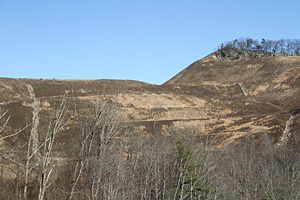
Reclamation is complete at the former surface mine near Hueysville, Ky.

Reclamation is complete at this former surface mine near Hueysville, Ky. Two rock riprap conduits are designed to channel stormwater runoff. Photo by Molly Moore

Kathy Selvage has lived in Stephens, Va., her entire life. From her front porch, she can almost see the field where her childhood home once sat. Instead of the hardwood forest that surrounded her home, graded hills lean against each other like a lumpy bag of onions beneath a blanket of savannah grasses and gravel. The sparse grassland across the road will never replace the ridgetops where she went berry-picking as a child.

In 2004, this land became an active surface mining site. Now the coal is gone, but orange water seeps out of the earth mere feet from the mine permit boundary, casting a warning glow down the ravine.

Living in Wise County, where 33 percent of the land has been permitted for surface mining, Selvage is familiar with mountaintop removal. For years, she has watched mine operators blast away mountaintops to access seams of coal, dumping overburden into valleys and burying headwater streams.

In 2009, while reclamation was underway, citizens noticed orange water, a signature indicator of pollution, near the site. Just months after the contaminated water was reported, the coal company and the state and federal agencies charged with enforcing mining laws signed a legal agreement that freed the company from further reclamation responsibility, years ahead of schedule. Now the orange water is back in another location.

“How anyone could look at the Appalachian region from far above it and call this reclamation is beyond me. They may call it reclamation but I call it desecration,” Selvage says, and her soft drawl doesn’t quite veil her frustration.

“Reclamation” is a volatile word in Appalachia. For Selvage, it represents her struggle to bring state attention to the polluted water oozing from the mine permit boundary. For those who worked on the surface mining law in the ‘70s, reclamation is a glaring example of the perils of weak enforcement. Researchers who show how, under certain conditions, tree growth on post-mining land can be comparable to growth on native soil, see reclamation as the flawed but necessary intersection of engineering and ecology. And for the coal companies that walk away from their legal responsibility to restore mined lands, reclamation is simply a forfeited bond amount on a spreadsheet.

* * *

Kathy Selvage surveys orange water near her Virginia home.

Kathy Selvage surveys orange water near her Virginia home. The water emerges just feet from a reclaimed mine stie. "It would take nothing short of a fool to try to convince you that a mountain can rise again," she says. Photo by Molly Moore

Thirty-five years after the Surface Mining Control and Reclamation Act became law, there is little evidence that reclamation in Appalachia is being enforced as the law intended, says Louise Dunlap, former head of the nonprofit Environmental Policy Center.

When the federal surface mining law was enacted in 1977, SMCRA was presented as the regulatory medicine needed to rein in the largely unregulated coal industry. The law created the federal Office of Surface Mining for enforcement, and allowed states to create their own regulatory agencies to implement SMCRA at the state level.

The path toward SMCRA started with a surface mining bill proposed in 1940 by Illinois Senator Everett Dirksen. By the early 1970s, when Dunlap got involved with the bill, strip mining was rapidly expanding. West Virginia Representative Ken Hechler introduced a bill in 1971 that would ban the practice within six months of the bill’s enactment. Hechler’s bold bill drew national attention to the issue.

Support from the United Mine Workers of America was also influential in the ‘70s. “Deep miners living in the hollows were having their houses threatened with boulders rolling down the hills from the strip mines up above,” Dunlap says. “At one time, Miners for Democracy and Arnold Miller, a former president of the UMWA, had a position of banning all strip mining.”

Around the same time, Pennsylvania began enforcing new environmental regulations for surface mines, and the coal industry responded by threatening to leave the state. “It became obvious that if we didn’t have a federal law, the coal industry would try to intimidate different states,” Dunlap says.

This coincided with congressional mark-up sessions being opened to the public, which made it easier for citizens to get amendments into legislation. In the days before Xerox and overnight mail, Dunlap recalls her colleagues making carbon copies of proposed amendments and driving to the midfield post office at the Washington, D.C. airport to send the language to citizens groups across the country. People familiar with similar amendments in their state mining laws would call and provide input. “Many of the provisions in the law were written by coal-impacted citizens,” she says.

Finally, after two vetoes from President Gerald Ford, the bill was signed by President Jimmy Carter. Its hardships began early on with lack of funding and challenges to its constitutionality.

“It’s easier to get a law passed than to get it implemented,” says Dunlap. In addition to problems with enforcement, she says some of the regulations, designed for the steep-slope mining of the 1970s, haven’t caught up to the scale of today’s industry.

A Flat Way Out

Three forestry research plots demonstrate some of Patriot Coal Company's reclamation efforts on Kayford Mountain, W. Va.

Three forestry research plots demonstrate some of Patriot Coal Company's reclamation efforts on Kayford Mountain, W. Va. The 750-acre mine site is supposed to be capable of supporting a commercial forest before reclamation can be considered complete. Photo by Vivian Stockman, courtesy of South Wings

Regarding reclamation, SMCRA is fairly clear. The coal operator is required to restore mined land “to a condition capable of supporting the uses which it was capable of supporting prior to any mining, or higher or better uses.”

When applying for permit, companies must present a reclamation plan that describes the condition of the land prior to mining, designates an intended “equal-or-better” post-mining use and explains how the company will make that future land use a reality.

“It it a privilege, not a right, to mine coal,” Dunlap says, adding that companies that can’t prove how they’re going to reclaim shouldn’t receive permits.

In drafting the law, legislators required that coal operators restore the general lay of the land, borrowing the phrase “approximate original contour” from Senator Dirksen’s 1940 bill.

But SMCRA also legalized swaths of flattened mountains by granting an exception to the approximate original contour requirement if the post-mining use generated an added public or economic benefit, such as a hospital, industrial park or residential area.

A 2009 study by the Natural Resources Defense Council surveyed 410 reclaimed mountaintop removal sites and reported that 89 percent had no verifiable economic reclamation, excluding forestry and pasture. Among the verified development projects: a federal prison, three oil and gas fields, two airports, a hospital, an ATV training center, three golf courses, four business parks, two municipal parks and a county fairground.

Research Takes Root

Since 1977, over 2,300 square miles of Appalachia — an area about the size of Delaware — has been surface mined, according to a 2011 study published in Environmental Management. Of those, over 1,540 square miles are in the mountains of Virginia, West Virginia, Tennessee and Kentucky, which are dominated by biodiverse forests.

Following SMCRA’s implementation, much of this forest was lost. Before the law, loose overburden littered the landscape, exacerbating floods, landslides and surface water contamination. Ironically, the new regulations stabilized mined land by compacting soil with heavy equipment and encouraging fast-growing non-native vegetation, inadvertently creating a climate hostile to native plants, including hardwood trees.

Aware that this was a tough environment for trees, mine operators rarely planted any. When they did, they planted species that survive but don’t restore the land’s biodiversity.

But Dr. Carl Zipper, co-author of the 2011 study and director of the Powell River Project, says that reclamation techniques are improving. The Powell River Project, a public-private partnership in Virginia, formed in 1980 with the goal of making reclamation more effective.

The Project’s research was incorporated into the Forestry Reclamation Approach, a five-step reforestation technique for recovering Appalachian strip mines. The FRA aims to restore the soil’s ability to support planted seedlings and to provide fertile ground for native seeds carried by wind or animals. The Appalachian Regional Reforestation Initiative, a seven-state association, formed in 2004 to advocate for the forestry approach.

Since the FRA was implemented in 2006, 15 square miles have been reclaimed using the technique and more than 46 square miles are permitted. Though a small percentage of the 2,300 square miles already surface mined, these 60-plus square miles represent land that might otherwise be barren.

As the Environmental Management study notes, the oldest sites using the forestry technique are only about five years old, so the science is still out on whether these practices are successful in permanently restoring forests.

Zipper says that reclamation techniques need to be cost-effective to be adopted. He explains that some parts of the forestry approach, such as the FRA’s use of loose soil material and lack of emphasis on heavy fertilizer and seed, save coal companies money. Other aspects, such as the seedlings themselves and the selection of appropriate soil and rock
layers, cost more than conventional grass reclamation.

Nathan Hall, an eastern Kentucky native and former deep miner, believes that revisiting post-SMCRA grasslands and applying the forestry approach will help the land and people move forward. Providing equipment operators who used to work for coal companies with jobs preparing compacted land for tree growth will make use of the region’s workforce, he says. And The American Chestnut Foundation recently received a three-year grant to plant hybrid chestnut trees and native hardwoods on compacted reclaimed land.

Dealing with the Damage

While researchers plan for the future, others are trying to mitigate existing problems.

On Kayford Mountain in southern West Virginia, Patriot Coal Company must produce commercial timber on its 750-acre mine site to achieve the designated post mining land use. Rob Goodwin, coordinator of the Citizens Enforcement Project at Coal River Mountain Watch, says the West Virginia Department of Environmental Protection allowed the permit’s post-mining land use to change to commercial forestry. This “higher and better” land use grants the company a cost-cutting approximate original contour variance.

“Even if you were doing commercial forestry, you wouldn’t necessarily need flat land,” Goodwin says.

Part of the permit hosts three West Virginia University forestry research plots, each the size of a football field. According to a permit map, one of the plots is designated a commercial forestry test plot. This plot use natural topsoil combined with weathered sandstone and minimal compaction. Another plot has similar soil with a different type of compaction, and the third had minimally compacted unweathered sandstone. The plots with natural topsoil are clearly more successful.

Goodwin says West Virgina and other Appalachian states have routinely waived SMCRA’s clear requirement to stockpile and re-spread topsoil during reclamation.

When Marfork Coal Company’s Bee Tree permit came up for renewal last summer, Coal River Mountain Watch intervened and was able to get the company to adopt a Forestry Reclamation Approach topsoil advisory. According to the advisory, operators who don’t have enough natural topsoil should combine the topsoil they do have with weathered sandstone.

Foreseeable Floods

Jack Spadaro, former superintendent of the National Mine Health and Safety Academy, was invited to testify before Congress about the relationship between surface mining and flooding just before President Carter signed SMCRA into law. He recalls an exchange from the 1977 hearing.

“The congressman who was conducting the hearing said, ‘Mr. Spadaro, Do you think the new law will be effective in controlling these negative environmental effects?’ I said, ‘Sir, I’m sorry to say that I don’t think so because I don’t think it’s ever going to be enforced.’ And I was right.”

SMCRA intended to protect surface mines’ downstream neighbors from flash floods intensified by huge expanses of barren, loose spoil. Such flooding was common before the law, so SMCRA requires that companies reclaim as they go.

On July 17, 2010, a wall of water rushed through the Harless Creek area of Pike County, Ky. One house exploded; another split in half. 37 families lost use of their wells.

126 residents are suing two surface mining companies that operate in the Harless Creek watershed for damages in a trial that will begin March 5.

Spadaro, who is serving as an expert witness in the Harless Creek case, says “[Regulators routinely let operators] go long, long periods of time without replacing topsoil, grading, seeding and mulching areas. What you get are these vast wastelands.”

At the time of the 2010 flood, one of the companies, Cambrian Coal Corp., hadn’t even begun to reclaim over half of the permited area, according to Spadaro.

“This company was essentially operating the way it wanted to without any control by the state of Kentucky,” he says, adding that the state inspector overseeing the site was “allowing them to violate the law and the intent of the law for months if not years before this flood happened.”

Immediately following the flood, Cambrian was cited for six violations.

The company’s lack of reclamation had drastic consequences for those downstream. Hydrologists serving as expert witnesses for the residents report that the two companies’ surface mines and failure to reclaim resulted in a 44 percent increase in peak runoff during the July 17 storm.

The Cost of Compliance

When it comes to mandating that coal companies clean up their mark on the land, money talks. SMCRA requires that operators post a bond before they begin mining so that the state has funds available for reclamation in case the company fails to comply. In places with state-level enforcement agencies, those agencies set the bond amounts and sign off on the permits. The money is returned to the company in three stages as the land meets the reclamation requirements of each stage.

In 2010, the federal Office of Surface Mining began a nationwide review of bond amounts. When a bond amount is too low, it can be cheaper for a company to forfeit the bond than reclaim. When that happens, states don’t have enough money to complete the reclamation plan. The reclamation cost is either passed on to state taxpayers or the land pays the price.

In Kentucky, nearly fifty permits were forfeited between January 2007 and May 2010. The Kentucky Division of Abandoned Mine Lands estimated reclamation costs for those sites. When those estimates are compared to the bond amounts the companies paid, the difference amounts to a shortfall of nearly $13 million.

After two years of back and forth between Kentucky state agencies and OSM’s Lexington office, the state has proposed new bond practices that OSM says are still deficient.

“Time continues to elapse without a final solution to Kentucky’s bonding issue,” states a Jan. 17 letter from OSM’s Lexington office to the Kentucky Energy and Environment Cabinet. The letter says that, unless the state comes up with a suitable plan soon, OSM might use its authority under SMCRA to federalize Kentucky bond calculations.

On Feb. 13, OSM began an enforcement review in Kentucky. If the agency finds mines without adequate bonds, it will notify the state, which has ten days to either increase the bond or tell OSM that it refuses to. If the state opts for the latter, OSM can use its authority to enforce the law.

The ability of the federal OSM to take direct action in cases where state agencies aren’t doing their jobs is just one of the tools in SMCRA that, if utilized, could help heal Appalachia’s surface mining scars. But bringing enforcement to bear is a difficult undertaking.

“Congress put an unprecedented array of citizen rights into the surface mining act,” says Tom FitzGerald, a lawyer with Kentucky Resources Council. “What they didn’t count on is how difficult it would be for the average citizen to muster the time and the energy and the resources to effectively monitor the performance of the industry. It is far from a level playing field.”

The Sewanee Coal Seam: The Dirt on East Tennessee’s Toxic Coal

Tuesday, February 21st, 2012 - posted by Jamie G. -- AV Communications Coordinator

Zeb Mountain in Campbell County, Tennessee.

This mountaintop removal site is Zeb Mountain in Campbell County, Tennessee. Local residents face water quality problems from the highly sulfuric runoff of mountaintop removal sites in Tennessee. The Sewanee coal seam, which underlies much of the surrounding area, is the most toxic coal seam east of the Mississippi. Photo courtesy of TNLeaf.org

By Jenni Frankenberg Veal

One of the most toxic coal seams east of the Mississippi River has cast a dark shadow over the land and people living in its boundaries.

Landon Medley, a resident and former county commissioner of Van Buren County, Tenn., has witnessed the impacts of mining in the Sewanee coal seam firsthand. “I remember being invited to dinner at a home on Cagle Mountain,” says Medley. “One wall of the home had subsided due to mine blasting, and the green beans that were being cooked for dinner turned blue in the water due to the acid mine drainage.”

More than 300 abandoned mines are sprinkled throughout the East Tennessee landscape — a majority are in the Sewanee coal seam — where runoff containing acid mine drainage, highly toxic to humans, animals and plants, has polluted waterways and communities.

The Sewanee coal seam is surrounded by a layer of shale that contains high levels of pyrite, an iron sulfide. When pyrite is exposed to water and air, it creates acid mine drainage. Because of its chemistry, there is no proven method of preventing acid mine drainage that would still allow companies to strip-mine the Sewanee coal seam.

While the seam is not currently being mined in Tennessee, the threat of future surface mining efforts is real. Currently, the Canadian mining company Tiacme is exploring opportunities within the pristine Rock Creek watershed on Walden’s Ridge, despite the area’s federal designation as Land Unsuitable for Mining. The Rock Creek watershed is located on the northern end of Walden’s Ridge near the Smithtown community in Bledsoe County.

Prior to enactment of the federal Surface Mining Control and Reclamation Act of 1977, mines in Tennessee were not regulated, making it difficult to create a comprehensive picture of the environmental damage from mining within the Sewanee coal seam.

Acid mine drainage from the Sewanee coal seam

Acid mine drainage from the Sewanee coal seam has groups across the state calling for a ban on surface coal mining on he toxic seam. Photo courtesy of D. Hardesty, USGS Columbia Environmental Research Center.

Underlying the Cumberland Plateau, the Sewanee coal seam’s largest and most toxic sections are thought to be limited to East Tennessee. According to James Macfarlane’s 1873 book, The Coal Regions of America, “The Sewanee Division includes that part of the table-land bounded on the east by the Sequatchie Valley, on the south by the Alabama line, and on the north by White and Cumberland Counties.”

Medley says that eight counties in Tennessee have been particularly impacted by acid mine drainage but that the actual extent of the Sewanee coal isn’t well known.

Medley lives near two abandoned Skyline Coal Company mine sites on Walden’s Ridge that border the Sequatchie and Van Buren county lines. Skyline declared bankruptcy and ended mining practices there 20 years ago; however, acid mine drainage devastated water quality in the area. The federal Office of Surface Mining stepped in and created a state trust fund to treat the acid mine drainage coming off the two sites. The water has been treated for the past six years and will continue to be “in perpetuity,” says Medley.

Currently, citizens of Tennessee are limited to three legislative tools to protect their communities from the impacts of surface mining in the Sewanee coal seam: the Water Quality Act on the state level and the Lands Unsuitable for Mining petition and Surface Mining Control and Reclamation Act on the federal level.

Local and statewide public interest groups are working with state legislators to find tools that would protect the citizens and waterways of Tennessee from the devastating impacts of acid mine drainage.

“We must addresse the Sewanee coal seam because of its impacts on water,” says Medley, a long-time member of Statewide Organizing for Community eMpowerment in Tennessee. “We know that if mining is allowed, it will result in acid mine drainage, which will impact water quality, which will impact tourism in this area. This is not just an environmental issue — it is directly linked to the economic growth of the state and employment as well.”

To learn more about efforts to end surface mining in the Sewanee coal seam, visit the Statewide Organizing for Community eMpowerment website at socm.org.

Jenni Frankenberg Veal enjoys writing about the natural world and exploration opportunities found within the southeastern United States, one of the most biologically and recreationally rich regions on earth. Visit her blog at www.YourOutdoorFamily.com.

Remembering Buffalo Creek

Tuesday, February 21st, 2012 - posted by Jamie G. -- AV Communications Coordinator

Special Feature: “The Day Baby Brucie Died” — Read an oral history that recalls the Buffalo Creek flood and the experience of growing up in a coal camp from Kistler, W.Va. resident, Larry Conn.

By Brian Sewell

Buffalo Creek Dam

Inspecting the Aftermath: Residents of Buffalo creek worried constantly about the stability of the slurry dams upstream. Photo courtesy of West Virginia State Archives.

In the morning of Feb. 26, 1972, nearly 132 million gallons of water and coal waste rushed from Buffalo Mining Company’s slurry impoundments through Buffalo Creek Hollow, Logan County, W.Va. The flood coursed through 16 coal mining settlements along the creek where hundreds of families lived, while children slept or watched cartoons as their mothers cooked breakfast. In an instant their lives were washed away.

The company men of Buffalo Mining’s owner, Pittston Coal Company, called it an “act of God.”

“People were in shock,” says Marty Backus, who was the news manager at WVOW Logan. “They just wanted to find their loved ones, find safety and find shelter.”

Backus navigated the floodwater to Man, a town at the mouth of Buffalo Creek, after staying on-air for a round-the-clock flood watch. He remembers vividly walking up the valley toward the town of Saunders and the broken dams.

“The clouds were hanging low over the valley,” he says.” People were walking down the railroad tracks. It seemed like hundreds of them. It was very quiet. People weren’t talking at all.”

He saw familiar faces. When William “Tootie” Carter, the head football coach at Man High School, emerged from the fog, Backus ran up to him.

“I said ‘Tootie, how bad is it?’ He didn’t even acknowledge me.”

Before mined coal is transported to the market and used for electricity, it is sent to a preparation plant, commonly called “tipples.” There, the raw coal is washed of impurities, crushed and transported to market by rail. Impounded in slurry ponds and injected underground, the toxic waste left over, mostly rock and fine coal suspended in water, contains toxic heavy metals such as arsenic and mercury. Many surface coal waste impoundments are simply valleys dammed with coal refuse, dry slurry — the very material that is being impounded.

A series of three dams were built on the Middle Fork upstream from the Buffalo Mining Co. tipple in the 1950s and 60s as Logan County continued to grow as one of southern West Virginia’s prolific coal-producing counties. Dam No. 3, the largest, stood 60 feet above the pond and downstream dams below. When it gave way, the others collapsed instantly.

Rushing through Buffalo Creek hollow, the slurry carried with it semi-rotten trees, rocks and sediment. It ripped homes from their foundations and swept up cars and bridges until it finished three hours and 15 miles later at the Guyandotte River, destroying nearly everything in its path. When the physical chaos settled, out of a population of 5,000 people, 125 were killed, 1,121 injured, and more than 4,000 were left homeless.

Jack Spadaro was a 23-year-old engineer teaching at West Virginia University’s School of Mines when Governor Arch Moore formed a commission to investigate the causes of the Buffalo Creek flood. He was asked by the dean of the School of Mines and chair of the governor’s commission, Jay Hillary Kelley, to travel to Buffalo Creek and investigate the disaster. When Spadaro arrived weeks later, they were still pulling bodies from the mud.

“I had never seen anything like that in my life,” he says. “It gave me a mission. It gave me a purpose.” Spadaro’s purpose became the protection of miners and communities where their families live; his mission, to enforce the laws already in place, and write new ones where they were needed.

Spadaro began his investigation by interviewing survivors, Buffalo Mining employees, engineers and contractors, recording them on a reel-to-reel in the Man, W.Va. high school gymnasium — a building that acted as a makeshift morgue and a gathering place for families of the missing. He dug through the records of the West Virgina Department of Natural Resources and Public Services Commission, the Bureau of Mines, and the U.S. Geological Survey. Before long, he began to uncover a pattern of shortcuts and regulators asleep at the wheel.

After the disaster. residents had few places to go - the flood had destroyed nearly everything in the path. Photo courtesy of West Virginia State Archives.

“All along, as these dams were being built, they weren’t really constructed using any engineering methods,” Spadaro says. “They were simply dumped, filled across the valley.”

The state’s Public Services Commission, responsible for dams blocking streams, required detailed plans for any structure over 15 feet high that obstructed a waterway. In the case of dams above Buffalo Creek, no plans were submitted.

“They just ignored the law.” says Spadaro. “But the Public Service Commission and the prosecutor in Logan County decided that since the dam was already built, they couldn’t do anything about it.”

Steve Dasovich, the vice president of Buffalo Mining, later admitted that during the construction of Dam No. 3, no engineering calculations were made and no outside soil experts’ or hydrologists’ services were solicited. Hours before the dam broke, it was Dasovich that who repeatedly told residents they were safe.

Still, some good came after the flood. By 1973, Spadaro had joined the Department of Natural Resources and began building an inventory of dams and enforcing new laws regulating coal waste and dam construction.

“We found about 150 unsafe coal waste dams in the state and forced the mining companies to stabilize them, build emergency spillways, put instruments in the dams that could monitor movement and bring everything up to the standards that were established in the laws,” he says.

Spadaro is certain that through preventative measures and strong enforcement, thousands of lives were saved. But even though the laws are on the books, a culture of corruption, non-compliance and the rejection of alternative technologies have led to more breaks, spills, and the necessity for advocacy groups who work to protect citizens. Forty years later, there are still lessons to learn from Buffalo Creek.

“It really did a lot of good and most of the state agencies and federal agencies were staffed with competent geotechnical engineers and hydrologists,” he says. “That is not the case now.”

Past Practice and a Culture of Corruption

On Oct. 11, 2000 it happened again. Around midnight, a portion of the reservoir basin of the Martin County Coal Corporation’s Big Branch impoundment near Inez, Ky. collapsed, inundating two tributaries of the Tug Fork with 306 million gallons of sludge. The EPA called it the worse [environmental] disaster in the southeastern United States, but luckily, this time no one was killed.

Martin County Coal, a subsidiary of Massey Energy, was quick to dismiss fault. Taking a page from the Pittston playbook, the company declared God had a hand in the massive spill. But when Mickey McCoy, a retired high school English teacher and longtime Martin County resident, stepped onto the soupy sludge that came into his community, he recognized it as an act of man. “That was one time you didn’t have to be Jesus Christ to walk on water,” he says.

Within days of the flood, Davitt McAteer, the head of MSHA during the Clinton administration, called someone he knew would not pull any punches. Jack Spadaro, who had become the superintendent at MSHA’s Mine Health and Safety Academy near Beckley, W.Va., joined team leader Tony Oppegard in Kentucky to launch an investigation into what went wrong.

Unlike Buffalo Creek, the 2-billion-gallon capacity, 70-acre slurry pond in Martin County suffered a breakthrough in the reservoir holding the slurry, not a dam failure. Almost two miles of active and abandoned underground mines beneath the basin were flooded out before the torrent of sludge blasted out of a mine opening and poured into Coldwater Creek. What connects the disasters are the patterns of neglect that were discovered too late.

According to Spadaro, by the time reservoir failure occurred, three agencies were responsible in the state of Kentucky: the state’s Division of Mine Reclamation and Enforcement, the Federal Office of Surface Mining and the Federal Mine Health and Safety Administration.

“Those agencies knew that that failure had occurred and they knew that there was a minimal amount of rock between the reservoir and those mine workings,” he says.

After a similar event at the same impoundment in 1994, Larry Wilson, an engineer at MSHA’s Technical Support Center in Pittsburgh, wrote a memo to the agency’s district office in Pikeville, Ky. with nine recommendations toward fixing flaws in the impoundment, including the revelation that as little as 15 feet of earth held up the reservoir, a fraction of the recommended 150 feet.

“They just completely ignored the recommendations,” says Spadaro. “All the managers in the various levels of these bureaucracies were simply not doing their jobs.”

In late 1994, Martin County Coal was granted a permit to expand the impoundment.

Once the heavy machinery moved in and recovery began, representatives from EPA region 4 held hearings in Inez to address residents’ concerns. McCoy remembers an auditorium full of students being told that the sludge, and their drinking water, is safe because everything it contains is on the periodic table of the elements. “It’s true,” the EPA representative reportedly said. “Go ask your biology teacher.”

McCoy’s wife, Nina, has taught biology at the school for 29 years.

“People have their buttons,” McCoy says. “That was her button. That was the bomb for her and then we started looking into everything about the mining industry.”

The University of Kentucky Markey Cancer Center in Lexington has expressed alarm at the high cancer rates in Martin County, and many others in Kentucky’s 5th congressional district. “There’s something about this region that we think is environmental causing this very high incidence,” the center’s director Dr. Mark Evers says. Markey Center research mentions the adverse effects of heavy metals such as arsenic and chromium in the water and soil and pointed out that counties with the highest levels of heavy metals are more likely to use well water.

“We all know the Markey Cancer Center,” says Nina McCoy. “I mean, it’s the University of Kentucky, who we think is a god here. So why don’t people here know that the Markey Cancer Center says that the cancer rate in this community is higher than anywhere else? Anybody that’s paying attention just buys their water because there is nothing else we feel like we can do.”

“Water is one of the best sellers at the supermarket here,” Mickey mentions.

Waking Up To the Toxic World We’ve Created

Brushy Fork

When the Brushy Fork impoundment reaches its permitted capacity, 9 billion gallons of slurry will be held in the 645-acre reservoir. Photo courtesy of Vivian Stockman

Of the hundreds of impoundments in Appalachia, several deemed high-hazard or Class “C” by MSHA — a classification given to dams whose failure would likely result in the loss of life — have been subjected to public condemnation and the grassroots efforts of citizens’ who refuse to forfeit their safety.

In West Virginia’s Coal River Valley is one of the largest dams of any kind on earth. The Brushy Fork dam, at 954 feet tall, looms over the towns of Sylvester and Whitesville in Raleigh County, W.Va. Around 645 acres, the impoundment will eventually hold 9 billion gallons of slurry. For activists, outside observers and residents in downstream communities, Brushy Fork has become a symbol of an industry out of control.

Over it’s lifetime, Brushy Fork’s size and rap sheet of violations have grown. Between 2000 and 2009, the impoundment received 20 violations. Some of them, especially issues related to dam compaction could, if left unabated, be fatal to downstream communities.

Jack Spadaro

Forty years after the Buffalo Creek disaster, Jack Spadaro still works to improve mine safety and oversight. Photo courtesy of Vivian Stockman

In December 2011, largely in response to the perseverance of a retired union miner named Joe Stanley bombarding the administration with complaints about the impoundment, MSHA held a public meeting to address Brushy Fork. Over several hours, MSHA addressed a variety of complaints from poor communication between agencies to the stability of the mine workings beneath the impoundment and blasting at a surface mine only 100 yards away, with the conclusion that they believe the dam is safe.

Through a Freedom of Information Act request, Stanley specifically requested evidence or paperwork that proved that those citations were properly abated. Except for one citation, none was provided.

“We’re holding MSHA liable,” Stanley adds. “If there is any way that we can get a lawyer, to take this and sue, for the devaluation of those people’s property downstream, the health hazards that water is releasing and the destruction to their mental well-being by having to live underneath that thing, we intend to get to the bottom of it in any way possible.

Rob Goodwin, coordinator of the Citizens’ Enforcement Project for the Whitesville-based Coal River Mountain Watch, sees the meeting with MSHA as a step forward on a long road.

“The regulatory structure is just not capable of dealing with 100 or 50 more years of producing slurry,” says Goodwin. “It would just be way, way simpler to use other technologies.”

A Future of (Less) Slurry

“Not only was I an underground coal miner,” says Joe Stanley. “I was transferred as a filter-press operator at Maribone Development’s prep plant, which was absolutely the most advanced technology in the United States by a long shot in 1981.”

In a dry filter press system, water is pumped through a filtration fabric leaving the fine coal, clay and heavy metals in a “cookie” with little moisture left behind.

Joe Stanley

Joe Stanley is challenging coal companies to adopt safer technologies. Photo courtesy of the Charleston Gazette

Directly after Buffalo Creek, Stanley says, it was impossible to get a permit for an impoundment. The plant operated from 1979 to 1987 with no impoundment and no underground injection using filter presses and a closed loop water system.

“We could have continued to operate using those,” says Stanley. “But the company was able to get an impoundment permit and they felt they were at a financial disadvantage as a company because it was costing them somewhere in between 25 and 50 cents a ton to use filter presses.”

Spadaro encountered the same argument when he interviewed Martin County Coal CEO, Ray Bradbury after the Martin County flood. “They had a dry filter press but they stopped using it,” he says. “We asked Mr. Bradbury ‘Why did you stop using it and go to an impoundment? He said ‘We saved a dollar a ton in cost on processing.’”

A prep plant on a closed loop system can use less than 10 gallons of water per ton of coal. An open loop plant that pumps to an impoundment, uses between 65 and 70 gallons per ton.

Recently, Stanley has put his knowledge of filter presses and alternative coal waste disposal toward convincing legislators to move away from slurry.

“I’m not anti-coal,” he says. “But I do not believe in the impoundments because I know for a fact, from being a young man, that I have seen that technology applied and I’ve seen it work and if the state or federal government had the courage, we would not even have these impoundments at the present time.”

In the final pages of the report on the Buffalo Creek disaster, investigators concluded that Dam No. 3 on the Middle Fork was born out of the age-old practice in the coal fields of disposing of waste material and was constructed without utilizing technology developed for earthen dams and without using or consulting with professional persons qualified to design and build such a structure.” Though, in their search for answers, they failed to find any evidence of an act of God.

Nuclear Confusion

Tuesday, February 21st, 2012 - posted by Jamie G. -- AV Communications Coordinator

The Complicated History of the Atom in Appalachia

Women monitored control panels at the Y-12 plant in Oak Ridge.

During World War II, women monitor control panels at the Y-12 plant in Oak Ridge, where Uranium one was refined to make atomic explosives. Workers toiled in secrecy without ever knowing the machinery's purpose. Photo by Ed Wescott, American Museum of Science and Energy

By Paige Campbell

Nuclear Fuel Services, Inc. sits on 66 acres between the Nolichucky River and the south end of Erwin, Tenn. This part of Erwin is the very picture of a small, blue-collar town. Within a quarter-mile of the fence surrounding the industrial site, there’s a volunteer fire department, an IGA grocery store, a United Steel Workers union hall and a tiny white church, its sign out front urging the faithful to “Take Time to Pray.” And there are houses — simple, single-story wooden homes, tidy and lively but showing their age.

Block after block of residential streets file up the hillside above the NFS complex, wedged since 1957 between Carolina Avenue and what is now Interstate 26. Considering the magnitude of what happens at the plant, it is striking to encounter it here. NFS processes highly enriched uranium for the U.S. Navy’s nuclear-powered submarines and air craft carriers, and does it in the middle of town. This is a residential neighborhood with one very imposing neighbor.

Even as sustainability-minded folks find consensus on the need to pivot away from fossil fuels, opinions are divided on what to pivot toward. Some support the expansion of nuclear power and urge skeptics to embrace nuclear as the most suitable “bridge fuel” toward a carbon-neutral future. But others stand in vigorous opposition. Greenpeace International, for instance, calls nuclear power, which currently supplies about 20 percent of U.S. energy, “an unacceptable risk to the environment and to humanity.”

In Appalachia, where the legacy of coal hangs over every conversation about energy, the possibility of nuclear expansion brings complexity. In some communities, it also brings a prospect already familiar to the region: the unwelcome responsibility of playing host to some of the energy industry’s unsavory realities.

In 1942, a momentous chapter in America’s early nuclear history began to unfold on the western edge of Appalachia, where the instant city of Oak Ridge, Tenn., was built to house the nearly 75,000 employees of the Manhattan Project. Within three years, the complex had created the nation’s first atomic weapons, including the two dropped on Japan to effectively end the Second World War.

Giant magnetic calutrons used to enrich uranium at the Y-12 plant.

Giant magnetic calutrons used to enrich uranium at the Y-12 plant. Photo by Ed Wescott, American Museum of Science and Energy.

The technology developed in Oak Ridge changed the face of warfare and later, commercial energy. When the U.S. Navy saw potential for nuclear fuel to power its fleet, Nuclear Fuel Services began creating it, choosing Erwin partly for its proximity to Oak Ridge. By the early nineties, NFS was also developing techniques to “downblend” weapons-grade uranium into fuel for commercial reactors.

According to the company’s website, this technology is a win-win and eliminates risks posed by leftover Cold War-era materials while supplying domestic power plants (representatives declined to be interviewed for this article). Yet many citizens of Erwin, concerned about the health and safety implications of having a nuclear processing plant in their backyards, have raised the same questions — about waste storage, soil and water contamination, and oversight — that have dogged the industry for decades.

Such questions prompted some state legislatures, including Appalachian states, to place restrictions on the nuclear power grid as it emerged. But recently, certain restrictions have been revisited.

A 1984 Kentucky law banned nuclear power plants in the state until a permanent federally-managed disposal facility could be established. No facility exists, but for three years in a row state senator Bob Leeper has introduced legislation to lift the ban. Leeper’s district is home to a uranium enrichment plant, and he sees clear economic benefits in allowing a reactor there as well.

Even after worldwide trust in nuclear safety soured following Japan’s Fukushima disaster in March 2011 (with U.S. public approval of new plants dropping sharply, and some nations planning to abandon nuclear entirely), Leeper vowed to try again in 2012. “We don’t get tsunamis in Kentucky,” he told the Lexington Herald-Leader.

West Virginia also banned nuclear plants in 1996. But since 2009, State Senator Brooks McCabe has proposed changing that. He envisions an energy plan based on domestic sources, including renewables like wind and geothermal; and yes, he told Beckley, W.Va.’s Register-Herald, “nuclear will have some part [in] that equation.”

Nationwide, proponents assert that despite well-known problems like the 1979 meltdown at Pennsylvania’s Three Mile Island, domestic nuclear plants have been consistently safe.

“There have been commercial plants operating in the United States for more than 50 years,” said Tom Kauffmann of the National Energy Institute in a 2010 Discovery News interview. “After all of those years and experience, there have been no deaths or negative health effects linked to the nuclear power plants in the public.”

But chronic mechanical problems at some older plants raise concerns about long-term maintenance. At a Vermont plant, a 2007 cooling tower collapse and various leaks convinced state officials to recommend decommissioning the reactor. They took their case to federal court — unsuccessfully — and the Nuclear Regulatory Commission granted a 20-year extension to the facility’s license anyway.

In Virginia, where commercial reactors already operate, legislators are preparing to consider another facet of the industry in 2013, when it will reevaluate the state’s 30-year ban on uranium mining.

One mining company, eyeing Pittsylvania County with its rich deposits of yellow-cake uranium, promises 300 jobs and healthy conditions for the community if the ban is lifted. But the Virginia Conservation Network supports the ban, citing higher rates of certain cancers, respiratory problems and kidney disease among people living near uranium mines.

Meanwhile, North Carolinians are revisiting the topic of nuclear waste. During the late 1980s, Sandy Mush, near Asheville in the southwest corner of the state, was evaluated as a potential federally-managed disposal site during a process that provoked significant public opposition and ultimately resulted in the selection of Nevada’s Yucca Mountain instead.

When Yucca Mountain was recently deemed unsuitable, the federal Blue Ribbon Commission on America’s Nuclear Future was tasked with proposing a new waste disposal strategy. The Commission’s 2011 report did not suggest alternative sites, but representatives of the Nuclear Information and Resource Service believe that North Carolina’s favorable geologic features could bring attention back to Sandy Mush. And a waste site, they say, would bring risks to public health.

Back in Erwin, some 170 residents have claimed that substances handled by Nuclear Fuel Services have proved riskier than the company admits. A suit filed in June 2011 alleges personal injury, wrongful death and property damage.

The Nuclear Regulatory Commission acknowledges problems at NFS, including a six-year output of radioactive technetium-99 into on-site groundwater, soil contamination at former waste lagoons and burial trenches and long-term cleanup needs at the site of a decommissioned plutonium building. More recently, a uranium accident prompted fines and a temporary shutdown when an NRC investigation found enough violations to constitute a “deficient safety culture.” But each issue, NFS says, has been handled adequately; pumps have kept Tc-99 from reaching the river, contaminated soil has been removed and the plutonium site is encased by a tent.

Yet claimants say their long-term exposure to radioactive material, including material NFS is authorized to release, has caused cancer rates to soar. While regulators insist the radiation output in Erwin is within a safe annual threshold, others argue that there may be no such thing.

“Even a single particle of ionizing radiation is capable of causing the genetic damage that could result in cancer,” Edwin Lyman of the Union of Concerned Scientists told Discovery News in 2010. “But the risk is proportional to the dose.” And the NRC-established threshold does not vary according to age or weight, Lyman added.

At an October 2011 meeting in Erwin, the National Academy of Sciences announced a study to track cancer rates near nuclear facilities. If a definitively higher rate is proven, it could prompt “radical changes” to regulations, said chairperson John Burris.

Of course, pinpointing a cancer’s trigger is notoriously difficult, Burris said, so the study will be a long-term one. To many in Erwin, though, the connection is already clear. They say the diagnoses, including those in children with adult-type brain tumors and patients with three or more separate cancers, are too numerous to be coincidental.

For Park Overall, whose property sits downstream from NFS, the lawsuit is only the latest chapter in a two-decade fight for answers about not just the plant’s output of hazardous substances, but also bigger-picture issues of oversight. How, she wonders, could the facility still be in operation after so many problems?

“The industry is out of control,” says Overall. And on the ground in Erwin, the struggles of residents to be heard louder than the industry echo so many past struggles across Appalachia. “We’ve been a sacrifice zone,” she says. “And it’s shameful.”

Is There A Kumbaya Moment Coming for the National Forests?

Tuesday, February 21st, 2012 - posted by Jamie G. -- AV Communications Coordinator

Pisgah

The disastrous late 19th and early 20th century clearcutting of the Southern Appalachians destroyed one of the world's most precious ecosystems. The 1911 passage of the Weeks Act gave the US Forest Service the chance to start heal the wounds. Photo courtesy of Randy Johnson

By Randy Johnson

As wildflowers and buds break out this spring in the Southern Appalachians, hope that a greener fate for federal forest lands will bloom as well.

On Feb. 9, 2012, the U.S. Forest Service and a handful of public and private collaborators — not all of them very collaborative in the past — announced a ten-year, $4.5 million plus effort to “restore” the forest landscape of Pisgah National Forest’s Grandfather Ranger District.

In the Blowing Rock area of western North Carolina, where the Grandfather District has seen its share of controversy, the move is seen as a harbinger of hope.

As recently as 2006, a dispute erupted over the size and visibility of timber cuts in Pisgah National Forest, just below the tourism town of Blowing Rock. But the “grandaddy” of all timber controversies exploded in 1988 in this same area. That battle and the following debate over clearcutting altered the course of forest management practices not only in the east, but the entire United States.

A Clear Cut Issue

Timber conflicts first surfaced in the 1970s when massive clearcuts in West Virginia’s Mononghela National Forest prompted congressional action that mandated the now routine forest planning process.

By the 1980s, many forests had offered timber management plans, but the continuing role of clearcutting had brought challenges from the public. By late May 1988, gaping timber cuts were visible in Pisgah National Forest under the Linn Cove Viaduct on the newly-opened Grandfather Mountain portion of the Blue Ridge Parkway. Votes of opposition came from chambers of commerce and tourism organizations. While travel ads for Asheville, another state tourism hot spot, pictured the city’s watershed forests — a clearcut had crept into the pristine scene of the North Carolina High Country. Outrage ensued.

Logging and tourism had squared off, and the scenic status of the Blue Ridge Parkway was at the heart of the debate.
It’s extremely difficult to argue that the Forest Service even considered scenery in 1988, when glaring timber harvests appeared directly below the final link of the Parkway at the same time it was opening to the public. Gary Everhardt, Parkway Superintendent at the time, didn’t like the clearcuts — neither did the citizenry urging towns and organizations to vote for resolutions of opposition.

Pisgah National Forest

Photo courtesy of Randy Johnson

the 80s, clearcutting has become an ever-smaller part of Forest Service timber harvest methods, in part due to protections ushered in by the Endangered Species Act. Ensuing years have seen ongoing reductions in timber harvesting on Forest Service land in general, and a dramatic rise in logging on private land.

The clearcuts of the 1980s beneath the Parkway’s viaduct may now be forgotten, but the viewshed of the Parkway — and the economic importance of scenery in general — has not been. If anything, Appalachian conservationists and tourism promoters consider the protection of mountain scenery more critical than ever.

In 2006, timber cuts were again planned for the Globe, an area of Pisgah National Forest near Blowing Rock, rekindling logging fears and it’s potential negative impact on the Parkway and area tourism.

When new timber cuts were announced, the U.S. Forest Service handled local public input in a fashion that led some to seek permanent guidelines to protect scenery. Conservationists, spearheaded by the grassroots organization Wild South, called for designation of a 25,500-acre area below Grandfather Mountain to be permanently protected as a National Scenic Area.

Despite the passage of resolutions by local and county governments supporting the designation, the movement stalled.

The emphasis then shifted to the opposition of the 2006 timber sale. Research by conservation groups revealed that the sale included “old growth” tracts containing trees up to 300 years old.

By summer 2010, Candice Wyman, then acting public affairs officer for U.S. National Forests in North Carolina, announced a “collaborative process” with conservationists that successfully achieved a “redirection” of the timber sale — including a reduction in logging area acreage from 212 acres to 137. Though no clearcuts were proposed, preservation groups were ecstatic that the Forest Service eliminated “old growth” trees from the harvest and pledged to reduce the visibility of the cuts with in surrounding areas.

New Ethos of Forest Service

Despite the success, the National Scenic Area proposal for the Grandfather District appears unlikely to overcome formidable political hurdles. Nevertheless, with plans for the Globe timber cuts ultimately and amicably amended — with a significant emphasis on serious “restoration” of wildlife habitat — some argue that the event prompted a new ethos of Forest Service management in the Southern Appalachians.

One of these proponents is Gordon Warburton, a supervising wildlife biologist for the North Carolina Wildlife Resources Commission. Warburton’s tenure at the Commission began in the early 1980s with the release of the Peregrine falcons on Grandfather Mountain. Since then, he has worked on many other projects including the regeneration of wild turkey populations. “There’s a brand new Forest Service out there,” Warburton says. “The agency had a problem in the 1980s, with legacy logging, and they live with that. We (the Commission) used to ask that they hold back on some of their land disturbance activities. Today, they’re almost solely focused on ecological restoration. Glaring timber cuts have gone away.”

When Warburton hears “the designation ‘national scenic area, it makes me think that very little forestry will be permitted, and that’s not good,” he says. “You need to put on your ‘wildlife glasses’ and see that most of our forests are 80-90 years old, and that’s bad for a lot of wildlife and for the diversity of the forest.”

Even with smaller and fewer timber cuts on national forest land, and growing timber harvests on private land, Warburton says, “that’s not enough. The American Birding Conservancy says that young forests are one of the top twenty most endangered habitats for birds in the Eastern United States.”

“There’s a new kid on the block,” he says, “and it’s a philosophy called ‘ecological restoration’ of habitat — and that takes being able to introduce disturbance.”

Increasingly, conservationists and forest managers share the same priorities, says Ben Prater, associate executive director of Wild South. Prater maintains that national scenic areas have flexible management guidelines and that the original draft of the legislation proposing the Grandfather National Scenic Area explicitly allows for management that benefits wildlife and ecological restoration, including the use of prescribed fire.

Despite the apparent agreement on some basic principles, Prater says, “Restoration is a new philosophical approach, but it has a long way to go. Clear cuts are out, but for the folks who wanted clearcutting — and there are serious pro-timber folks still there — even ecological restoration has been a tough pill to swallow. We’ve changed, the Forest Service is changing, but it has a way to go.”

That’s where the new restoration project in the Grandfather District, announced in February, comes in. There is significant money to be spent on projects that reduce invasive non-native species, increase forest species diversity, treat important stands of hemlocks against the hemlock woolly adelgid, enhance habitat for the rare golden-winged warbler and introduce controlled fire into areas where fire is part of the natural ecosystem and fuel loads are now dangerously high.

Groups joining the Forest Service in that agreement include the N.C. Wildlife Resources Commission, The Nature Conservancy, Wild South, the Southern Appalachian Forest Coalition, The Southern Forest Network and the Western North Carolina Alliance, among others.

“This collaboration between the Forest Service and the community is new, and it’s an awesome emergence from controversy to a new age of forestry,” Prater says. “This is a great reflection that the future holds a focus on regenerating ecological diversity and working with local communities.”

“The Forest Service is a resource extraction endeavor, after all,” he says, “but the Obama Administration is funding this effort and it’s a marquee project for our region.”

When Marisue Hilliard recently retired as forest supervisor in North Carolina, she said one of the things she was most pleased with was the eventual end result of the Globe timber sale.

“While the timber sale was controversial at first, I believe it worked out well in the end,” Hilliard said. “The biggest lesson I learned is that you need to take time to work through issues that people feel passionately about. Sometimes you have to slow down to make sure that things are done right.”

No one knows for certain, but perhaps the time will come soon when all groups involved will sing a rousing version of “Kumbaya” together around a campfire. There’s always hope.

Randy Johnson’s articles published in The Mountain Times on the late 1980s clearcutting controversy won first place N.C. Press Association Awards for Investigative Reporting and Community Service. The Wilderness Society said the series “influenced national policy,” and the N.C. Press Association stated that the articles were “clearly of national significance.” Visit www.randyjohnsonbooks.com.