Follow Us on Twitter: Appalachian Voices | iLoveMountains.org

Archive for the ‘2011 – Issue 6 (Dec/Jan)’ Category

Seeds of Change Initiative to Improve Access to Local Food

Wednesday, December 21st, 2011 - posted by brian

The Boone, N.C.-based non-profit group Blue Ridge Women in Agriculture received a $1.1 million grant from Heifer USA to strengthen the local food system in what is known as the High Country region of North Carolina. The Seeds of Change Initiative is a multi-year program that will build upon the emerging local food movement to foster economic development and improve access to nutritious, locally produced food among under-served populations.

According to the Center for Environmental Farming Systems, North Carolinians spend $35 billion on food every year. If 10 percent of that money was spent locally, the state would gain $3.5 billion in sales. The grant will support efforts to strengthen the economies of communities across the North Carolina High Country who are choosing to reinvest in local farmers and food producers.

The first phase of the initiative, including organization, assessment and planning, was awarded to the Appalachian District Health Department and Blue Ridge Women in Agriculture with technical assistance from the Center for Participatory Change. Phase two includes four years of funding for implementation of projects that support the goals of the Initiative.

The High Country region, includes Alleghany Ashe, Watauga and Wilkes counties in North Carolina, and Johnson County, Tenn.

Wind for Schools Program to Install Turbine at Watauga High School

Watauga High School in Boone, N.C., is making a new addition to their campus, a 2.4 kilowatt Skystream 3.7 wind turbine as part of the Wind for Schools program. A ribbon cutting is set for Dec. 14. Watauga High School is one of seven schools in the state that will receive a free turbine through the nationwide program that moved to North Carolina last year. Sundance Power Systems of Asheville, N.C., will set up the seven turbines.

Local Politicians, Community Members Cheer 1.2-megawatt Solar Farm in Mount Airy, N.C.

More than 140 people attended the opening celebration of the Mayberry Solar Farm in Mount Airy, N.C. The Mayberry Solar Farm, built on six acres owned by the town and leased to O2 Energies will feed the Duke Energy grid, helping to meet the requirements for the North Carolina Renewable Energy Portfolio Standard. Joel Olsen, the founder and director of O2 Energies, says the six-acre solar farm created 100 local jobs, involved 30 contractors, and will generate power for hundreds of homes and small businesses.

University of Kentucky Students Say ‘Shut Down Coal Boilers’

Students and environmentalists at the University of Kentucky in Lexington are joining with the Sierra Club’s Beyond Coal campaign. With the goal of shutting down nearby coal-fired power plants and replacing it with renewable energy, the group is presenting to the university’s Board of Trustees’ finance committee and campus chiefs. Because of the university’s connections with the coal industry, the group acknowledges renewable energy could be a hard sell. A feasibility study could determine the possibilities of using geothermal, solar and other forms of renewable energy in the future.

Another Nordic Revolution

Wednesday, December 21st, 2011 - posted by brian

By Kristian Jackson

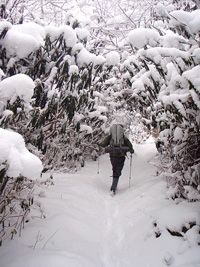
It’s 5 a.m. and outside the truck, headlights reveal driving snow squalls and drifts as high as the pickup’s hood. Our crawl up Roaring Creek Road near the Toe River of North Carolina comes to a sudden halt in a wall of whiteness. We abandon our attempt to dig out the beast and don skis.

Chris Curtin and John Fennell shush along the Appalachian Trail en route to the Hump Mountain. Photos By Kristian Jackson

Minutes later we are skiing up the Overmountain Victory Trail in search of an adventure higher up in Roan Highlands, a 20-mile group of mountain peaks straddling the border between North Carolina and Tennessee. Winter is palpable and immediate here. The wind scours its way through bare tree limbs and whips up the powdery snow, creating an atmosphere that is felt as much as seen.

We seal our zippers and pockets to keep winter out and stay moving to stave off the bone-chilling cold. Further into the Highlands we pass through a sheltered cove near 5,000 feet in elevation where the trees hang heavy with snow. We reach the open expanse beyond the trees. In calm weather, the nearby open balds of The Hump and Little Hump Mountains would provide outstanding views, but now everything is white, threatening and loud. We turn our backs to the wind, eager to make some teleturns in the deep powder.

Telemark skiing (also known as nordic or cross-country) has been practiced in the South for decades. The style refers to both a technique and a type of ski and boots. Fixed in the front and free at the heel, the free heel allows the skier to kick and glide uphill (sometimes with the use of skins that help grip the snow) then drop a knee and perform elegant “telemark turns” to descend.

The New Revolution

Devotees of telemark skiing have waxed and waned over the years. The style almost died out in the 1970s but experienced a resurgence in the 1980s. During that decade, the peaks of the North Carolina High Country region were so popular that cross country ski rentals were available in several places and a company called High South Nordic Guides offered tours to Roan Mountain and telemark lessons at a nearby ski resort.

Here there are no lifts, no lines, no crowds, and only a fraction of the environmental impact of the ski resorts. Nordic skiers in the High Country are rewarded with solitude, unspoiled beauty, and the exhilaration of human powered fun.

Drought and warmer winters in the 1990s and early 2000s brought another slump to the sport, until the high snowfall totals of the past few winters sparked a new telemark revolution. Downhill devotees, snowboarders and cross country traditionalists quickly rediscovered the beauty and excitement of ski touring. Now, formerly obscure pockets of powder are often covered with ski tracks as soon as a winter storm is over, and the word has spread about “secret stashes,” where skiers and boarders.

New technology has also added to the latest telemark revolution. In the 1980s, nordic enthusiasts sported skinny skis, leather boots, and floppy three-pin bindings. Today’s backcountry skiers use technology that resembles downhill gear and allows for more efficient touring in varied conditions.

But ask any skier about the most critical component to back country touring in the South and the answer will invariably be “snow.”

Prior to the past three winters, the common refrain of regional nordic skiers was, “It was snowier back in the day.” In fact, the first telemark boom in the 1980s ended when “the winters changed,” according to High South Nordic Guide co-founder Jeep Barrett.

A look at weather charts from Ray’sWeather.com, a popular amateur weather website that covers the western part of North Carolina, reveals a dramatic decline in snowfall amounts since the mid-80s. Although the past three winters have brought impressive snow, the numbers show that trends over the past two decades simply do not measure up to the dumps of 30 years ago.

Snow in the South, even at the highest elevations, will likely remain hit or miss. Perhaps this is what draws the attention and enthusiasm of the Southern skier: When the snow is good, it’s really good, and then it’s gone. However, even in low snow fall years, nordic skiers will still find enjoyable tours in the Southern highlands.

Fun Events & More Info

The High Country Nordic Association was formed in 2010, when a group of nordic skiers met to plan a “Tele-Fest.” The association is planning many activities this season, including a Film Festival, the 2nd Annual Telefest Jan. 21 at Beech Mountain, N.C., and updates on regional skiing conditions. Visit their group and page on Facebook to find ski partners and ask for tips. To find the best backcountry spots in your area, check with local ski shops or area outdoor outfitters. If you can find it, get your hands on a copy of Randy Johnson’s book Southern Snow to discover the vastness of our winter world.

Now go make some tracks.

TOURING THE ROAN HIGHLANDS

No southern skier should go without a tour of the Roan Highlands. Regarded as Nordic Nirvana, when the snow is right the Roan Highlands are the crown jewel for ski touring in the Southeast. The Highlands rise like a weathervane above the hills of Tennessee and catch the full force of arctic weather systems moving in from the northwest. Gale force winds howl through the evergreens, breaking branches and driving snow into massive drifts. On the balds, wind scours the open country nearly clean of snow and deposits enormous snow fields on the lee side.

The High Country Nordic Association's Justin Studt finds the flow of the telemark turn in the trees.

Tours in the Highlands are as varied as the weather, passing through a unique combination of evergreen forests, hardwood glades and open balds. Some can be moderate winter excursions, others can cause the most die-hard snow freaks to question their love of extreme conditions. Several classic tours begin from Carver’s Gap on the Tennessee/North Carolina line:

– For a short out-and-back tour, ski along the road to Rhododendron Gardens, tour the gardens, then return. To lengthen this tour, head out the old Balsam Road, the first road on the left when heading up from Carver’s Gap. This is a pleasant, quick tour with little elevation change.

– For a more ambitious route that requires a few tele-turns, head up the road to the old Cloudland Hotel site and continue on the Cloudland Trail. After passing the first gate, check the Appalachian Trail on your right for snow depth. If the creeks are frozen and the snow is at least 12 inches, this should work as a return route. This trail undulates along the top of the massif and climbs to its terminus at Roan High Bluff. Often the winds at the bluff can be heard well before reaching the top. After a snack at the bluff (stay in the woods and out of the wind) head back down the Cloudland Trail. This requires deep snow and a solid tele-turn.

– For a fast and exciting downhill from the Cloudland Hotel site, head into the spruce trees and down the Appalachian Trail. This run requires quick reflexes to handle the switchbacks and other surprises.

– For more experienced adventures in the Highlands, try the Roaring Creek Area. Flanked by the Yellow Mountains and the crest of the Highlands, this impressive watershed on the North Carolina side rises from the low elevations of the Toe River to the massif crest. For tours beginning on Roaring Creek Road, you will need to be prepared for skiing up and down steeper terrain, turning in trees, route finding, and self-rescue. (Note: the road to Roaring Creek is not plowed, so you may also need to ski to the trailhead). From the Overmountain Victory Trailhead, skiers can access the Appalachian Trail, Little Hump and the Hump. Look for open downhill runs on the lee sides of the fields and be prepared for brutal conditions.

Golden Eagles Winter in Appalachia

Wednesday, December 21st, 2011 - posted by brian

By Molly Moore

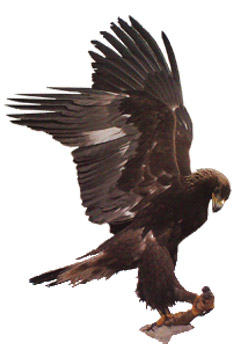
With their deep brown bodies and gold-tinged feathery manes, golden eagles are icons of ferocity.

An Eastern golden eagle is caught on film by a research camera. Clearings were baited with roadkill deer to attract the aerial predators. Photo by Barb Sargent/Todd Katzner

When Americans imagine a golden eagle diving through the air with talons outstretched, they typically pair the image with a Western backdrop. But as Appalachian researchers are quick to point out, the notion of golden eagles as strictly creatures of the West simply isn’t true.

“It turns out that there’s a small but substantial population of golden eagles in eastern North America,” says Todd Katzner, research assistant professor at West Virginia University. Katzner is a member of the Eastern Golden Eagle Working Group, an international partnership founded in 2010 to study the mighty raptor’s distribution and ecology.

Katzner’s preliminary research suggests that West Virginia and Virginia are the eagles’ main winter stomping grounds, though golden eagles have been spotted wintering as far north as upstate New York and as far south as Florida. Eastern golden eagles breed in northeastern Canada. When they migrate south, they primarily winter in the central and southern Appalachian Mountains.

“We don’t know if there is a really strict habitat requirement, but we do know that the areas of West Virginia and Virginia where the birds are found are primarily the Monongohela National Forest and the George Washington and Jefferson National Forests,” Katzner says. “Those are some of the more densely forested areas that we have in this region.”

In other parts of the world, golden eagles are found primarily over open country. This habitat difference has fueled speculation that Eastern golden eagles could be genetically distinct from their Western counterparts.

Maria Wheeler, a doctoral student at Duquesene University in Pittsburgh, Pa. co-supervised by Katzner, is researching the level of genetic distinction present in Eastern golden eagles. Not only is Wheeler studying how separate the Eastern birds are from Western North American populations and those around the world, she’s delving into the golden eagles’ genetic past. In a well-intentioned attempt to bolster the golden eagle population of the Southern Appalachians, Western golden eagles were introduced between 15 and 35 years ago, and these introductions may have changed the biology of Eastern goldens already living in the area.

To determine whether the genetic code of Eastern golden eagles’ has actually changed, Wheeler is collecting tissue samples from museum specimens of Eastern goldens collected before the introduction of the Western birds. She then compares the Eastern eagles’ historic genotypes with modern genotypes.

Wheeler’s genetic study is just one topic being probed by the Eastern Golden Eagle Working Group and their collaborators. To understand the birds’ behavior in their Appalachian winter homes, researchers have placed over 80 motion-sensitive cameras at select sites between New York and North Carolina. These cameras are rigged in small, remote clearings that are baited with roadkill deer.

Over the past five years, thousands of images have been recorded at these sites. The high numbers affirm the raptor’s winter appetite for carrion.

Less certain is whether Eastern golden eagles dine on other birds during the summer, as some suggest. Katzner’s team has placed telemetry tracking devices on about 50 birds, which record location every fifteen minutes throughout the year. Research partners in Quebec have provided some summertime assistance, but often these goldens soar into the roadless territory of Canada’s far north.

Golden eagle researchers, including Katzner, hope that learning the raptor’s migratory flight patterns will help avoid conflicts between future wind energy development projects in Appalachia and the mighty birds. In the most famous conflict between the energy and avian worlds, at California’s Altamount Pass Wind Farm the failure to study bird movement patterns — as well as flawed turbine design — tragically led to high raptor death tolls from turbines.

By analyzing the risk golden eagles face from wind development, researchers could protect a range of other slopesoaring birds of prey, such as redtail hawks, broadwing hawks, bald eagles and osprey.

“In the East we know of no turbines that have killed golden eagles,” he says. “What we don’t understand is why some turbines are dangerous and some are not. The goal of our research is to figure that out.”

Pure Golden Facts

Golden eagles are monogamous, and their partnerships can last from several years to life. Females lay one to four eggs per year, which both parents incubate. Typically, one or two survive to fledgling age. The ladies are typically larger, but both sexes sport the species’ trademark plumage — a pattern of brown, gold, grey and sometimes even white feathers.

Golden eagles are used by Mongolian and Kazakh falconers to hunt wolves in Central Asia’s wild steppes. With a wingspan that averages from six to nearly eight feet, it’s no wonder that the only natural predators golden eagles face are brown bears and wolverines. There’s even one confirmed report of a golden eagle preying on a brown bear cub.

There are six known subspecies of golden eagle, which range from Japan to Siberia and North Africa to the Himalayas.

Old Folktales Die Hard

Wednesday, December 21st, 2011 - posted by molly

The Ballad of Tom Dooley

By Brian Sewell

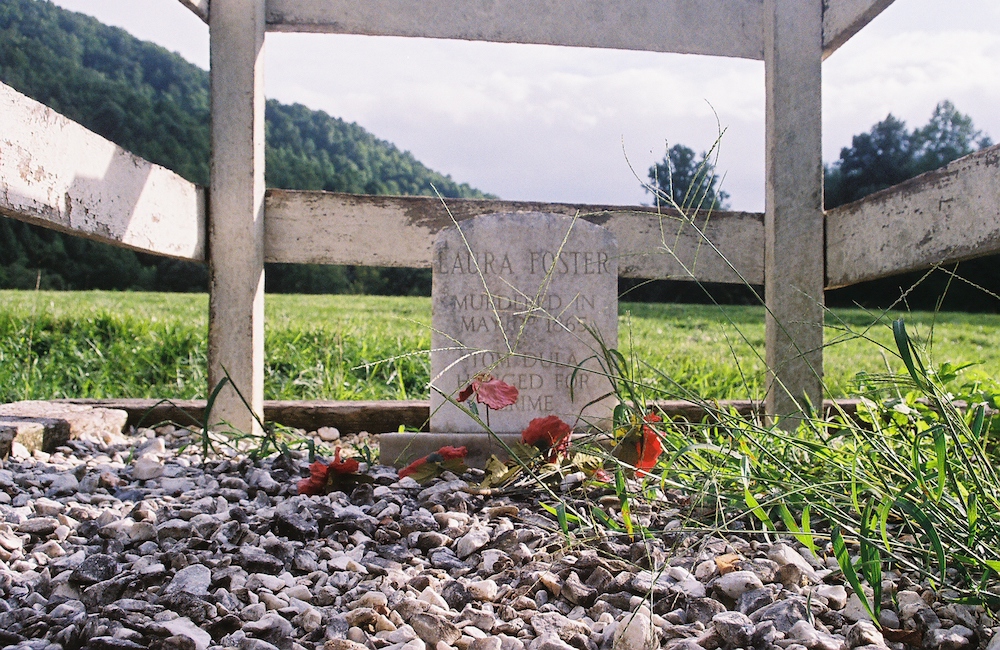
“Murdered in May of 1865,” a white gravestone on the banks of the Yadkin River in Wilkes County, N.C., reads. “Tom Dula hanged for crime.”

The grave belongs to Laura Foster, the victim in one of the most popularized and retold murder cases in Appalachian folk history. Like a game of cultural telephone, the story of Tom Dula (sometimes spelled “Dooley”) has been passed through time in songs, ballads, film and poems. Now, it has been put into novel form by Appalachia-focused author Sharyn McCrumb.

The Ballad of Tom Dooley by Sharyn McCrumb is the latest retelling of the long-lived folk story of Tom Dula.

In The Ballad of Tom Dooley, McCrumb does the legend justice by searching for the truth, and where the case goes cold, she does a little guesswork of her own (it is a work of fiction after all). Her account is much closer to the truth, she argues, than The Kingston Trio’s, the group that truly made the folktale famous with their 1958 song “Tom Dooley.”

After returning from the Civil War, Dula worked as a laborer in the Yadkin River Valley. Soon after, he fell for Laura Foster, cousin of his long time love interest, Ann Foster Melton. Folklore suggests that Laura became pregnant with Dula’s child and the lovers decided to elope. The morning they were to leave, May 26, was the last time Laura would be seen alive.

Everyone knows, if you tell a story enough the facts begin to grow a bit hazy. The shopkeeper, banker and borrower all have their own versions. But since the murder, the guilty verdict and the hanging of Tom Dula outside of a train depot in Statesville, N.C., the details haven’t truly mattered in a story that has made an indelible mark on the area’s past and present.

Originally recorded in 1929 by Gilliam Banmon Grayson and Henry Whitter, the murder ballad “Tom Dooley,” also known as “Hang Down Your Head Tom Dooley,” became a hit when the Kingston Trio harmonized the dark history. The Trio’s version has been selected as a “Song of the Century” by the Recording Industry Association of America and the National Endowment for the Arts and was inducted into the National Recording Registry of the Library of Congress.

The Laura Foster grave lies on a private farm in a culturally significant area of Wilkes County called Happy Valley. Even today, passers-by will leave flowers for Laura. The story of her death draws visitors to the site and, due partially to its cultural significance, the Jones Farm is being placed under conservation easement by Foothills Conservancy of North Carolina land trust to prevent the farm from being developed or subdivided.

Laura Foster's grave rests in Historic Happy Valley, Wilkes County, N.C. Photo by Sharyn McCrumb.

Each year in his open pastures, landowner Tony Jones hosts the Happy Valley Fiddler’s Convention and invites hundreds of folk musicians to the very valleys and hills that Tom and Laura walked. The fiddler’s convention began because the story is so well known in folk music circles, Jones says. He is using that impetus to develop economic benefit through agritourism, rather than selling his land for development of riverfront homes.

Investigating for The Ballad of Tom Dooley, McCrumb walked the same hills. She spoke with those who had grown up hearing the story, each with their own opinions and no two stories the same. In becoming an item of pop culture — hit cartoon The Simpsons once included a verse of “Tom Dooley” in an episode — even what little is known of the truth has been twisted.

What could have been a closed case, a dusty trial record in the North Carolina Archives and a solitary forgotten grave, over time has become the Appalachian equivalent of a Shakespearean tragedy. One historical fact that McCrumb couldn’t get wrong: Though it had no legal force, Tom Dula was acquitted in 2001 after a petition circulated around Wilkes County.

Fact or fiction, it’s how a story is told that makes it last.

The Qualla Creators

Wednesday, December 21st, 2011 - posted by molly

Conserving Cherokee Traditions

By Molly Moore

On the Qualla Boundary, the Eastern Band of Cherokee Indians’ reservation, local resources have inspired arts traditions for generations. Today the community’s rich arts heritage is flourishing.

Carved wooden masks by artisans such as Davy Arch are sold at Qualla Arts and Crafts Mutual, Inc. Photos by Molly Moore

The town of Cherokee, N.C.,positioned at the southern terminus of the Blue Ridge Parkway and bordering the Great Smoky Mountains National Park, was opened to the tourism economy with the birth of the national park in 1940.

“Early on, people began to realize that they could market traditional crafts as souvenirs to the tourists,” says Davy Arch, a Cherokee artist who works in traditional and contemporary forms. “People began to supplement their income by selling what they had been using on the farm.”

With the influx of visitors came a surge of entrepreneurs. At the time, the tribal levy — a business tax — was a main source of revenue for the Eastern Band of Cherokee Indians. The revenue benefited the tribe as well as the artist, but soon outsider-owned businesses flooded the local market with mass-produced goods that promoted disparaging stereotypes drawn from “Cowboy-and-Indian” films.

In response, local artists banded together in 1946 to form the first Native American cooperative, Qualla Arts & Crafts Mutual, Inc. The organization currently has 300 artisan members, and their combined gallery and museum presents a wide variety of goods that blend traditional and contemporary elements.

“We want our artists to grow and try new ways to express themselves,” says Tonya Carroll, Outreach Coordinator at Qualla Arts and Crafts Mutual. “We do want items that incorporate Native American culture but that can be open to interpretation.”

Basketry, mat-making and wood carvings are some of the best-selling items at Qualla Arts and Crafts, but member arts also include beadwork, stone carving, pottery, finger weaving, doll making, painting, drawing, crocheting, shell engraving, wood burning and metal jewelry.

An Economic and Cultural Lifeway

Davy Arch is known for fine wooden masks, but he also carves arrowheads that are available on the lower end of the price spectrum. His mother and grandmothers crafted beadwork, and he can’t remember a time when he didn’t have a carving knife. In his lifetime of involvement in the Cherokee arts community, he’s seen the craft economy shift.

“People used to use the baskets to pick up potatoes and gather corn,” Arch says. “But now [traditional baskets] are high-end collectibles that can sell for thousands of dollars, so you’re not seeing a lot of people out in the potato patch picking up potatoes in their Cherokee baskets. The shift to marketing artwork as a high-end collectible is something that has controlled the way we market things and the product itself.”

Beaded jewelry is just one of the local crafts sold in a gift shop at the casino in Cherokee, N.C. Photo by Molly Moore

The ability to command higher prices has helped these time- and skill-intensive arts survive, but competing with cheap imported goods remains a challenge. Recently, Cherokee artisans have received more support from tribal government and current businesses on the Qualla Boundary. The reservation’s casino is a reliable customer of the Qualla Arts and Crafts Mutual and sells local crafts at casino and hotel gift shops.

“Tribal government is aware that most families have an artist in the family and have a tradition of artwork that links us directly to the past as a culture,” Arch says. “So it’s a concern of the politicians to ensure that there are opportunities for artists.”

The Eastern Band of Cherokee Indians’ Principal Chief Michell Hicks campaigned for Artist’s Row, an outdoor market area near Oconaluftee Islands Park where artists can sign up for space. An attempt by the Tribal Council to pass a resolution that would have required all craft shops on tribal land to sell a certain percentage of local artists’ work did not pass.

Resourceful Arts

Revitalization of traditional artwork has increased demand on the natural resources used in these crafts. To meet that need, the Cherokee Preservation Foundation, which is funded by the tribe’s gaming revenues, established the Revitalization of Traditional Cherokee Artisan Resources program to restore the traditional balance between maintaining and using vital resources.

“Land preservation is a wonderful thing but for us it’s preservation with a purpose,” says David Cozzo, project director for the program. “It’s a living act of management.”

River cane is one such resource. The Cherokee are known for their intricate double-weave baskets crafted from this member of the bamboo family, but not long ago the tribe was down to just two active basket makers. Thanks to a program at the local high school, there are now 15 teens who can make the signature art. But ensuring an adequate supply of river cane is as important to the craft’s survival as the teachers. Fostering river cane stands in the mountainous Qualla Boundary is difficult, particularly since much of the species’ former range has been taken over by agriculture and development.

To find suitable habitat for river cane introduction and management, the revitalization program works with outside groups such as the Land Trust for the Little Tennessee and the Watershed Association of the Tuckaseegee River. Land Trust for the Little Tennessee and Cozzo’s program are planning river cane restoration at Welch Farm, a tract of land that had been used for corn cultivation.

Artisans from the Eastern Band of Cherokee Indians harvest river cane with partner organizations. Photo by Land Trust for Little Tennessee

The resource revitalization program is also working on its first project with the U.S. Forest Service. If all goes well, South Carolina’s Sumter National Forest will house 29 acres of river cane, which would make it the largest actively managed cane site in the Southeast.

The butternut tree is another key species, since the bark produces a distinct dark dye. But a fungus has decimated the butternut population, and the tree’s survival is threatened. A partnership with high school students aims to help researchers find ways to select disease-hardy butternut for cultivation.

Organizations are also experimenting with growing white oak for basketry. But recreating traditional environments has its challenges. Because white oaks grown too quickly are too fibrous for weaving, Cherokee artisans prefer white oaks that grow slowly in laurel thickets with acidic soil. The Land Trust for the Little Tennessee, University of Tennessee and the tribe’s resource revitalization program are working to replicate that habitat on available land trust property. So far, the groups have seen mixed results, but recent plantings are still a few years away from harvest. “It takes eight to 10 years to test the idea,” Cozzo says.

Between the efforts of tribal government, schools and non-profit organizations, there is a network of economic and educational support behind traditional Cherokee crafts. With thoughtful management of natural arts resources, young hands will weave these venerable traditions into the future.

Bees Share the True Cost of Coal

Wednesday, December 21st, 2011 - posted by brian


By Brian Sewell

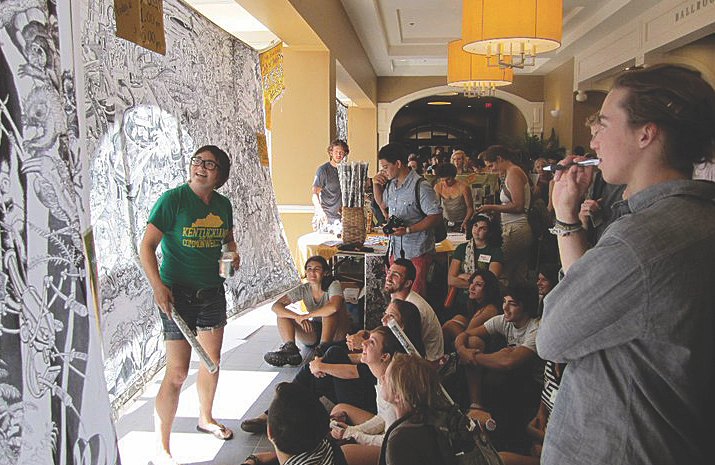
Outside of Appalachia, artists who acknowledge their connection to coal have adopted the issue of mountaintop removal and taken to the road. The Beehive Collective’s True Cost of Coal illustration transforms ways of thinking as it travels by inviting all who see it into a web of stories.

The panoramic poster depicts the complex relationships between industry, commerce, society and the natural world that are inseparable from the fight to end mountaintop removal. The large form pen and ink image transitions from scenes of undisturbed wilderness to industrialized madness. Gradually, the characters, the diverse creatures of Appalachia, actively resist and, finally, take back and restore the land.

A closer look at a portion of The True Cost of Coal reveals the visual metaphors Beehive Collective found in coalfield communities. Photos courtesy of Beehive Collective.

Beehive Collective, a Manchias, Maine-based collaborative artists’ group, is known for their expansive graphics. Depicting globalization, free trade and militarism, their works deconstruct some of the most debated issues of the time. But they also understand the power of using their graphics as educational tools and touring to accomplish their mission of “cross-pollinating the grassroots.”

“We do a lot of traveling and touring with the work we do and generating conversations and actions,” says Zeph Fishlyn, an illustrator and educator who has worked with the collective since 2007. “We’re also carrying ideas and stories that people tell us from one place to the next.”

After interviewing residents of Appalachian coalfield communities, the “Bees” collected stories and perspectives of the effects of mountaintop removal and how people are taking action. The challenge arises when they must craft a drawing to convey all the information in a creative and compelling way.

“That’s where we are crafting metaphors,” Fishlyn explains. One portion of the poster depicts the story of land grab perpetrated by the fossil fuel industry. It’s shown by a railroad unrolling itself across the landscape, intruding on homes and farmsteads and causing animals to scurry away seeking protection.

There are hundreds of distilled but profound visual metaphors hiding in The True Cost of Coal – a testament to its power as an education tool.

With the True Cost of Coal, the collective’s outreach and education efforts have taken off. The poster and presentation are the most in-demand of any of the collective’s projects. Since the poster was printed in June 2010, the group has distributed more than 15,000 copies and given almost 600 presentations.

“The story of mountaintop removal coal mining is resonating with people,” says Emma Hornback, a founding member and full-time “Bee.” “Our allies have told us: ‘We know this story. It’s useful for us to have this but you need to get this message out to other people.’”

The Beehive Collective tour the Americas with their narrative graphics to educate and inspire.

Fishlyn and Hornback have worked on every phase of the True Cost of Coal project since the project began in 2008, from planning research trips and speaking with residents in Appalachia to illustrating and touring throughout the Americas with the poster.

The main theme in the work, resource extraction, resonates with people everywhere. Touring the gulf coast, the collective used the graphic to engage those dealing with the aftermath of the BP oil spill.

“If you were to change the characters from Appalachian songbirds to crawdads and alligators this could be their story,” Hornback says. “If you change the bad guy from coal to oil, the story is almost the same.”

Sharing their work is as much a priority as creating the graphic itself, and the “Bees” have been busy. In the past year, 25 people have toured with the poster, counting stops in Montana and the Dakotas among other stops. Invitations pour in requesting presentations in Northern Arizona, where locals struggle against Peabody Coal Company on the Navajo reservation. Other presenters recently returned from Alberta, Canada, the epicenter of the heated tar sands debate. They’ve even taken the poster to Bogota, Colombia where a “Bee” and Colombia native used the graphic to discuss coal mining in South America.

“People have learned about mountaintop removal through the graphic,” Hornback says. “A lot of folks associate the two things and point to it as a pivotal moment in their understanding of climate issues and coal issues in particular.”

Putting the Human Perspective into Mountaintop Removal
Wednesday, December 21st, 2011 - posted by brian

By Brian Sewell

For every movement, there is a message. This message can take many forms, but often the most moving is the creation of art to inform. Art helps people see problems anew, even those who see them everyday. The campaign to end mountaintop removal is no different.

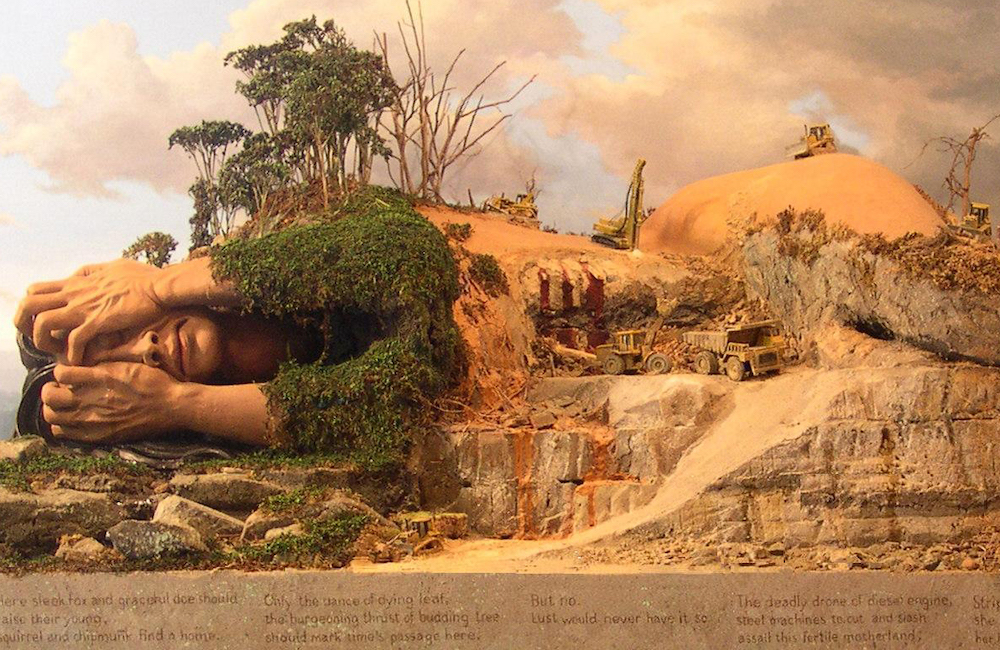
At the annual meeting of Kentuckians For The Commonwealth in 2004, a life-sized sculpture by Kentucky artist Jeff Chapman-Crane,16 years in the making, debuted. For many, seeing The Agony of Gaia for the first time had an effect similar to witnessing mountaintop removal in person. Some stared in disbelief, others could not contain their emotions.

“People have always been really moved by it,” Chapman-Crane says. “They understand the issue much better by looking at the sculpture. It’s made some aware of the issue for the first time and inspired them to get involved.”

Looking at Gaia, the human form of a mountain in agony feels familiar while the damage inflicted on the natural world is put into perspective.
“I wanted to express that the earth is not just this source of raw material we can exploit for coal with no cost to the earth or ourselves,”

Chapman-Crane says about the piece. “The earth is actually a living thing. It feels what we’re doing to it and there is a real price to pay for the kind of abuse and exploitation that we’ve been subjecting the earth to for so long now.”

Adding to the realistic look, natural materials like rock dust and moss cover the surfaces of the sculpture. Even the machinery is to scale. The most detailed section, the figure’s head and the hands, are fired clay. The rest is simple Styrofoam.

Chapman-Crane designed the provacative sculpture with quick and frequent travel in mind, mounting it on a table with folding legs and wheels. Attached to the table are panels that fold up and lock together to protect the piece while its being transported.

“I feel good about the engineering of it,” Chapman-Crane says. “I wanted to make it lightweight and portable. It’s very quick to setup and very easy to move. That’s part of the design because I knew I wanted to take it to a lot of places.”

The Agony of Gaia has been exhibited at more than 50 venues around Appalachia. It has traveled to New York City and Washington, D.C., and was featured in a billboard campaign by Kentuckians for the Commonwealth, displaying the work to thousands of daily commuters in Frankfort, Ky.

“We’ve taken it to college campuses, churches and exhibited it in conjunction with a United Nations special hearing,” says Chapman-Crane. “We try to focus on venues where there are people who have never been made aware of the issue. It’s a great opportunity to teach people about it.”

For a piece so powerful, simply stumbling upon the image on the Internet can inspire action and create drastic personal change. Chapman-Crane was once contacted by a Catholic sister living in India who had seen an image of Gaia online.

“It inspired her to come back here and get involved,” he says. “It’s really out there.” I have no idea just how far reaching it is.”

Paul Corbit Brown: Truth Before Profit

Wednesday, December 21st, 2011 - posted by molly


By Jamie Goodman

Paul Corbit Brown’s life has come full circle – thanks to the lens on his camera.

He was born into a coal miner’s family in Kilsyth, W.Va. For generations, every male in his family had become coal miners, but a chance encounter when he was 12 years old ultimately resulted in a different career.

Brown, pictured here on assignment in Israel, says of photography, "I have such a pure and passionate love for this artform that it felt wrong for me to use it for purposes of misleading people."

“In seventh grade, they told us if we kept good grades, that when we got to eighth grade we would have the option to learn photography as part of our science class,” says Brown, who became captivated by cameras in his early youth. “So I went to the [teacher] and said ‘I don’t want to wait, I want to do it now.’”

With Brown’s continuous prodding, his teacher relented and challenged Brown to give up his lunch breaks to pursue photography. Brown showed every day, learning first to develop film and then to print. “As soon as I saw that image come up… I was hooked.”

After intensively studying photography in college, Brown wound up in advertising and marketing. He quickly grew disillusioned and reached an “existential crisis” with photography around age 23, while also going through a divorce. Around this same time, Brown met a Lakota Medicine Man who would eventually adopt him as a grandson and bring Brown to a pivotal choice.

Residents dealing with poisoned water. Photo by Paul Corbit Brown.

“I walked away from everything and just moved out onto the reservation in South Dakota.”

For three years Brown lived in relative isolation from the rest of the world, teaching in the tribal school and taking pictures of the beautiful mesa countryside. One day a woman from the tribal college asked if he would create a photo documentary of the issues bearing down on Lakota teenagers — pregnancy, alcoholism, drug addiction and suicide — and detailing how traditional tribal culture could help.

“It was a big success, people really loved it,” Brown says. “Kids would come to me and say ‘You changed my life.’ And I thought, wow, here’s something I can do with photography that actually does some good and is truthful, and I can live with the results.”

“I realized I could do something with photography besides just make money. I could make a difference.”

The juxtaposition of signs (and attitudes) in coal country. Photo by Paul Corbit Brown

In the mid ‘90s, Brown returned home to West Virginia to help his ailing mother. He took a part time job as a photographer with a local paper, and soon started to hear talk of mountaintop removal coal mining and a group of people campaigning to stop it. He asked his co-workers about it, but heard nothing.

“But it didn’t make sense to me, because nobody could really tell me what MTR was,” he says.

Then a press release about an anti-mountaintop removal rally in the nearby town of Blair found him. Brown’s editor was not interested in the story and refused to let him leave to cover the rally. Brown requested the day off.

Brown was so moved by the event’s speakers — including retired miner Jimmy Weekley — that when organizers called for the public to speak, he jumped to the mic. “I was mortified of speaking publicly. But For some reason, the injustice of [mountaintop removal] overwhelmed me to no end.”

Rally organizers, impressed with his passion, recruited him to present the issue and he soon recognized a need for impactful images conveying the scope of devastation. Brown connected with the newly-formed SouthWings organization to produce some of the first aerial photographs of mountaintop removal mine sites.

Aerial shot of a mine in West Virginia by Paul Corbit Brown

“My first thought was “Oh my God, these things are huge,” says Brown of his first overflight.

Brown worked to document the families affected by mountaintop removal, making international waves with his images. He was invited to testify in front of Amnesty International about the issue. “I told them, “We in the coalfields of Appalachia are suffering from a genocide,’” he says.

Shortly after, Brown started his travels around the world documenting humanitarian issues in exotic and turbulent places like Rwanda, Indonesia, northern Iraq, Laos and, most recently, Haiti.

“I don’t use the word genocide lightly. I’ve been to Rwanda five times, I’ve slept on the streets with kids who were orphaned by genocide. I know what genocide looks like,” Brown says. “The death of my people doesn’t come quickly and at the end of a gun,” he adds, “It comes slowly and from the simple act of drawing water from your kitchen sink. And we have a government who’s complicit in it.”

Creeks polluted by mining and slurry. Photo by Paul Corbit Brown.

Brown’s photographs are haunting and evocative: a family holding jars of sludge-brown water drawn from their kitchen sink; a stream frothing with thick, orange and red ooze; a man examining his property destroyed by out-of-control flooding from mountaintop removal operations.

“The strength of a photo is that it captures a moment, and gives you a chance to study that moment for a long time,” he adds. “Photos are a way to give a voice to people who otherwise would not be seen or heard.”

Brown chooses to live simply in order to pursue humanitarian photography. He shares his images freely with organizations who cannot afford to pay. Situated on family land in Fayette County, Brown built his home with recycled and reclaimed materials. He exists primarily off the grid, refusing to add to the problems created by coal-fired electricity generation, and farms to grow most of his food.

“I never got in this movement as a way to make a living, or become famous,” Brown says. “I got in this movement because I want to end mountaintop removal.”

On a recent photo shoot with two West Virginia civil rights religious leaders, the Rev. Jeremiah Watts made a comment that resonated deeply with Brown and epitomizes his work to document the tragedies of the world. “’The only thing that powerful people fear is the truth,’” quoted Brown. “’And that is what we can do, we can offer the truth.’”

Following the Patchwork Path

Wednesday, December 21st, 2011 - posted by brian

Quilt Trails Drive Rural Economic Revival

By Dana Kuhnline

Barn quilts, a relatively new art form that draws on rich rural craft traditions of the past, are helping communities answer an important economic question.

“How do we get travelers off the four-lane highways and into communities where they might never go otherwise? How do we lead them to cash registers and special community treasures?” asks Lindy Turner, an associate of the Appalachian Quilt Trail, a Tennessee-based organization promoting the colorful rural designs known as barn quilts.

The Appalachian sunburst block graces an 1880s barn.

Turner says that driving tours of barn quilts, known as quilt trails, encourage rural economic development that celebrates local heritage.
Barn quilts were created in 2001 in Adams County, Ohio, by Donna Sue Groves. Groves wanted to honor her mother, a noted quilter, and celebrate her family’s Appalachian heritage. What began as an idea for one barn quickly became a driving trail with 20 squares across Adams County, but the idea didn’t stop there. To date, Groves’ idea of “a clothesline of quilts” now stretches across 3,000 barns in 29 states.

The idea is simple: a quilt square is painted onto the side of a barn. In many communities, these beautiful barns are linked by trail guides and maps. One of the first priorities of these projects is to preserve and highlight local heritage skills, including barn building and, of course, quilting.

“There’s a lot of history in the quilt patterns themselves, a lot of them have been in the families for hundreds of years; it’s similar to a family crest,” explains Charis Endicott, an AmeriCorps VISTA member with the Appalachian Resource Conservation and Development Council’s quilt trail. “People who don’t know anything about quilting want to know more about the image and about the project. It gives an opportunity for cultural exchange, for the land owner to talk about their family history and to celebrate local history.”

The Star Brick Block was based on a late 1800s brick produced in Ohio.

In southeast Ohio, the Quilt Barn Trail in Athens County integrates traditional quilt squares with one-of-a-kind patterns such as the Star Brick Block square, which was based on a historic 1800s brick pattern that was produced in the area.

“About 70 percent of our squares are original, we find this lends that local touch to the quilt barn and tells a local story, just like a traditional quilt square does,” says Paige Allost of the Athens County Convention and Visitors Bureau. “The Nelsonville Coal Miners Block was chosen to be placed on a barn that is located right on the edge of former mining communities.”

Because many heritage Appalachian quilt blocks were inspired by everyday mountain life, quilts are especially suited to tell community stories and highlight local activities. Heritage quilt blocks are often chosen to attract tourists to current community landmarks by featuring designs such as Cabin Windows and Log Cabin blocks at cabin rental locations, the Turkey Tracks quilt block at an eco-tourism destination in Kyles Ford, Tenn. and the Crossed Canoe pattern at a river outfitter.

“In some cases people honor a family quilt, in [other] cases, it’s [the] pattern that has special meaning,” says Turner.

Ideally, barn quilts don’t just preserve local history, but also encourage new growth. “It is expensive and hard to remain on a farm these days,” says Turner. “We are honoring quilting and the beautiful art of barn [building], but we also need to lead people to spend money in the community. We are using a heritage art to create economic development in depressed areas, but in order for it to be a true rural economic development project, it needs to ring cash registers.”

The Tree of Life block highlights area forests.

The Dairy Barn Arts Center in Athens, Ohio, hosts Quilt National, a biannual quilt show attended by more than 15,000 people. The Dairy Barn itself has a quilt square displayed on each end. “Often this is one of the main starting points where people see the squares and then get hooked on the quilt trail. It gets people out to see the beautiful farms and barns on the back roads of Ohio,” says Allost.

Endicott at the Appalachian Resource Conservation and Development Council has seen the same thing happen in Tennessee. “We get calls from people all over the eastern United States, often on their way to Gatlinburg, Tenn., who want to stop and take pictures,” she says. “While they’re here, they enjoy local food and farms and support local craftspeople that would otherwise get less recognition.”

For more information, visit VacationAQT.com, QuiltTrail.org and AthensOhio.com

Bringin’ Anachronism Back

Wednesday, December 21st, 2011 - posted by brian

Modern Adventures in Traditional Appalachian Craft

By Julie Johnson

I was 25, slogging through yet another post-college retail job, when I realized I should run away to the hills and be a craftperson’s apprentice. It was a dream nurtured since childhood; I longed to be slavishly worked for naught but the benefit of a hands-on education and perhaps a hot meal.

From quilting to blacksmithing, students at the folk schools of Appalachia learn traditional methods from the folks dedicated to their craft. Photos by Kether Wiedeman, John C. Campbell Folk School

I shared this dream with prophetic friends who steered me to the John C. Campbell Folk School in Brasstown, N.C. There I found, through the hum of this hectic, electrified world of tweets, links and 24-hour rollback pricing, the rare breed of folks who also seek the networks of a bygone era.

The traditional craft and folk schools of Appalachia attract an eclectic bunch of teachers and learners. Some offer full degree programs while others, like John C. Campbell, host short-format classes that offer patrons a chance to take a week or weekend to become conscientious objectors of computational manufacturing.

In my time around the Folk School, I’ve seen trees become bows, coffins, faces, chairs, garden sheds and baskets, and fibers become quilts, yarns, felt, hats and clothes. I’ve seen leather shoes cobbled, knives forged, books bound and all manner of things painted, drawn, carved and enameled. I’ve seen a pictorial woodburning of Sasquatch crossing the ruined landscape of post-eruption Mt. St. Helen’s.

The people who create these crafts uphold the delicate processes of the eye and hand necessary to create a product that not only fulfills its function but also becomes an heirloom-quality treasure, and often feel a call to conserve the natural materials that go into its composition.

Even in a listless economy, enrollment holds steady, and I asked John C. Campbell director Jan Davidson why. “When times get hard, people want value for their money,” he says. “It’s worth more to learn something. It has something to do with being in control of your life, your activities, and their results.”

Photo by Kether Wiedeman, John C. Campbell Folk School

For the same reason, many also continue to spend their hard-earned dollars to support artisans. Cory Podielski, a former John C. Campbell student host, says she chooses to buy handcrafted goods because they are “unique and reflect the style and creativity of the artist. When you buy them, you are taking a stand against the cultural homogenization propagated by corporate attempts to mass-market to our desires,” she adds. “You are encouraging diversity, learning and creativity.”

Rob Withrow, a Brasstown, N.C., potter is encouraged by his customers often. “People come up to me all the time and tell me how they use one of my mugs every morning for their coffee, and how much they love it,” he says. “A bunch of folks, thinking good thoughts about you and what you made every day, where else can you get that? When you’re accountable to your neighbors for the product that you make, I tell you what, you put your heart into it.”

The Slow Food movement has brought worldwide focus to promoting systems of locally sourced and environmentally conscious agriculture. At a craft school, attendees can exercise the same ideals and become part of the slow stuff movement.

“The convenience of shopping kills our souls and makes us lazy,” says Podielski, “but the process and effort of craft builds up love, pride, and satisfaction. Handcrafted items are one of the core ways to build a local economy, and having a more local-based economy encourages community-building and learning. Yep, handcrafted items just might save the world.”

Save the world — or at least your sanity — at one of the fine samples of craft and folk schools of Appalachia listed below, each with its own rich history and specialized programming.

Handpicked Regional Craft Schools

Kentucky

Berea College: Offers workshops and bachelor’s degree programs.
berea.edu/studentcrafts

Kentucky School of Craft: Based out of Hazard Community and Technical College, offers certificates, diplomas and AAS degrees. hazard.kctcs.edu

Pine Mountain Settlement School: Offers day and week-long programs.
pinemountainsettlementschool.com

North Carolina

Haywood Community College: Offers an associate degree in Professional Crafts.
haywood.edu/creative_arts/professional_crafts

John C. Campbell Folk School: Offers week and weekend classes. folkschool.org

Penland School of Craft: Offers classes from one to eight weeks. penland.org

Tennessee

The Appalachian Center for Craft: Based out of Tennessee Tech University, offers workshops, craft certificates and bachelor’s programs. tntech.edu/craftcenter

Arrowmont School of Arts and Crafts: Offers one- and two-week classes.
arrowmont.org

West Virginia

Cedar Lakes Craft Center: Offers week and weekend classes. wvde.state.wv.us/cedarlakes/craftscenter.htm

Craftworks: Offers workshops and craft events. craftworksatcoolspring.org

Virginia

Virginia Commonwealth University: Offers bachelor’s and master’s degrees.
vcu.edu/arts/craft/dept