
Follow Us on Twitter: Appalachian Voices | iLoveMountains.org

Archive for the ‘2009 – Issue 1 (Feb/March)’ Category

Tennessee Crud- Appalachia plays host to yet another environmental disaster

Thursday, February 5th, 2009 - posted by Anna


Story by Bill Kovarik

At first, when a 55-foot wall of coal fly ash sludge broke loose from an earthen dam early Dec. 22 near Kingston, TN, the nation barely paid attention.

Initial reports from the Associated Press said there had been an isolated spill of “inert material not harmful to the environment,” according to TVA.

Within two days, as observers with environmental and science organizations began to question reports about the size and toxic nature of the spill, at least five independent toxicological test efforts were launched. These included sampling by the U.S. EPA, Appalachian Voices in partnership with Appalachian State University, and United Mountain Defense working with the
Environmental Integrity Project, Duke University, and others.

The disaster involved 5.4 million cubic yards of material, or an estimated one billion gallons of wet coal fly ash sludge. It was, officially, the largest toxic spill on record, and compares to a 300 million gallon coal slurry sludge spill on Oct. 11, 2000 at Inez, Martin County, Kentucky and to the 11 million gallon oil spill from the Exxon Valdez on March 24, 1989.

The December 22 coal fly ash disaster covered approximately 400 acres with a thick layer of toxic muck. Aerial photo by Dot Griffith Photography

Using descriptions of toxic make-up of the sludge, it was possible to put together estimates of an enormous amount of carcinogens and neurotoxins released into the river. These included a witches’ brew of 2.2 million pounds of arsenic, 5.6 million pounds of chromium VI, five million pounds of lead, nearly a million pounds of thallium and another million of polycyclic aromatic hydrocarbons.

Experts expected to find evidence of contamination in the river, and they did.
“Of the 17 compounds we tested, eight of them popped out as significantly higher than they should have been,” said Dr. Shea R. Tuberty of Appalachian State University, who conducted tests along with Dr. Carol Babyak.

“Arsenic was quite hot,” Tuberty said, with levels at 3.06 parts per million, or 300 times higher than EPA’s drinking water standard.

Testing by EPA, Duke University and other independent groups also showed a very high level of toxins in the river.

In rather sharp contrast, results from TVA itself showed a far different picture, with arsenic 20 to 40 times lower than the drinking water standard or sometimes even below detection. TVA conceded that one sample from the river near the spill “slightly exceeds drinking water standards.”

Senate hearing grills TVA chief Kilgore

A composite map of the region surrounding the TVA coal ash spill, pictured in high resolution before the December 22 disaster. Marks indicate direction of river water flow


As TVA’s public relations efforts collapsed, the U.S. Senate Environment committee called a hearing with TVA head Tom Kilgore as its star witness. Kilgore emphasized that TVA would “do cleanup right,” but did not explain how.

Senators repeatedly asked Kilgore for a sign that he took TVA’s leadership role in regards to environmental stewardship seriously.

With cleanup costs so high, one senator asked whether there aren’t cheaper and safer ways to generate electricity. No, Kilgore said: “Solar we don’t have a lot of,” and wind energy would cost “70 cents per kilowatt hour.” In fact, TVA itself charges green power consumers only 2.6 cents more for wind power than for coal power.

Asked about conservation, Kilgore could only point to a feeble program that TVA started within the last few years.

Repeated questions about TVA’s honesty met with stony resistance. New Jersey senator Frank Lautenberg asked why TVA told people that coal ash is not toxic, and not something to be alarmed about. Kilgore had no response.

By acknowledging TVA’s ash disaster problems with an evasive phrase — “this is not a proud moment” — Kilgore could not have given the senators less. In frustration, Senator Barbara Boxer flatly commented on one Kilgore response: “That’s not an answer.”

A week later, two more TVA coal sludge dams failed, a train full of TVA coal fell into a river, and a federal court ordered it to quit stalling on air pollution control equipment in a lawsuit brought by the state of North Carolina.

“Critics would say it looks like the wheels are starting to fall off at TVA,” observed the Chattanooga Times Free Press in an editorial describing the agency’s leaderless drift.

Fly ash had already been controversial

On December 27, Watauga Riverkeeper Donna Lisenby paddled up the Emory River to the site of the spill to obtain water and soil samples, the results of which contradicted TVA’s test results. Photo by Hurricane Creekkeeper John Wathen


Every year, 120 million tons of fly ash make up the residue of 1.1 billion tons of coal burned for electricity. Coal waste is the second largest waste stream in America after municipal solid waste. A train with cars full of a year’s fly ash production would stretch 9,600 miles.

Fly ash has often been used to make grout, asphalt, Portland cement, roofing tiles and filler for other products, but only about 43 percent is stabilized that way, according to the American Coal Ash Association.

Fly ash disposal has become increasingly controversial in recent years. Studies from the 1980s said that fly ash was harmless, but more recent scientific and EPA assessments have sounded alarms.

Environmental groups have been alarmed at the groundwater contamination by heavy metals from coal fly ash. Incidents have taken place all over the country where old fly ash deposits have broken loose, contaminating neighborhoods, threatening health and reducing property values. Fish and other species die quickly when directly exposed to fly ash, and those exposed indirectly accumulate heavy metals in their bodies, harming the ecosystem and posing a serious health risk to anglers.

Undeterred, the coal and utility industries kept insisting that fly ash was harmless. Yet in 2003, EPA identified over 70 sites nationwide where fly ash and similar coal power plant waste has contaminated surface and groundwater. The next year, 130 environmental groups petitioned the federal government to stop allowing fly ash to be dumped where it could come into contact with drinking water supplies.

At the time, EPA put off a decision on new regulations for 18 months. Five years later, regulations have yet to be written, although two years ago, a National Science Foundation report urged EPA to begin regulation.

In the summer of 2007, the EPA released a national risk assessment on coal fly ash disposal. One of the most important factors involved in risk was whether runoff could carry contaminants away from the site and into groundwater.

Cancer risk from arsenic is one of the biggest issues with fly ash. People drinking groundwater contaminated by a coal waste landfill that did not use a plastic liner had a 10,000 times greater than allowable risk of cancer, the EPA said. Other risks include high levels of mercury, lead and other heavy metal contaminants.

Communities in Indiana, Pennsylvania and Maryland have already experienced severe fly ash problems. Water supplies had to be shut down in 2004 in the town of Pines, Indiana, and families were provided with bottled water after molybdenum showed up the town’s drinking water.

In September of 2007, the Boston-based Clean Air Task Force and EarthJustice released a report on the use of coal fly ash to fill in Pennsylvania mines. In 10 of 15 mines examined across the state, groundwater and streams near areas where coal ash (or coal combustion waste) had been used as fill material contained high levels of arsenic, lead, cadmium, selenium and other pollutants above safe standards.

Also in 2007, residents of Giles County, VA filed a lawsuit over coal fly ash landfills being placed by American Electric Power adjacent to the New River. They said that landfills posed a danger to people and to the recreational uses of the river.

In November 2008, residents of Gambrills, Maryland, settled a class action lawsuit against a power company for $45 million after water supplies were contaminated by a fly ash landfill.
Though a National Academy of Sciences report in 2007 said it would be safe to fill abandoned mines with coal fly ash, the Clean Air Task Force and EarthJustice, which have been pushing for more regulations, disagreed: “The public has been told for decades that these coal wastes are not hazardous—it’s time to end that fraud.”

Water sampling shows variety of results

Wildly differing results from heavy metals sampling downstream from the ash spill have led to questions about the methods used by the TVA.

University and environmental groups, such as Appalachian State University – Appalachian Voices (ASU-AV), the Environmental Integrity Project/United Mountain Defense (EIP-UMD), and Duke University, all had significantly higher results for arsenic. The Environmental Protection Agency (USEPA) also had a higher result for arsenic than TVA. Here are the sample results for arsenic (total metals) in river water near the spill.

Note: Results are given in parts per million (ppm), which is equivalent to milligrams per liter (mg/L). The EPA drinking water standard is no more than 0.010 ppm (mg/L). **

(ADD CHART HERE… ASK JAMIE)

** Sometimes the results are reported as parts per billion (ug/L or micrograms per liter), in which case 3.06 ppm would be 3,060 ppb. For more information on drinking water standards for toxic chemicals, see http://www.epa.gov/safewater/contaminants/index.html

(TIMELINE??)

William Blizzard, Writer and Son of Blair Mountain Leader, Dies

Thursday, February 5th, 2009 - posted by Anna

Wess Harriss, publisher of Blizzard’s book “When Miners March,”Ross Ballard, Appalachian storyteller who teaches at John Hopkins University, and Molly Louise Thompson during the memorial service for Blizzard in January 2009. (Photo by Bill Kovarik)

Mourners wearing red neckerchiefs laid William Blizzard to rest amid refrains of the old Union hymn, “Solidarity Forever” and the sound of rifle volleys from the Veterans of Foreign Wars echoing over a Charleston, WV cemetery.

Blizzard died in December 2008 and was buried in January.

A writer and photographer, William Blizzard was the son of Bill Blizzard, the man who led the “Red Neck Army” in the 1921 Battle of Blair Mountain. Although William was a child at the time, he heard stories of the battle while growing up and remembered events surrounding his father’s trial for treason in 1922. The trial ended in acquittal.

William Blizzard on his 90th birthday in 2006. Photo courtesy of The Charleston Gazette.


Blizzard’s memories and research were published in a series of columns in 1952 and republished by Wess Harris in 2004 as the book When Miners March. Blizzard’s work was the only first-hand account of the Union side of the battle and subsequent treason trials. Blizzard was a living link to one of Appalachia’s most important and least known chapters of history, Harris said.
“Bill Blizzard wrote the definitive story about the struggles of coal miners in Southern West Virginia to win justice for themselves and their families through the United Mine Workers Association,” Cecil Roberts, president of the UMWA, told the Charleston Gazette. “He wasn’t just a bystander, he was there.”

Make Green By Thinking Green- Green Business Seminar February 24 at Appalachian State University

Story by Sarah Vig

People don’t always associate doing good things for the environment or “being green” with business savvy. According to Ged Moody, Appalachian State University’s Entrepreneur-in-Residence, however, today’s economy means that “going green” is an important way for businesspeople to add value to their products and potentially conserve resources while they’re at it. “You can think green and make green,” Moody says.

This mindset is what prompted the university’s Center for Entrepreneurship to organize a “Realizing Green Business Opportunities” seminar and networking event, set to be held on Tuesday, February 24 at 5:30p.m. on the ASU campus, located in Boone, N.C.

Moody will speak at the event, as will Scott Suddreth, the technical program director with Building Performance Engineering. There will also be presentations by renewable energy and business consulting experts. Following this, nearly 30 existing green businesses, business incubators and related community organizations from the Boone area will be answering questions as part of a casual, networking event.

The intent of the event is to provide interested community members with two important areas of information: a solid understanding of the technologies involved in this emerging area, and how a new or existing business could take part in this “green economy.”
There is no cost to attend, but registration is required. The event will take place in the
Blue Ridge Ballroom in the ASU Student Union, and food and beverages will be provided for all attending.

To register, or for questions, contact Julia Rowland at rowlandja@appstate.edu or at (828) 262-8325.

Tennessee Grandfather Cleans Up Creek, Wins Volunteer Award

Thursday, February 5th, 2009 - posted by meghan

Sierra Club members Carl and Iva Lee Wolfe moved from Florida to Mountain City, Tennessee, three years ago, after Carl retired. That’s Carl at left, pictured, with granddaughter Mariah.

“We were impressed with the beauty of the area,” says Iva Lee. “But the condition of the road and the nearby Falls at Fall Branch was a disgrace.” For years people had been tossing trash onto Fall Branch Road and dumping garbage, tires, old appliances, gas tanks, and assorted junk into the branch, which flows into Lake Watauga, a source of drinking water for the area.

After finishing work on the couple’s mobile home, Carl, then 68, began venturing out to bag trash along the road. But he soon deepened his commitment—literally—rappelling 50 feet down into the creek to clean up trash at the base of the falls.

“Some folks said it couldn’t be done,” he says, “but when someone tells me I can’t do something, I want to prove I can.”

The pace picked up in 2007 when Mariah moved to town and began helping out, pulling up the trash by rope that her grandfather had bagged. Over the last six months they have hauled more than 60 large garbage bags out of the creek, emblazoned with Carl’s handwritten message. 

Carl and Iva Lee speak at Kiwanis and Sierra Club meetings, encouraging others to get involved. Carl also volunteers at the local recycling center and transfer station. This fall he was nominated by the mayor for a Governor’s Volunteer Award, presented by Volunteer Tennessee to one person from each county in the state. Carl received his award on October 27 in Nashville.

“Carl is a humble man,” says Iva Lee, “but he hopes this will motivate more people to volunteer and get involved in the community. This isn’t our land; it’s provided for us. We’re the caretakers, and we could all be better stewards.”

Reproduced with permission from the Sierra Club Grassroots Scrapbook website © 2008 Sierra Club. All Rights Reserved.

Largest Wind Turbine In NC to be Installed by ASU’s Renewable Energy Initiative

Story by Jamie Goodman
Harkening back to 1978, when the little town of Boone, NC was chosen as one of only 17 test sites for a NASA-sponsored wind experiment—and the location of the largest of the wind generators in that project—the small mountain metropolis will once again be on the forefront of wind energy development when the largest community-scale wind turbine in the state is erected on the campus of Appalachian State University.

This time, however, research is a little more advanced, and the turbine will point the right direction into the wind.
Standing 37 meters (121 ft) tall with a 21 meter (68.9 ft) blade span, the Northwind 100 turbine, slated for installation in April, will be erected into a class two to three wind zone and is projected to produce 147,000 kilowatt hours of electricity per year. The purchase and installation will cost an estimated $529,000, and the turbine will be erected adjacent to the Broyhill Inn and Conference Center, ASU’s on-campus dining and public lodging facility.

The project is overseen and funded by the Renewable Energy Initiative, a student-run, student-funded program at Appalachian State University. According to Crystal Simmons, Chair of REI and current project manager for the Broyhill Wind Project, since REI’s inception four years ago a community-scale wind turbine was always on the wish list.

A public educational forum and Q&A session is scheduled for March 4, from 6:00-7:30 p.m. at the Broyhill Inn and Conference Center in Boone. Simmons stressed that anyone interested in the project is welcome to attend, not just the university or local communities. 

The organization also plans to install a 36-panel solar thermal system on the roof of the university’s Student Union, which will use the sun’s energy to heat water for two dining facilities located within the building. The system, which will provide up to 60 percent of the water needs for the dining facilities, will cost an estimated $153,000 and is slated for installation by the end of April.

For more information on the ASU Renewable Energy Initiative or their projects, visit rei.appstate.edu.

Coal River Mountain – The Line in the Sand for Mountaintop Removal?
Thursday, February 5th, 2009 - posted by Anna

Story and photos by Jamie Goodman

For those who support alternative energy and oppose mountaintop removal, a line has been drawn in the proverbial sand. That line is at Coal River Mountain, West Virginia.

Bulldozers have continued to clear trees and topsoil from Coal River Mountain, a peak that could potentially provide some of the best wind power in the entire state of West Virginia. In late November 2008, a permit was issued to Marfork Coal Company, a subsidary of Massey Energy, to proceed with mountaintop removal coal mining on the top of Coal River Mountain.
Simultaneously, non-profit organization Coal River Mountain Watch (CRMW) hired scientific consultants Downstream Strategies to conduct wind and economic feasibility studies on the mountain, releasing their findings on December 9, 2008. The findings served to cement what CRMW and many local residents had been saying all along—Coal River Mountain is an almost perfect location for setting up a wind farm.

West Virginia residents and conservationists alike flooded the office of state Governor Manchin with phone calls, emails and letters begging him to intervene and rescind the permit and to allow further studies of the wind potential of the mountain. But the Governor ignored public opinion in support of a Coal River Mountain wind farm, and the West Virginia Department of Environment Protection pointedly excluded public comment on the mining permits.
Though pro-mining entities would say otherwise, Coal River Mountain Watch—created when a group of local residents teamed up with environmentalists opposing mountaintop removal—is not opposed to coal mining in general. The overarching message of this organization is to encourage the mining company to mine coal responsibly while pursing alternative energy possibilities. For CRMW, this means underground mining, which creates more job opportunities for local residents than mountaintop removal mining while leaving the mountains relatively unspoiled. Combined with a wind farm, their proposal would create even more jobs for local residents as well as provide another revenue source for Massey Energy.

“This is one of the most progressive environmental movements I’ve ever seen,” said Jeff Deal, IT specialist with Appalachian Voices. “It is a movement that is under-recognized nationally, and it is poised, it is ready.”

But blasting for the first part of the operation could begin at any time, very close to a nine-billion-gallon toxic coal waste sludge dam called the Brushy Fork impoundment. Local residents have expressed concerns about the possibility of blasting causing a catastrophic dam failure at the sludge impoundment. In 1972, a sludge dam operated by Pittston Coal Company failed and killed 125 people in Buffalo Creek, WV. And in 2000, a sludge dam operated by Massey Energy in Martin County, KY released approximately 300 million gallons of coal waste that broke through into underground mines.

The Brushy Fork impoundment on Coal River Mountain also rests above old underground mine chambers. “I fear for my friends and all the people living below this coal sludge dam,” said Gary Anderson, who lives on the mountain near the site. “Blasting beside the dam, over underground mines, could decimate the valley for miles. The ‘experts’ said that the Buffalo Creek sludge dam was safe, but it failed. They said that the TVA sludge dam [near Harriman, TN] was safe, but it failed. Massey is setting up an even greater catastrophe here.”

Coal River resident Lorelei Scarbro reads a letter intended for Massey Energy CEO Don Blankenship to a representative from Marfolk Coal Company. The letter insists that Massey Energy cease preparations to blast Coal River Mountain and consider the wind potential of the mountain as an alternative to mountaintop removal mining.


“If they’re going to keep coal here,” Anderson continued, ”they’re going to have to mine responsibly. Who gives anyone the right to blow up the mountains to mine the coal?”

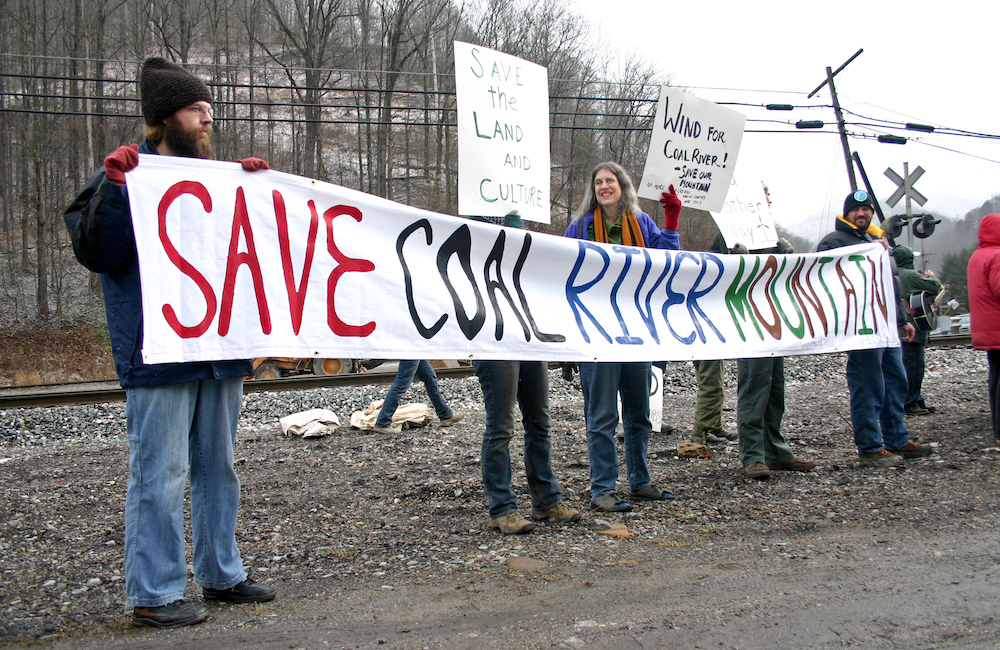
On February 3, 2009, members of the local community, regional citizens, and concerned environmentalists crossed the invisible line in two separate displays of non-violent protest. In the first, five people chained themselves to a bulldozer and an excavator near the mountaintop removal site on Coal River Mountain in the early morning hours. Beside them in the snow lay a large banner that said “Save Coal River Mountain,” and another one saying “Windmills, Not Toxic Spills” hung across the excavator beside a windmill prop. All five individuals, plus a videographer, were arrested, cited for misdemeanor trespassing, and released.

During the second event that same day, several dozen people from the region converged at the mine’s main gate, bearing signs and a letter intended for Massey Energy CEO Don Blankenship which insisted that Massey cease the mountaintop removal operation on Coal River Mountain. A representative of Marfork Coal Company, accompanied by state police, met the protesters at the line—in actuality a set of railroad tracks—and listened to Coal River resident Lorelei Scarbro read the letter intended for Blankenship. Scarbro and seven other protesters then stepped over the line and were arrested for misdemeanor trespassing. The violation carries a fine of up to $100.

Massey Energy company had no official reaction to the protests or to the blasting safety issue, but told the West Virginia Gazette that “if environmental groups think wind projects are such a good idea, they should buy land, obtain permits and build such projects themselves.”

According to Sergeant Michael Smith of the West Virginia State Police, “[The protesters] just wanted to voice their opinion. Some of them indicated to me that with the new president they felt like they could get a bigger voice in the public, and so that’s what they were doing. As long as they’re not violating any laws, they have the right to a peaceful protest. The tresspassing issue, we have to stop that immediately, it’s just breaking the law.”

“We hope this action will reach national media to bring attention to what’s happening in Appalachia,” said local resident Judy Bonds. “It’s going to take action from the federal government. It’s going to take national regulations and the Obama administration stepping in.”

“If Massey Energy wanted to do the right thing,” Bonds continued, “they would withdraw those permits and help us put the wind farm up.”

“We need to go with the better energy option, and that’s a wind farm, which is perfect for Coal River Mountain.” said Gary Anderson. “We could have a green energy future for the country, starting right here.”

Letters to the Editor

Thursday, February 5th, 2009 - posted by meghan

Appalachian Voice welcomes letters to the editor and comments on our website. We run as many letters as possible, space permitting. The views expressed in these letters, and in personal editor responses, are the opinions of the authors and are not necessarily the views of the organization Appalachian Voices. Write to editor@appvoices.org.

Mountaintop Removal – Flyover Is Worth 1000 Words
Dear sir,

I am writing to voice my say regarding banning mountaintop removal. I hope efforts are under way to get President-elect Obama to totally ban mountaintop removal. If it has not been done I suggest former V.P. Al Gore be contacted to get it done before the affected area becomes a total waste land – get Obama to fly over the area to see for himself the destruction that is being done – a picture is worth a 1000 words, especially a personal eye ball picture.
Thank you for you efforts to keep our mountains like God intended for them to be.

Sincerely,
John Ferrill
Lenoir, NC

An Inclusive and Diverse Future Appalachia
Dear Appalachian Voices,

I salute Dr. Jeff Boyer who wrote on the future of Appalachia in the last issue. Acknowledging that Appalachia is growing to be a very ethnically and racially diverse region, Dr. Boyer called for a broadening of the “Appalachia we” and for building a new, more inclusive “we.”

How fitting it would have been if the visionaries chosen to share their thoughts had reflected this growing diversity, this changing “we.” According to the Appalachian Regional Council (ARC), well over 3 million Appalachians are people of color and I would very much like to hear these voices share their vision of Appalachia’s future. I agree that we in Appalachia are at a tipping point. This is all the more reason to expand the circle of sharing, visioning and planning.

Thanks for all you do!
andrea van gunst

The Third Raping of Appalachia
Dear Editor:

This is in response to a letter to the editor by Gerry Grantham, Range Resources/Pine Mountain Gas and Oil out of Texas. While it is true that Southwest Virginia holds some of the purest gas reserves in the nation, Mr. Grantham is way off-target when writing of the benefits of natural gas to the residents of Appalachia.

Range Resources/Pine Mountain Gas and Oil are one of several companies that raced to Southwest Virginia to explore and produce natural gas because in this area the gas industry only has to pay $5 per acre to the land owner for a gas lease for five years (Dickenson County) and only $1 per acre for a lease for five years in Buchanan County. Also, the gas companies only have to give the land/gas owner a small royalty payment for their gas. Compared with $20,000 plus, per leased acre and up to 30% in royalties in other states, doing business in Southwestern Virginia is a very sweet deal.

The gas industry is not held to regular environmental protection standards as many other industries are. While clearing land to accommodate the well, holding tanks, pipelines, etc., the land is stripped bare and acres of hardwood trees are dozed down the mountainside to lie and rot. Supposedly the land owner would get a payment for his trees called a “destruction” payment; however, dozer operators place the trees in inaccessible areas so the land owner cannot get to them.

There exists no regard for ecosystems, roadways and waterways. At one gas well in Dickenson County, fifty thousand gallons of a solution called “BRINE” was spilled. Other gas wells had numerous spills. Again there was no fine or reprimand levied onto the offending gas company.

When a land/surface owner also owns the minerals (gas, oil, and coal) under his surface and does not wish to have the gas company trespass upon his land, the gas company that wants the gas under the land then goes to the Virginia Gas and Oil Board and asks the Board to issue a “forced pooling order.” The Board never disallows the request!

The owner is notified that he will be “force pooled” and there is nothing he can do about it. His right to negotiate a fair market price has been stripped from him. He gets pennies or nothing for his minerals.

When Mr. Grantham referred to environmental organizations such as Sierra Club endorsing the cleanest burning fossil fuel available, he was correct when speaking only about coal bed methane or conventional gas. What Mr. Grantham failed to mention was the despicable ways in which the people are treated by the gas companies.

Sierra Club representatives were here and witnessed the total destruction of mountaintops, ecosystems, waterways, roadways, and the demoralization of humanity by gas companies attempting to get at the vast rich reserves underground.

The people are poorer because of the rich gas finds in the area. They are exploited, lied to, cheated, deceived, and simply run over by gas companies.

There is a feeling of hopelessness and helplessness among the people. Eleven percent of the population of Dickenson and Buchanan counties have fled. Suicide rates have risen. When all you have left is a plot of land and that, too, is taken, what is left?

This is the largest “taking” in the history of the nation, endorsed and sanctioned by the Virginia legislature.

Juanita Sneeuwjagt
Clintwood, Va

Cumberland Park Fly Ash, Giles Virginia
Dear Editor,

The Cumberland Park Fly Ash Project, located on the 100-year flood plain of the New River in the town of Narrows, Giles County, Virginia is an environmental abomination. Here’s what this means.

Over 250,000 cubic yards of coal ash is being dumped right next to the New River. The heavy metals and toxins will leach out when rain, highway runoff, and other water comes in contact with the dump. At best, flooding will leach toxic heavy metals into the river and groundwater at some point in the future. At worst, the contamination will start to occur immediately.

American Electric Power (Appalachian Power Co.) and a not for profit school foundation created the project. Under state environmental regulations, this dump can avoid stricter permitting requirements otherwise required for hazardous waste sites (which require more protections and oversight) because a “beneficial end use” is proposed. The project presumes that the fly ash can be used safely as a construction material, and that, one day, some commercial enterprises would want to purchase the real estate on top of the dump. Proposed profits from this project are designated to go to the Giles County School Board to benefit the local schools. This begs the question of how future generations of children in Giles County will actually benefit when the project promises to pollute their community and endanger their wellbeing.

One might ask the Giles County School Board, since it is supposed to have significant oversight of the Foundation’s activities. When such questions were presented at numerous public meetings, the board apparently had no answers, since they’d never heard of the project, and claimed not to have any authority to do anything about it.

Though many may argue that if no laws are being violated, and the majority of elected local officials appear to have granted their tacit approval, and there is at least some payment for the hazards to which the community will be subjected, that there is no foul. This avoids some of the serious questions that surround the inception of this project. The first is that Howard Spencer, Executive Director of the Partnership for Excellence when the project was proposed and begun, was also the Chairman of the Giles County Board of Supervisors. He’s also the town manager and town clerk of Glen Lyn where the AEP-owned coal-fired plant is located, and which is the major employer of his constituency. This apparent conflict of interest was never addressed as the Board of Supervisors approved the project. No public input was ever sought. Indeed, by saying that the project has a beneficial end use, state regulations did not require any public discussion of the plan.

Because the community-at-large was completely by-passed in any discussion of the potentially disastrous effects of this project on Giles County, including the impact on future recreational tourism, the welfare of the citizens, contamination of the ground water table and the health of the New River in Virginia and West Virginia, a grass-roots resistance formed the Concerned Citizens of Giles County. www.concernedgilescitizens.org

Last year, the Concerned Citizens requested a court hearing to determine if the Cumberland Park Fly Ash project could legally be considered a public nuisance. A Special Grand Jury convened in Giles County and rendered a decision in favor of the project, claiming all regulations had been met. The grand jury, however, made its decision without hearing the testimony of the five citizens who filed the public nuisance law suit.

This did not stop the Concerned Citizens which has started the second phase of a three phase assault against the project.
The first phase began December 4, 2008 when we drilled our own water testing wells. We believe that when the results are in, we will be able to get regulatory bodies to protect us at last.

Phase Two involves an examination of county zoning ordinances which mandate public hearings for rezoning. If the project had been presented to the public for review as required by county ordinance it is doubtful that it would exist. As a guardian of the public trust, Howard Spencer had the ethical and moral duty to open this project to public review.

Phase Three concerns further legal action to stop fly ash dumping from the flood plain on the banks of the New River. The winds of change are blowing to Giles County from Washington, D.C., and the promise of a new and meaningful environmental policy will bring justice back to Giles County.

This is our home, and the New River is our heritage. It’s only a matter of time before the we stop the disastrous Cumberland Park Fly Ash Project.

James A. McGrath
Chair, Concerned Citizens of Giles County VA

How TVA Could Lead Utilities Into the Future

Thursday, February 5th, 2009 - posted by Anna

Story by Bill Kovark

Old fashioned utilities used to make money by selling electric power. In a bygone era, making money by NOT selling electric power seemed unthinkable.
A few weeks ago, Virginia Gov. Tim Kaine stood the old logic on its ear by saying that “it just makes no sense” not to conserve.

“Under current law, we guarantee a rate of return for a utility building a new coal plant, but not for investments that promote conservation,” Kaine said in a Jan. 14 State of the Commonwealth address.

As it turns out, Virginia is only catching up by recognizing this new reality for electric production. In most states, conservation services have already become a standard part of the utility business.

In contrast, conservation and renewable energy programs at TVA and most other utilities in the Appalachian region have been half-hearted at best. But doesn’t have to be that way, many people are insisting.

“TVA was born out of crippling economic times,” said Southern Alliance for Clean Energy chair Steven Smith. “As we find ourselves again in difficult times, this is an opportunity to remake TVA as an effective utility in the 21st century.”

TVA’s average electric rates are low. The agency’s 6.96 cents per kilowatt compares favorably with California’s average 11.8 cents per kilowatt. Yet, California consumers use 50 percent less electricity, in effect, paying less than TVA consumers for the same service, and with less pollution.

The difference in approaches between TVA and more progressive utilities involves the idea of making money from saving energy as well as producing it.

Most utilities offer at least some token conservation incentives to consumers. TVA offers residents of Sevier County, for example, $100 for buying an energy efficient water heater or loans for heat pumps. Still, it’s a far cry from, say, the $5,000 of rebates per residence available in Riverside CA, or the Burbank, CA green building incentive of up to $30,000. These rebates avoid new power cost, and the value of this avoided cost can be high.

Conservation is valuable

The cost of new power plants has gone up by about 70 percent in three years, according to a May 27, 2008 Wall Street Journal article, making the value of energy conservation all the greater.

The value of avoiding a kilowatt hour of production can vary from 5.3 cents to 15.7 cents, considering the cost of emissions control as well as a portion of the national security benefit of reducing oil use, according to Charles Gicchetti of the University of Southern California.

For example, the Natural Resources Defense Council estimated that the benefit of saving energy from Duke Power Company’s controversial new Cliffside power plant in North Carolina would be between 3 and 6.3 cents per kilowatt hour, considering the avoided cost minus the actual expense of conservation efforts.

In Virginia recently, a governor’s commission reported that energy conservation measures could reduce current electric consumption by at least 19 percent by 2025, even with adjustments for population growth.

“Our long-term planning should recognize that conservation is just as important an energy source as new construction,” Kaine said. “We should treat conservation investments at least as favorably as new generation investments, and my bill will do that.”

TVA has a small wind energy program, and voluntary purchases of green power are available at about 2.6 cents extra per kilowatt hour. But in 43 states, Renewable Portfolio Standards mandate that utilities will produce a portion of the state’s energy with wind, solar, biomass or other renewable energy sources.

Virginia and North Carolina both passed legislation last year requiring 12 percent of energy production from renewable sources by 2022.

TVA doesn’t need to wait for state legislation. As a federal agency, it has always been
expected to lead. Or, at the very least, it doesn’t need permission to follow.

“TVA must be a living laboratory, modeling a clean energy future heavily invested in energy efficiency, renewable energy and smart-grid technology,” Smith said in his Senate hearing testimony.

Coal Ash Cleanup Effort Comes in Phases

Thursday, February 5th, 2009 - posted by Anna

Story by Sarah Vig

“A clean-up can either be done right or it can be a ticking time bomb,” California Senator Barbara Boxer cautioned TVA CEO Tom Kilgore during the Environment and Public Works committee’s oversight hearing on the recent coal ash spill at the Kingston Fossil Plant near Harriman, TN.
In response, Kilgore promised a “first-rate job” of cleaning up the affected area. “It is not a time when we hold our heads high, but it is a time when we will look our neighbors in the eye and say ‘We will stay on the job until it’s finished. We are going to do this and do it right,’” Kilgore told the committee members.

A helicoptor drops a load of hay and hydroseed onto the ash near Swan Pond Circle in an attempt to prevent the ash from becoming airborne. Both ash recovery and temporary storage areas will have to be constructed before the ash can be removed from the Watts Bar Lake area. Photo by Jamie Goodman


At the time of the hearing—held on January 8—TVA’s plans for cleanup were still largely unformed. They were in the process of seeding the ash with hydroseed and hay dropped from helicopters in an attempt to prevent the ash from becoming airborne. They knew that the next step would be dredging the river, but due to the possibility of deep-lying radioactive sediment—historic pollution discharged from the Oak Ridge nuclear facility upstream—their dredging plans had to be approved by the Watts Bar Interagency Working Group. According to a Knoxville News report, the working group unanimously approved the plan, and it now awaits approval by the Tennessee Department of Environment and Conservation (TDEC) and the U.S. Army Corps of Engineers.

TVA’s proposal involves dredging the ash from the river channel using hydraulic dredges. The proposal includes pumping the material through a pipe to the onsite sluice channel, allowing it to dry, and then moving it to a temporary storage location onsite.

Gil Francis, a TVA spokesperson indicated that TVA would not be able to begin dredging until “four to six weeks after the permitting process is complete.” Their plan estimates March 2 as an “early start” date. Even after the plan is approved, both an ash recovery and a temporary ash storage area must be constructed. There is no timeline for the completion of dredging at this time.

Until the dredging begins, coal ash is being retained by a 615-foot underwater rock weir built on the Emory River, just north of the existing plant intake skimmer wall. The weir will allow water to continue flowing and retain the ash at the bottom of the river channel.

Feelings on the speed or effectiveness of TVA’s cleanup plan are mixed among area residents. Travis Cantrell, who was living on one of the river’s inlets before the spill, expressed some skepticism about the plans for the cove TVA had outlined in their correspondence with him. “They’re going to come in here [and] remove all the trees … they’re going to remove all the waste out of here and pretty much come through, level it off, bring rock and sand in and sod it,” Cantrell informed us. With appeal of lakefront property gone, Cantrell says he will be relocating.

Cantrell’s neighbor, Nancy Hall, however, is more optimistic, and will be staying put. “We feel like TVA is going to do it,” she said. According to Hall, TVA has been “excellent” about keeping in touch with them since the spill and keeping them informed.

TVA Spokesman Francis could not officially verify Cantrell’s statements regarding TVA’s plans for the coves, as each step of the clean-up process must be reviewed according to National Environmental Policy Act (NEPA) standards. NEPA requires an Environmental Impact Assessment for all federal agency actions. According to Francis, anything beyond the Phase I dredging is a “plan that obviously hasn’t been made yet.”

Opinion

Thursday, February 5th, 2009 - posted by meghan

Citizens and Advocates: The New Newsmakers

By Bill Kovarik and Sarah Vig
From the standpoint of public information, the TVA Fly Ash Disaster was unlike any other environmental disaster in recent history.

Immediately following the spill, TVA’s public relations department attempted to spin the catastrophic failure of an earthen dam holding back a billion gallons of wet coal fly ash as a “sudden, accidental release” of “inert material not harmful to the environment.” At the same time, they refused to release material safety data sheets to the public (including affected residents), and underestimated the amount of ash that had been “released” by a factor of three.

But soon after the spill, pictures from residents on the ground showing the immensity of the damage up close, and aerial shots from Southwings (a conservation aviation non-profit) flights showing the extent of the damage in hundreds of acres, kept the issue alive. Quick responses from environmental non-profits like United Mountain Defense and Appalachian Voices among others led to independent testing and analysis that showed elevated levels of toxic heavy metals long before the EPA released their results from the immediate spill area, weeks after the spill.

TVA was playing by the old rulebook, hoping that by stonewalling inquiries from the public and the media, watering down information, and waiting to release sensitive data, it might ease the sense of outrage. Unfortunately for them, new media such as blogs, e-mail listservs, Twitter and YouTube have blown open the older, narrower channels of information, allowing citizens and advocates the ability to quickly and effectively disperse personal narratives, photo and video documentation, and independent scientific data.

With this shift in how information is distributed comes a change in the way credibility is determined. An increasingly skeptical and discerning audience demands more than just the company line. Nevertheless, traditional media are still important. On the internet, there is no filter except search engines and no barriers to access except having use of a computer; however, though the amount of information available has no limit, the amount of information actually paid attention to is still finite. While the traditional media are no longer the only gatekeepers, it remains an important way to gain in credibility and readership, such as when The New York Times picked up the data from samples gathered by Appalachian Voices and Appalachian State University.

Arizona State University communications professor Don Gilmor noted recently that advocacy groups “are doing something infinitely closer to journalism than they ever have before.” Speaking at a Society of Environmental Journalists seminar,

Gilmor said he was “OK with advocates being a part of this ecosystem of the media…. I think advocates have a huge role to play in the future of journalism.” In some ways though it seems that advocates and citizens have had to step in to fill the void left by slashed investigative budgets at journalism institutions across the country, and as laudatory as it is that they have gained the skills required to do so credibly, it still raises the question of why though the media retain the title of gatekeeper, they have relinquished that of watchdog, and what stories have gone uncovered because of it.

TVA must clean house

Thursday, February 5th, 2009 - posted by meghan

Recent events clearly show the need for a clean sweep of TVA’s leadership.

It’s not just Tom Kilgore, the CEO of TVA, who needs to be held accountable. The nine-member board of directors, entirely appointed by the Bush Administration as part of an old-school, old boy network, is directly responsible for the tragic and disturbing atmosphere in the federal agency.

Until 2004, the TVA board consisted of three bipartisan presidential appointees. That governing structure was swept away in the conservative euphoria over the 2004 election, when conservatives packed the TVA board and had the word “bipartisan” dropped from its enabling legislation.

Today, two seats are open on the board and two more expire on May 18. Four new board members will not be enough to turn the agency around until 2010 when a fifth member term expires.
It is high time for Mr. Kilgore and the entire TVA board to take responsibility for the awful mess that has been created in the heart of the Tennessee Valley.

They should all immediately offer President Obama their resignations. It would be the only graceful note in this whole disgraceful mess.

United Mountain Defense: On the Front Lines at TVA Spill Site

Thursday, February 5th, 2009 - posted by Anna

Story by Sarah Vig

Call them the environmental movement’s equivalent of an emergency response team. Within only 14 hours of the dam failure at the Kingston Fossil Plant, United Mountain Defense mobilized. Having gained years of experience organizing and conducting water sampling in communities throughout Tennessee impacted by mountaintop removal mining, and with headquarters in nearby Knoxville, UMD was uniquely positioned to be on the ground at the disaster site and to get there fast.

United Mountain Defense volunteers arrived at the disaster site within 14 hours to find almost unimaginable destruction. Photo courtesy of United Mountain Defense.

The first thing UMD volunteers organized were door-to-door listening projects to determine the needs of the impacted community. There was an “overwhelming response that people liked to be listened to,” according to Bonnie Swinford, one of UMD’s lead organizers. Through these projects, the UMD volunteers found that people “knew very little about what was happening at the plant and what was in the fly ash,” Swinford said.

Following the listening projects, UMD began a number of efforts to address residents’ concerns. They printed and distributed copies of informational material, which helped elucidate what materials the fly ash contains, they also began distributing bottled water, collected water samples at a number of sites around the spill area, and organized the first community meeting on January 3, 2009. But that was just the beginning.

They are working now to train the residents themselves to take on the community organizing that UMD initiated following the spill. Matt Landon, a full-time volunteer staff person for UMD recounted giving a “documentation pep talk” to a resident who approached him with a concerning story following one of the meetings UMD helped organize. “If there’s any way you can get out there with a camera and just document what you’re seeing, that will be really important,” Landon told the man, who said he had seen a dump truck washing the coal ash off into the front yard of his relatives.

Matt Landon, a full-time volunteer for UMD is shown here taking ash samples to be tested, one of the many activities initiated by the TN-based grassroots group. Photo courtesy of United Mountain Defense.


In late January, a neighborhood group, the Tennessee Coal Ash Survivors Network (TCASN) formed to continue organizing impacted residents, ensuring accurate and continued air and water quality testing, and keeping the issue in regional and national newspapers.

Currently, one of UMD’s primary projects is ensuring accurate air quality monitoring is being conducted using the proper equipment. Landon and members of TCASN are training on how to construct and use low volume air monitors that are housed inside a five gallon plastic bucket (for more information go to www.bucketbrigade.net). Landon says the greatest challenge they have faced since coming to the area is “getting the regulators to take up their responsibility in holding TVA responsible to cleaning this disaster up in the best way.”

In some ways the TVA coal ash disaster has turned some residents into activists virtually overnight. What was once a “sleepy little community” has become an epi-center of the environmental justice movement, and its residents are “ready to debunk the myth of clean coal,” according to Swinford. UMD says its plans are to continue working with the residents of Roane County as long as they can. “We’ve made lots of relationships and friendships,” Swinford says. “This will just be one more coal impacted community that we will continue working in.”