Follow Us on Twitter: Appalachian Voices | iLoveMountains.org

Archive for the ‘2011 — Issue 5 (Oct/Nov)’ Category

By The Numbers

Wednesday, December 21st, 2011 - posted by brian

78%:

Voters nationwide who support the U.S. Environmental Protection Agency’s work to hold polluters accountable.

170:

Votes against environmental protection in the House of Representatives since the beginning of 2011

1,048.3 million:

Number of short tons of coal the U.S. consumed in 2010, the second-lowest consumption rate in a decade.

1995:

The last time coal productivity was lower than it is now. Productivity, measured as short tons per employee hour, fell to 5.57 tons.

2015:

Year when Central Appalachian coal production is expected to be 49 percent of 2008 levels because of decreased availability of coal.

59,059:

Number of Appalachian coal mining jobs in the third quarter of 2011, the highest number since 1997.

10%:

Increase in Appalachian mine jobs since the EPA issued a guidance on surface mining permits in Appalachia in April 2010

2.3%:

Effective corporate income tax rate utilities, gas and electricity industries paid in 2010
16: Number of major energy companies that paid no income tax in 2010

$87 million:

Amount of Dominion Resources’ Domestic Production Activities tax deduction between 2008 and 2010

1986:

Last time active, permitted coal mines had the capacity to produce as much coal as they do now.

1986:

Last time coal mines used as little of their production capacity as they do now.

Data from the Federal Reserve, Public Policy Polling, U.S. Energy Information Administration, Citizens for Tax Justice, Mine Safety and Health Administration

EPA Awards Grants to Seven Universities in the Southeast

The U.S. Environmental Protection Agency has awarded seven universities in the Southeast with the People, Prosperity and the Planet (P3) Phase I grants for the 2011-2012 academic year. Grant recipients will design solutions to sustainability challenges that improve quality of life, promote economic development and protect the environment.

Two Appalachian schools are among this year’s recipients — Appalachian State University and Vanderbilt University. Appalachian State is working to develop an artificial wetland suitable for recycling of graywater from small businesses for immediate reuse, and Vanderbilt University is creating a biohybrid solar panel that substitutes a protein from spinach for rare metals, and produces electrical energy.

For more information, visit epa.gov/P3/

WNC Forest Report Card Yields Mixed Results

A comprehensive report card on the state of Western North Carolina’s forests shows that while land protection and economic activity have improved, development continues to encroach on the states forested areas. The report was created through a collaboration between the Forest Service and the University of North Carolina at Asheville’s National Environmental Modeling and Analysis Center. The project began in 2008 and focuses on 18 counties in western North Carolina, covering 7,480 square miles or 4.8 million acres.

Among categories rated as “improving” are overall economic activity, indicating a steady growth in recreation, tourism and arts and crafts. Lands managed for conservation have also grown by about five percent since 2005, with nearly 60,000 acres preserved. Development and population growth are mentioned as increasing forest fragmentation and at-risk species.

The report, aimed at helping decision makers across the state, considers factors such as biodiversity, production, overall ecosystem health and how forests are affected by natural and man-made changes. Categories are rated as improving, stable, at risk, worsening, dynamic and uncertain.

The report card will be updated periodically at wncforestreportcard.org

EPA to Develop Natural Gas Wastewater Standards

On Oct. 20, the U.S. Environmental Protection Agency announced a schedule to develop standards for wastewater discharge produced by mining and drilling underground coalbed and shale formations. Currently no comprehensive set of national standards exists for the disposal of wastewater discharged from natural gas drilling.

As natural gas drilling increases across the nation and especially in the Marcellus Shale formation, the nation’s energy independence increases. But regulators see the lack of standards to regulate wastewater as a liability that can potentially harm the health of the air and water and that of communities where drilling takes place. Information reviewed by the EPA, including state-supplied wastewater sampling data, has documented elevated levels of pollutants entering surface waters as a result of leaks and inadequate treatment at water treatment plants.

The EPA will gather input on the proposed standard from of stakeholders including industry and public health groups. The agency will also solicit public comment and plans to announce a proposed rule for coalbed methane in 2013 and for shale gas in 2014.

The Solar Decathlon

Thursday, October 20th, 2011 - posted by brian

Students Build Tomorrow’s Homes Today

By Jeff Deal

Those weren’t spaceships on Washington D.C.’s National Mall in September — they were entries for this year’s U.S. Department of Energy Solar Decathlon.

Every two years, the competition challenges teams of college students to design, build and operate solar-powered homes that are affordable to build and maintain, energy-efficient and beautiful. The winner is the group with the highest combined score across 10 categories that evaluate the efficiency, sustainability and the livability of the students homes.

This year, two teams from Appalachia were invited to participate with just 18 other universities from around the world in the creation of these forward thinking homes.

Solar Homestead – Appalachian State University

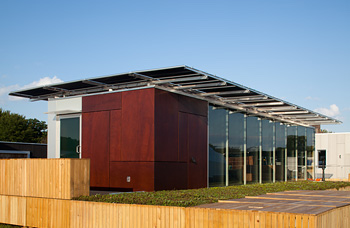
The 2011 Solar Decathlon People’s Choice Winner, Appalachian State University, has garnered a lot of attention recently. The student-led team’s modular creation, called the Solar Homestead, tied for first in the water heating competition, placed second in the communications category and third in the architecture contest.

Photo courtesy The Solar Homestead

The students’ housing concept was based on the traditional Appalachian homestead: a family, home, outbuildings and land functioning together to produce an independent livelihood.

ASU’s 21st century homestead features a solar energy collecting “trombe” wall in the main house that can absorb and radiate solar warmth in the winter but can be shielded from the sun during summer months, allowing the wall to absorb additional heat inside the dwelling.

Other green features include: roofing constructed from an 8.2 kW solar electric system capable of providing all electricity for the home; innovative dynamic modular construction allowing living space to be added or subtracted on demand; a cutting-edge phase-change solar water heating system; day-lighting galore; and a 900-square-foot, covered breezeway for outdoor living and “porch sitting.”

Living Light – University of Tennessee

Another team of Appalachian students also found a bright spot in this year’s Solar Decathlon. The University of Tennessee at Knoxville’s entry, Living Light, placed eighth overall in the competition and took third place honors in the engineering and appliance categories.

Photo courtesy Solar Decathalon

The home’s exceptional lighting engineering utilizes programmable blinds sandwiched between two panes of insulated glass to help passively heat the home in winter and cool it in summer. The same structure also provides rich day-lighting to the interior living space.

The Living Light home is powered by a 10.9 kW solar electric system comprised of easily installed cylindrical solar collectors that passively track the sun throughout the day while maintaining a lower operating temperature to increase electricity production. Air quality within the space is maintained by a high efficiency ventilation system that harvests heat from the air in colder months and cools inside air in hotter weather.

In the end, all entries in the 2011 Solar Decathlon brought unique design and vastly different innovative technology solutions to the table, proving an important point — that variety is an attainable spice of sustainable life.

If You Could Only See Them Now

If you didn’t make it to Washington, D.C., to see these “future-is-now” student home designs, you will still have a chance. ASU Chancellor Ken Peacock plans to permanently install the Solar Homestead on the Boone, N.C. campus, while the UT team will take Living Light on a state-wide tour of Tennessee.

Visit solardecathlon.gov to learn more about the 2011 contestants.

Other Tidbits

Wednesday, October 19th, 2011 - posted by Jamie G. -- AV Communications Coordinator

Rallying for Ison Rock Ridge

In southwestern Virginia, a mountain known as Ison Rock Ridge — along with several headwater streams — is slated for destruction to access the coal seams inside it. During October, Appalachian Voices, the Southern Appalachian Mountain Stewards and the Wise Energy for Virginia Coalition are hosting three major rallies to save Ison Rock Ridge. The first rally will be in Richmond, Va. on Oct. 17 and feature a funeral procession for mountains already lost. The following day, Oct. 18 a rally will be held at the Governor’s Energy Conference in Richmond. The third rally will be in front of the Environmental Protection Agency headquarters in Washington, D.C., on Nov. 16 at noon, to remind the EPA that the fate of Ison Rock Ridge and nearby communities is in their hands. Visit wiseenergyforvirginia.org for more information.

Appalachian Treasures on the Road Again

This fall, our Appalachian Treasures tour hit the road once more to educate citizens about mountaintop removal coal mining. In September, Appalachian Voices Field Organizer Austin Hall and W.Va. native Adam Hall (no relation), visited the great states of Ohio and Pennsylvania with our Appalachian Treasures slide show. During one week, the team talked with over 200 people from Rotary clubs, churches and civic meeting halls about the devastation caused by mountaintop removal coal mining.

Austin has been with Appalachian Voices for more than five years as one of our top-notch field coordinators. Adam is a veteran of the Iraq and Afghanistan wars. His family farm was destroyed by the Edwight Surface mine in Raleigh County, W.Va.

In mid-October, the Appalachian Treasures tour will head to Indiana and Illinois. Visit appvoices.org/apptreasures for details.

Becoming Wiser about Mountaintop Removal

In September, over twenty-five people from across Appalachia travelled to Wise County, Va., to visit with the Southern Appalachian Mountain Stewards (SAMS) for the fourth annual Weekend in Wise County. People came to see mountaintop removal coal mining, some for the first time, and to learn more about the difficult issues facing those who live in areas impacted by Appalachian coal production. The students, families and individuals who made the trek helped SAMS clean up nearly forgotten graveyards, tested water below strip mines and learned about the history and culture of southwestern Virginia. The schedule combined education, hands-on activities and merriment to encourage the attendants to help make a difference from their homes. Appalachian Voices provided support to SAMS in pulling the event together.

Campaign to Revoke Massey’s Corporate Charter Heats Up

Appalachian Voices recently traveled to Delaware to publically deliver over 35,000 petitions to that State Attorney General Beau Biden, who has the power to revoke coal-giant Massey Energy’s ability to conduct more bad business in Appalachia. Bobby Kennedy, Jr. also joined the campaign, as did residents of coal-bearing regions whose families are impacted by Massey’s disregard for workers and mountains. Massey Energy is now a subsidiary of Alpha Resources, but even with a name change they can’t hide from they damage they’ve caused. Learn more on our Front Porch Blog, and sign the petition at appvoices.org/revoke-massey-charter.

Higher Fines for Big Coal in Kentucky Clean Water Act Case

Wednesday, October 19th, 2011 - posted by Jamie G. -- AV Communications Coordinator

By Erin Savage

The Kentucky Energy and Environment Cabinet recently reached a settlement of $507,000, with Nally & Hamilton Enterprises, Inc., a mountaintop removal coal mining company in eastern Kentucky.
The fine tops previous record-setting fines issued in Appalachian Voices’ on-going case against Frasure Creek and ICG coal companies, $310,000 and $350,000, respectively. Appalachian Voices, Kentuckians for the Commonwealth, Kentucky Riverkeeper, Waterkeeper Alliance and the Natural Resources Defense Council are suing Nally & Hamilton for 12,000 violations of the Clean Water Act.

On Sept. 14, a conference was held for the Office of Administrative Hearing case between the cabinet and Nally & Hamilton to determine whether Appalachian Voices and its partners may continue with legal proceedings as intervenors in the case. The decision halted legal proceedings, including Appalachian Voices’ ability to request additional records from Nally & Hamilton and the cabinet.

The cabinet failed to respond to any previous discovery requests, before the recent conference. Without disclosure of relevant information, it cannot be determined whether the settlement is based on a thorough investigation or if it will remedy past and deter future violations.

Though the fines represent a major step toward holding coal companies accountable for their pollution, they are still insufficient. Under Kentucky law, Nally & Hamilton could be fined $300 million.

The settlement provides a low monetary penalty, ignores the potential of fraud, provides little deterrent for future violations and absolves Nally & Hamilton of liability for additional violations already committed.

The cabinet also failed to identify most of the violations uncovered by Appalachian Voices and did not include Appalachian Voices and its partners in the settlement negotiations. For these reasons, Appalachian Voices and its partners continue to pursue Clean Water Act justice as intervenors in this case.

Viewpoint

Friday, October 14th, 2011 - posted by brian

Please Don’t Trash the Outdoors

Dear Editor,

For my school service project, I picked up trash around the forest. I picked up trash at campsites and on the forest roads. I found a lot of things like beer cans, milk containers, soda bottles, food wrappings, and someone even threw away a broken camp chair. I pulled a lot of trash out of the river also. I filled four large bags in two hours! The places where I picked up trash were in the National Forest. Please do not litter because the forest is so beautiful. Don’t you want to keep the forest clean? When you come to the woods to camp or hike don’t you want to see a clean forest, a clean river, healthy fish, and beautiful flowers, NOT a trash dump? Throw your trash away in trash cans. Trash your trash, not the forest!

Skyler Williams, Age 7
Mountain Sun Community School, Brevard, N.C.

Putting Damaged Land to Good Use

Dear Editor,

I was reading an article recently about mountaintop removal (MTR) coal mining and got to thinking….

How many square miles have been cleared in Kentucky for MTR? And, if we covered all that space with photovoltaic (PV) solar panels, how much electricity in kilowatt-hours (kWh) would be produced?

According to the Appalachian Voices’ website, 574,000 acres (897 square miles) of land in Kentucky has been surface mined for coal and more than 293 mountains have been severely impacted or destroyed. According to the U.S. Department of Energy website, the total electricity consumption in Kentucky in 2005 was 89,351,000,000 kWh.

The following projection is based on experience from PV solar installations already in place here in Kentucky and from the fact that we get four and a half hours of sunlight per day on average, accounting for clouds. To produce that much electricity in one year, around 190 square miles of land would need to be covered by a 69.1 GW (gigawatt) solar array. Therefore, if we merely put PV solar panels on 1/5th of our already cleared land, we would supply ALL of the electricity needs for the entire Commonwealth of Kentucky!

If we covered the entire 897 square miles of cleared MTR space in Kentucky, we could supply nearly 10 percent of the electricity needs of the entire U.S.! Additionally, a total of 1,160,000 acres (1,813 square miles) of land has been surface mined for coal in the central and southern Appalachian region.

According to the Central Intelligence Agency website, the United States consumed a total of 3.873 trillion kWh of electricity in 2008. To produce that much electricity in one year from PV solar panels in this region, 8,225 square miles of land would need to be covered. Accordingly, roughly 22 percent of the electricity consumed in America could be provided by PV solar panels if the 1,813 square miles of land cleared by MTR in Appalachia were covered.

At this point, you’re probably asking yourself: that’s great, but how much would it cost? And, what about energy storage so we can use that electricity at night?
Projecting costs for a solar array of this size is pure conjecture, but I’ll do my best.

Currently, large scale, megawatt PV arrays cost around $3 per watt to install without tax subsidies. A GW scale solar array might be closer to $2 per watt. Using this metric, it would cost about $138 billion to install the 69.1 GW solar array required to produce 100 percent of the electricity consumed in Kentucky per year. If the solar panels have the industry standard 25-year warranty, the cost of electricity comes to 6.2 cents per kWh. That’s cheaper than what consumers in Kentucky pay for electricity right now (LG&E residential customers pay 7.9 cents/kWh).

There are many options available now for grid level energy storage, including, but not limited to: pumped hydro, compressed air energy storage (CAES), sodium-sulfur batteries, lead acid batteries, nickel-cadmium batteries, flywheels, and lithium ion batteries.

Empty, abandoned coal mines in Germany are being looked at for pumped hydro energy storage for renewable energy systems, something I would assume we have plenty of in Kentucky.
Adding energy storage could cost around $1 per watt to the solar array. This would increase the cost of the array for Kentucky to $207 billion with an electricity cost of around 9.3 cents per kWh. That price will soon be on par [with current consumer rates] as LG&E recently requested the Kentucky Public Service Commission to allow rates to increase by 19 percent over the next five years.

Again, the cost projection is all conjecture and does not include grid transmission and maintenance. But it’s a start.
This sounds like a lot of money until you consider that, according to a study by the Environmental Law Institute, the fossil fuel industry in the U.S. received $72 billion in subsidies from 2002 to 2008. Imagine using that money to fund a GW solar project in Kentucky!

Dan Hofmann
President, Regenensolar.com

The Business of Building Green

Friday, October 14th, 2011 - posted by brian

What’s good for the earth is good for the bottom line

By Molly Moore

When dentist Kendalyn Lutz-Craver decided it was time to move out of her leased, musty office and build her own structure, she had three building goals in mind. She didn’t want the building to be square, she wanted all patients to face a window, and she wanted to minimize her office’s environmental footprint.

Now Lutz-Craver and her Cornerstone Dental Associates staff practice in a graceful white stone building that is also the first building with Leadership in Energy and Environmental Design (LEED) certification in Cleveland County, N.C.. Architect Mark Patterson estimates that greening the building added just 5 percent to the overall tab, an investment he expects will be returned within five years because of increased efficiency.

Building green was cost-effective for Cornerstone Dental Associates. Photo by Nicole Mosley

Carolyn Dankowski, plant manager at PepsiCo’s Blue Ridge Gatorade facility, enjoyed the LEED process. Facility designers originally targeted LEED Silver but were pleasantly surprised to achieve Gold. Gatorade’s facility in Wytheville, Va., manufactures four products including Propel Fitness Water and Sobe Teas, a workload that requires heavy water use and heating and cooling massive quantities of liquid. Dankowski says energy-efficient water features, including state-of-the-art water heaters and coolers and a regeneration system that captures heat to reuse later, have taken a bite out of energy bills as well as saving 100 million gallons of water annually.

“We’re using 15 percent less gas, 30 percent less electricity, and 20 percent less water per gallon of Gatorade produced,” Dankowski says, using the plant’s favorite unit of measurement.

In addition to lowered energy bills, businesses are finding that green buildings bring not-so-obvious benefits. Mountain States Health Alliance — an Appalachian hospital system with 13 healthcare centers — will open their third LEED-certified facility in April. Franklin Woods Community Hospital in Johnson City, Tenn., their first green facility, includes among other features an emphasis on natural light, which according to Herbert is conducive to healing. ‘We hope that patients will enjoy their visits as much as possible and think of us when they’re choosing an elective surgery or having a baby,” says Ed Herbert, Vice President of Communications and Marketing at MSHA.

At Cornerstone Dental, Lutz-Craver gave every patient a window seat, a decision which also benefits her employees.

“I don’t have a staff member who doesn’t have a daylight view, [and] it really improves the day-to-day grind,” she says. Lutz-Craver says the building upgrade has translated into fewer allergies among her staff. And Herbert notes that MSHA’s employees enjoy the comfort of new cork floors.

“LEED is not just a recognition, it’s a great way to measure how much you’re helping the environment as you build,” Herbert says.

Of course, buildings can be ecologically responsible without a shiny LEED label. Mountain States Health Alliance appreciated the benefits of natural light at their new green hospitals so much that they have incorporated daylighting into renovations in older facilities.

Recycled renovations

Our Daily Bread's bar features four types of wood repurposed from an old homestead. Photo by Molly Moore

When Sam and Jennifer Parker, owners of Our Daily Bread delicatessen in Boone, N.C., wanted to update their restaurant, they found that unveiling the building’s historic features enhanced the space without requiring new materials. Underneath ugly acoustic tile, plaster and drywall they discovered original Italian ceiling tiles and brick walls.
The Parkers chose reclaimed barn wood for the restaurant’s tables and used Forest Steward Council-certified heart-of-pine wood to ensure that the cafe floor came from a responsibly-managed forest.

And their new, slip-resistant kitchen floor? It’s seamless, durable, fire-retardant and 100 percent recycled thermoplastic PVC, welded to fit the floor space and provide a bathtub-like splashguard at the base of the walls.

Sam Parker said that while the overall renovations to his restaurant were expensive, it didn’t cost much more to use sustainable materials. “You’ll find some [green building materials] that are pretty comparable and competitive in pricing,” he says.

Building budgets

In Chattanooga, Greenspaces co-director Anj McClain says people often assume that it costs 20 percent more to meet LEED standards. In reality, however, it costs a mere two to five percent more to use sustainable materials and construction practices.

Official certification, however, can add significantly to a project’s cost — Lutz-Craver paid a hefty fee for a LEED consultant on her building. That’s why groups like the Chattanooga nonprofit Greenspaces provides incentive funding to help commercial projects cover administrative costs of LEED construction.

About half of the projects Greenspaces is involved with are renovations and half are new construction.

“We encourage reusing a building,” McClain says. “It’s really the greenest thing you can do.”

How Architecture Can Lead to Energy Efficiency

“Maximize passive qualities. Use deciduous trees on the side so you have their leaves in summer and light in winter. Let things work without technological fixes.” — Luke W. Perry, Adjunct Instructor, Appalachian State University Department of Technology and Environmental Design, N.C.

“By performing. There is no better advocate than a building that actively demonstrates its performance, such as lower utility costs or harnessing energy and water.” — D. Craig Rushing, Architect/ Builder/ LEED AP, Lexington, Ky.

“Design a building that optimizes daylight and reduces the need for artificial lighting. That reduces energy bills.” — Anj McClain Co-Director, Greenspaces, Chattanooga, Tenn.

“Roof overhangs or window-shading devices on south facing windows can reduce ventilation and air conditioning loads during the summer and decrease heating loads during the winter. ” — Brian Bumann, LEED AP, The FWA Group, Charlotte N.C., Chair of the USGBC Southeast Regional Committee

“We can design responsibly by specifying materials that require less energy to produce, use, and reuse.” — Oscar E. Sorcia, American Institute of Architecture Students member, a Junior at Appalachian State University

Congregations Put Faith in Solar Power

Friday, October 14th, 2011 - posted by brian

By Brian Sewell

On a sunny day in April at the First Congregational United Church of Christ in Asheville, N.C., the Reverend Joe Hoffman welcomed his congregation with an unusual liturgy. “Today we celebrate a particular act of faith with the dedication of solar panels on our roof,” he announced from the pulpit.

The event, dubbed a “Solarbration,” marked the completion of a collaborative project between The Appalachian Institute for Renewable Energy, North Carolina Interfaith Power & Light and Sundance Power Systems of Asheville, that installed a 10 kilowatt system of 42 solar panels,

Across the country, groups like Interfaith Power & Light are working with communities of faith, recruiting them to a common cause to help reduce their carbon footprint. As the price of solar falls and its popularity grows, more and more congregations are putting faith in solar power.

“We want to communicate to people that it is the business of the faith community to care for the environment,” Hoffman says. “That is what it means to be a person of faith.”
For nearly five years, Hoffman nurtured an interest in installing solar panels on the roof of the church’s education building.

“When we moved into our new space, we had the perfect roof for solar panels,” Hoffman says of the building that is attached to the gothic-style cathedral recently purchased by the United Church of Christ.

Hoffman wasn’t alone in his mission. The Boone, N.C.-based organization The Appalachian Institute for Renewable Energy (AIRE), partnered with N.C. Interfaith Power & Light’s outreach coordinator, Richard Fireman, to develop and promote an innovative solar finance model in which congregations create a limited liability company. “When Richard started coming to see me about five years ago, he was looking for a church to take the lead and to show that we care about the sources of energy we use and how they effect the environment,” Hoffman says.

“Churches are very stable organizations,” Fireman says. “Investing in a solar array on a church is different than any other business that could shut down.”

When the state’s Renewable Energy Portfolio Standard passed in 2007 and allowed individuals who donated to renewable energy projects to receive renewable energy credits or “RECs,” Fireman and Hoffman hit the ground running to create a solar project for the United Church of Christ.

The United Church of Christ was the first congregation to use AIRE’s innovative solar finance model. Working with nine investors, AIRE helped the church organize “First Church Solar, LLC” to raise the capital investment for the project. Fireman says the new company envisions donating the system to the church in about six years, depending on the price of electricity and other elements in the marketplace, at which point many of the investors will have made their money back, and some a little extra.

“In this model, since the LLC owns the system, the church doesn’t directly benefit from decreased power bills,” says Fireman. “But the church receives community goodwill, understanding that the congregation is now supplying green energy and they’re seen as a model for caring for creation.”

The United Church of Christ’s solar array is connected to the grid while First Church Solar LLC sell the RECs to Progress Energy and receive tax credits. The investors in the LLC pay a small amount to lease the church’s roof space.

“In six years, once the church owns the system and depending on the price of electricity and other elements in the marketplace, the church may decide to net-meter and use the electricity itself,” Fireman says.

While continuing to develop the AIRE model, Fireman is working on a clearinghouse document to describe the three finance models and exhibit congregations who’ve been successful in completing renewable energy projects.

Churches that have adopted solar like the United Church Christ are also doing their part to spread the good word. “We continue to tell our story and how we accomplished this in an inexpensive way and remind others that our faith tradition supports caring for the earth and using resources wisely,” Hoffman says.

As the “Solarbration” concluded, the modern additions to the stone cathedral gathered the sun’s energy. Squinting into the light, the congregation responded: “Take these solar panels and through them shine the light of Your way into our hearts and minds. Amen.”

Finance Models for Renewable Energy

The Donor Model:

In this model, individual donations allow congregations to own the system outright and benefit from the electricity. Donors receive a 35 percent N.C. state tax credit and a tax deduction on their federal return for a charitable donation.
• Myers Park Church in Charlotte
• Temple Emmanuel, Greensboro

AIRE Model, Create an LLC:

In the model used by the First Congregational United Church of Christ Asheville, the investors in the LLC own the system and benefit from the tax credits, depreciation and revenue from selling the electricity and Renewable Energy Credits. After a period of six or seven years, depending on price of electricity and other elements of the marketplace, the LLC donates the system to the congregation.
• United Church of Christ
• Other Projects in the works: First Lutheran Church Albemarle, Elon Community Church

Third-party Payer Power Purchase Agreement:

Investors install an array and make an arrangement with the church to sell electricity at a specified rate. Investors benefit from the depreciation, tax incentives and sale of electricity. This model is not used for solar electric in N.C. because only Duke and Progress Energy can sell electricity. However, First Light Solar in Asheville developed a similar Solar Energy Purchase Agreement model, selling BTUS and Therms, since hot water is not regulated by the Utilities Commission.
• Montreat Conference Center

Making Your Home More Sustainable

Friday, October 14th, 2011 - posted by brian

Stories by Meg Holden, Molly Moore, David Pferdekamper and Jillian Randel

In sustainable building and remodeling, terms like “conservation” and “efficiency” are thrown around a lot. But how does the difference between efficiency and conservation affect the sustainability of your home?

Simply put, conservation is using less of a resource. Efficiency is using the same amount of that resource to get a higher output. Think of it in terms of water. Not running the sink while you brush your teeth is an example of conservation. Collecting your dishwashing water and using it to flush your toilet — using the same water twice for different uses — is efficiency.

Conservation and efficiency are both important to consider in sustainable building, but neither one is necessarily better than the other. It all comes down to your sustainable building goals and practices. What matters is using your budget, time limits and space constraints to create a more environmentally responsible home.

On the Web: Tax Incentives, Credits and Rebates

City and state utility rebates on toilets, faucets and shower heads: epa.gov/WaterSense

2011 federal tax credits and incentives on items such as solar energy systems, biomass stoves, geothermal heat pipes, insulation, roofs, small wind turbines and more: energystar.gov

Residential energy efficiency tax credits for items such as insulation, doors, windows and heating systems: dsireusa.org

Doing-It-Yourself Workshops

Transition Initiatives is a great way to get involved in do-it-yourself energy efficiency activities. They host workshops for free or nominal prices and neighbors often work together to complete projects. Find an initiative near your community at transitionus.org.

The North Carolina Wind Energy program at Appalachian State offers a variety of energy efficiency home-improvement workshops. Visit wind.appstate.edu.

Warren Wilson College in Black Mountain, N.C., is a hub for green campus initiatives and the school offers a variety of year-round energy efficiency projects for homeowners: warrenwilson.edu

Getting Green Machines

According to the U.S. Department of Energy, lighting, refrigeration, and cooking are responsible for over 40 percent of a home’s energy use. If you add in a washer and dryer and other large appliances — well, it’s a good thing many new appliances help conserve more energy than ever. But what should you look for in a new appliance to make sure it’s as green as possible?

The most important element is energy use. Products with an Energy Star sticker are at least 20 percent more energy-efficient than the national standard and have performance consistent with consumer expectations. Some appliances even go above and beyond Energy Star specifications. Many Bosch appliances have a “Sabbath Mode,” a feature that enables an oven to keep pre-cooked foods hot for extended periods — such as the Jewish Sabbath — without being actively on.

An appliance’s size plays a huge role in how much energy it uses. Compact washing machines use much less water than full-sized machines and are perfect for those who live alone or just don’t wash their clothes often. By using more energy-efficient appliances, thousands of people have shrunk their carbon footprint. Follow their example, and yours will shrink, too.

Start Conserving and Stop Flushing Your Money Away

Remember the explanation of conservation versus efficiency? Buying low-flow shower heads and toilets and an aerator for the sink can save thousands of gallons of water each year. According to National Geographic, a seven-minute shower with a low-flow shower head uses only 14 gallons of water. New, water-conserving dishwashers are also eco-friendly alternatives to old water wasters.

In the kitchen, many appliances combine energy efficiency and conservation. To prevent heat loss, induction cooktop stoves use electromagnetic energy to disperse heat throughout the pan rather than just through the bottom.

And finally, the ultimate efficient appliance: The one you don’t have. Going without a microwave, coffee maker, dryer or other appliance is more space- and energy-efficient than using one. Plus, it’s free.

Getting Rid of Old Appliances

What should you do with those energy hogs after replacing them with their more efficient cousins? Don’t drop them off at the dump — put it back to work! Goodwill and other thrift stores often take old appliances as long as they are in working condition.

Even broken appliances are worth something. Someone might be interested in your old dryer for parts, an art project or to repair it themselves. Check with your local landfill or visit recycle-steel.org to learn how to recycle appliances in your area.

Weatherization Helps Low-income Families Save Money

WAMY Community Action Network, based in Boone, N.C., has a program designed to help low-income families save on their energy bills. Their Weatherization Assistance and Heating Appliance Repair and Replacement programs, like similar programs around the country, help families replace insulation, heating and air conditioning systems, apply caulking and weather stripping to windows and doors, tune-up water heaters and assess efficiency of home energy appliances. The U.S. Department of Energy estimates that weatherization reduces heating bills by 31 percent and overall household energy bills by $358 per year.

To find a program like WAMY in your county, visit the National Community Action Foundation website, ncaf.org or call 202.842.2092.

Improving your Prefab’s Performance

By Molly Moore

Mobile homes typically use more energy per square foot than their conventional counterparts. But because these manufactured homes are often built similarly, energy-efficiency retrofits are just as attainable.

Jackie Rader is Weatherization Coordinator for Coalfield Community Action, one of thirteen West Virginia community-action agencies working to increase efficiency and lower energy bills for low-income residents. Of the 434 homes her agency has weatherized, 200 are mobile homes.

According to Rader, the most common weaknesses are the sub-floor insulation and bellyboard. Bellyboards are strong tarps that keep insulation wrapped tightly to the heating ductwork beneath a mobile home. Some older mobile homes lack bellyboards altogether, and others are torn by rodents. Once a bellyboard is compromised, insulation begins to fall out. Eventually, the heating system can be breached and the ductwork itself can fall.

Rader’s team is trained to work on bellyboards and insulation, but some homeowners are capable of doing these repairs themselves. She cautions that this work needs to be done carefully, however; insufficient insulation around the ductwork will cause condensation to build up within the structure and lead to future problems.

Some steps concerned residents can take to control air leaks include weatherstripping around doors, sealing mobile home windows with window clips (available at most hardware stores), and closing gaps around pipe entry points with foam sealant. Dryer vents should be securely attached and operate completely outside of the home to prevent moisture buildup.

Federally-funded weatherization agencies such as Coalfield Community Action offer free weatherization services to qualifying low-income residents. On average, homeowners see their energy usage drop by about 25 percent.

Johnny Scores a Royal Flush

By Jillian Randel

According to the U.S. Environmental Protection Agency, toilets account for nearly 30 percent of an average home’s indoor water consumption, which makes them the biggest culprit of a homeowner’s water usage. There are many options when shopping for eco-friendly toilets. But it is also possible to keep things simple and make a toilet at home, like Foscoe, N.C. resident Cory Alexander Kornegay did with his sawdust composting toilet.

“To make our toilet we took a five gallon bucket and built three pieces of wood around it and added a toilet seat on top,” says Kornegay.

Kornegay recommends The Humanure Handbook by Joseph Jenkins as a reference. The book details the science behind composting human waste and includes a guide to building your own composting toilet.

“The key is to rotate out the buckets,” explains Kornegay. “Dump them onto your compost pile over the course of a year. Every time you dump it, cover it up with straw or more sawdust. After the compost pile sits for another year, it is ready to use as humanure.”

For homeowners who are not quite ready to take the extreme toilet approach, there are plenty of other options available on the market. Low-flush toilet models boast a water-usage as low as 1.25 gallons per flush (compared to 3.5 gallons per flush or more on older models). New low-flush toilet prices range from $196 to $264.

Dual flush toilets, used widely in Europe, are designed with two flush options — one for solid waste and one for liquid waste. They save up to 67 percent more water than an average toilet. Prices start at $219.

For homeowners who want to go green but are worried about costs, low-priced conversion kits are available. A dual flush retrofit conversion kit can be purchased for as low as $40.

Many local utility companies offer rebates and vouchers for water-related appliances — an added bonus for consumers. Low-flow shower heads, energy efficient washing machines, dishwashers and low-flow sink appliances are all available with tax incentives.

Whether you are ready to start composting or invest in a low-flush toilet, there are plenty of options. Below is a list of websites to help make your shopping experience a bit cheaper, or visit www.humanurehandbook.com to start building your own toilet now.

Take a Sunshower!

Few hygiene routines are as refreshing as watching butterflies flit by while you scrub yourself under the summer sun. Solar showers can be as simple or complex as your bathing fantasies, and plenty of designs and prefabricated options are available online. But you can construct the most basic models with little more than scrap wood, household tools, a black trash can, a garden hose, and a nozzle with a “shower” setting. Consider that routing a shower’s drainage toward a garden patch waters the plants every time you bathe, and you might find yourself more motivated to get clean.

Ghostly Legends Rooted in History

Friday, October 14th, 2011 - posted by brian

By Molly Moore

As fall creeps into Appalachia, a smoky fog drifts through the hollows and wraps trees and church steeples in a ghostly haze. At this time of year, it’s wise to pay attention to the human stories buried in the region’s historical towns and landmarks.

Elizabethton, Tenn., one of the earliest permanent settlements west of the Appalachian Mountains, possesses haunted tales tied to the town’s distinguished history. The first independent government formed by settlers in North America, the Watauga Association, resided in Elizabethton. In 1772, thirteen men assembled beneath a landmark sycamore tree and held the first court of the fledgling government under its branches. Though the tree succumbed to disease and age, its stump still stands beside an old covered bridge.

“Stories circulate in the area where that tree was,” says Elizabethton storyteller Chad Bogart. “People have seen the tree and 13 men under the tree deliberating.”

Bogart and the other two members of the Front Porch Storytellers will guide Elizabethton’s Historic Ghost Walk, an event held in conjunction with the town’s Fall Fling Festival. Since the Front Porch Storytellers began their walking tours of Elizabethton in 2005, they have woven ghostly legends into their historical journeys.

The Front Porch Storytellers aren’t the only chroniclers of southern Appalachia’s ghostly tales. Joe Tennis, author of six books including Marble and Other Ghost Tales of Tennessee, Virginia and Haunts of Virginia’s Blue Ridge Highlands and a freelance writer for The Appalachian Voice, has written about Elizabethton’s haunted Carter Mansion.

“This is a story largely rooted in history and tells of a little girl who might be seen in the window of the historic Carter Mansion home,” Tennis says. “I actually am just as interested — or more — in the history of the home and Elizabethton and Carter County. I like stories that, even if you took out the ghost element, there was still a good story.”

As Tennis delved into southwest Virginia’s past for a historical guidebook, he unearthed otherworldly legends associated with locally-known locations such as Honaker High School, Mountain Lake Hotel and the Virgina Creeper Trail.

While Tennis was originally skeptical of the haunted rumors he heard, further investigation convinced him of the truth behind some of the tales.

“I tried to play devil’s advocate everywhere I went,” Tennis said. In his interviews, he isolated community members and tested their stories with probing questions. Yet, time after time, different people recounted similar happenings.

But sometimes local legends prove more fascinating than the actual hauntings. Tennis recounts the story of Christiansburg Middle School, a contemporary building constructed on the foundation of an all-girls academy that was torn down in the 1930s. Generations have shared sightings of ghostly 19th century women on the property — clicking heels, creaking doors and pale faces in the windows. Even more frightening, however, are the stories of murdered family members, burned homes and graveyard chanting that encircle three women who attended the girls’ academy.

Whether it’s history or haint — the mountain word for ghost — elements of mystery tie many regional spots to the past.

“If there is no such thing as ghosts, how did all of this start?” Tennis asks.

Haunted Walking Tours

Haunted History Walk, Summersville, W.Va. — Oct. 29 at 8 p.m. $10/adult, kids 10 and under free with adult. Visit www.hauntedhistory.net or call (330) 412-6114.

Appalachian Ghost Walk, Abingdon, Va. and other locations — Nightly, start times vary. Varies from $13-$30 depending on group size, kids 5 and under free. Visit www.appalachianghostwalks.com or call (423) 743-9255.

Elizabethton Historic Ghost Walks, Meet at Bonnie Kate Theatre Elizabethton, Tenn. — Oct. 22 at 10 a.m. and noon. $12/person for ages 12 and up. Call (423) 542-9360 or email
fpstorytellers@hotmail.com

Haunted Asheville’s Classic Ghost Experience walking tour, Asheville, N.C. — Nightly based on reservation. Cost: $20/adults, $15 age 14 and under. Call (828) 335-6764 or (828) 398-4678.

Gatlinburg Ghost & Haunt Tour, Gatlinburg, Tenn. — Nightly at 9 p.m. through Oct. 31; Nov. 1-31 Fri. & Sat. at 7 p.m.; Dec. 26-31 nightly at 7 p.m. $18/adults, $10 kids 8-14, 7 & under free. Visit www.gatlinburgghosts.com or call (865) 366-5834.

Shooting Our Ecological Footprint: Appalachian Mountain Photo Competition Taking Submissions

Friday, October 14th, 2011 - posted by brian

By Molly Moore

Laura Varney-Watts, "Turk's Cap"

Beauty isn’t limited to blue skies. Sometimes a photograph captures the resilience of a besieged hemlock or the bleak gray of a mountaintop removal site and reveals beauty in the midst of ecological turmoil.

With that in mind, Appalachian Voices is again sponsoring the Our Ecological Footprint category of the ninth annual Appalachian Mountain Photography Competition. This year, Mast General Store joined Appalachian Voices in sponsoring this category. As a result, the winner’s prize for Our Ecological Footprint submissions is now $500.

“The Our Ecological Footprint category encourages photographers to document threats to Appalachian ecosystems,” says Willa Mays, executive director of Appalachian Voices. “As a society, we have had a visible effect on the landscape.”

Though only photographers have a shot at the prize money, the competition is as much about the public as it is about the artists. Selected works will be displayed at the Turchin Center for the Visual Arts in Boone, N.C., and the public will have nearly two months to view the exhibit and cast their votes for the annual People’s Choice award next February.

Other award categories include: Best in Show; Blue Ridge Parkway; People’s Choice; Culture; Adventure; Flora and Fauna, and Landscape. All submissions are due by 5 p.m. Nov. 18.

Dale King, "Golden Sunrise"

The photography competition is a partnership between Appalachian State University Outdoor Programs, Turchin Center for the Visual Arts, and the Blue Ridge Parkway Foundation. AMPC is made possible through the sponsorship of Boone-area businesses, particularly Virtual Blue Ridge and Mast General Store. Other contributors to AMPC’s $4,000 prize pool include the Blue Ridge Parkway Foundation, Footsloggers Outdoor and Travel Outfitters, and Appalachian Voices.

Since it began in 2002, the competition has grown in size and prestige. Last year, there were 600 submissions, and the exhibit was viewed in person by more than 10,000 people at the Turchin Center for Visual Arts.