Follow Us on Twitter: Appalachian Voices | iLoveMountains.org

Archive for December, 2010

Health Fairs & Clinics: Neighbors Healing Neighbors

Monday, December 6th, 2010 - posted by jillian

Story by Jeff Deal

While the U.S. Congress wrestled with the question of uninsured Americans, many Appalachian residents were without health insurance in 2008 and 2009.

According to the U.S. Census Bureau’s Current Population Survey, the number of insured residents in the region ranges between one out of every five people in Georgia to one out of eight in Virginia, compared to a national average of one out of six. Growing concern regarding access to substantive health care is mounting.

To address the limited access to affordable healthcare, health professionals have united with local communities to address the shortfall of medical services within their communities at free health fairs and clinics around the region. Doctors, nurses and other providers team up with volunteers to donate their medical expertise to those lacking these critical services.

Wise, Va.,— lying in the southwestern corner of the state—hosted a 2010 Remote Area Medical Volunteer Corp “RAM” clinic in July. In just two and a half days, the confederation of volunteer community members and professionals met with more than 1,250 patients seeking treatment for ailments ranging from depression to pulmonary disease in the improvised examining rooms of the county’s fairgrounds.

Wise will once again offer this service when they hold the 11th annual health clinic July 22 – 24, 2011. Volunteers seeking to assist with the fair may submit their applications in April, 2011.

Grundy, Va.,—an hour and half northeast of Wise—is also the site of a yearly RAM clinic, taking place each October. According to RAM, his year’s Grundy clinic treated 766 patients an estimated $89,000 worth of medical care in just two days.

“Volunteering with RAM was a powerful experience that helped me decide to go to medical school,” says Patricia Feeney, a student at the Virginia College of Osteopathic Medicine in Blacksburg, Va., who volunteered at a Union, Tenn., RAM event last year. “We need more accessible and affordable long term care in Appalachia, and while we work for that, RAM gives us all a way to reach out to our neighbors and help meet immediate needs.”

Tennesseans in need of health services had opportunities to attend RAM clinics in Oneida, Knoxville, Nashville, Pigeon Forge, and Clinton; these sites will once again offer clinics during 2011.

RAM accepts all volunteers, in addition to physicians and health care professionals. RAM clinics provide eye exams, prescription eye glasses, and dental care, as well as primary care visits. For more information on the Remote Area Medical Volunteer Corp, visit: ramusa.org or call 1-877-5RAM-USA.

For a comprehensive step-by-step guide to available health insurance options by state, as well as an explanation of the health care reform legislation enacted by the U.S. Congress, visit healthcare.gov

______________________

Clinics Around the Region

In addition to the volunteer medical clinics organized by RAM, other free and/or accessible clinics offer health care for Appalachian residents in need.

The West Virginia Association of Free Clinics offers medical services at 13 sites throughout the state (www.wvafc.org or call 304-414-5941).

Fifty-nine member clinics, spread over the state, make up The Virginia Association of Free Clinics (www.vafreeclinics.org or call 804-340-3434).

North Carolina also has an Association of Free Clinics (www.ncfreeclinics.org or call 336-251-1111).

Residents without health insurance in Kentucky may contact Health Kentucky to gain information regarding health care opportunities in their area (www.healthkentucky.org or call 1-800-633-8100).
_______________________

Community Caregivers

A number of organizations are working to combat health disparities and improve the physical and emotional well-being of people in Appalachia. From public universities to statewide nonprofits to community clinics, there are programs throughout the region that provide medical care to the uninsured, advocate for healthcare legislation and educate children about the importance of healthy behaviors.

Appalachia Community Cancer Network is an initiative funded by the National Caner Institute aimed at reducing cancer disparities in the region through community participation in education, research, and training.

They focus on the prevention and early detection of cervical, lung and colorectal cancers, all of which have high incidence rates in the region. Based at the University of Kentucky, ACCN serves the northern and central Appalachian regions. www.accnweb.com

Health Kentucky works with a statewide network of volunteer health care providers, dentists, pharmacies, and pharmaceutical companies to provide free health care and medication to uninsured residents of Kentucky. Since 1984, they have provided free health care to more than 300,000 patients Visit: www.healthkentucky.org

Appalachian Regional Healthcare operates a system of hospitals in eastern Kentucky and southwestern Virginia. In 2010 they were named an Outstanding Rural Health Organization by the National Rural Health Association. www.arh.org

Healthy Appalachia Institute – part of UVa-Wise – provides policy makers, healthcare workers, educators and community members the necessary tools, resources, ideas and strategies to foster a healthy population. They provide community based research opportunities, service learning and health education. www.healthyappalachia.org

The Center for Rural Health Development Inc. provides leadership on rural health issues in West Virginia. They work with community health centers, hospitals, private physicians and dentists to improve the health of WV residents. They also work with banks to provide financing for healthcare providers strengthening rural health infrastructure. Visit: www.wvruralhealth.org

Rural Health Association of Tennessee advocates and educates on rural health issues including substance abuse, mental health, health professional education, disease prevention, oral health and emergency preparedness. Visit: www.rhat.org

Health Report

Monday, December 6th, 2010 - posted by jillian

An End-of-the-Decade Checkup on the Wellbeing of Our Region

Story by Parker Stevens and Jeff Deal

How much money would you take in exchange for 40 years of your life? $1 million? $1 billion? Would any sum of money be sufficient to replace the years with your family and friends, the laughter and the love we all hope to share? In Appalachia, there is an alarming trend of lower life expectancy and higher disease rate than in most other parts of the country. Poverty, lack of education, a spotty regional medical infrastructure and polluting industry are all contributors to the numbers that are stacking up against us. The real question is, how do we reverse the trend?

It’s often remarked that if you have your health, you’ve got everything. As I watched my grandmother die of bone cancer at 63 years of age, I realized just how profound, for me, this cliché is.

When you think of the ancient rolling green tree clad mountains that form the backbone of the Eastern seaboard, what do you imagine? Most find Appalachia a premiere vacation destination, a land of flora, fauna and four distinct seasons—a landscape of near indescribable loveliness, where one can relax, “get away” and “breath easy” while fishing a trout stream, swimming in a hole, hiking to a waterfall or daydreaming lazily under the lone tree of a serene mountain pasture.

It is ironic to consider the health challenges faced by many living in or near this most enchanted natural wonder.

Poverty and poor health have long plagued Appalachia. Quality of health concerns in the region have been influenced by issues of prosperity, education, physical landscape, culture, history, medical infrastructure, health insurance, occupation and daily behaviors.

The Appalachian Regional Commission (ARC) classifies one in four Appalachian counties as “high poverty.” Per capita income in Appalachia consistently falls below the national average. Impoverished residents in the region have a life expectancy equal to that of Panama and Mexico. A report released by the ARC indicates that people living in poverty and without health insurance are more likely to die prematurely, particularly from cancer or cardiovascular disease, than people with higher incomes.

Exposure to harmful substances in coal mines, chemical factories, and agriculture—common occupations in the region—can also prove damaging to the health of an individual.

A study published in the Californian Journal of Health Promotion found that, on a cultural level, there is a general sentiment of mistrust among Appalachian people with respect to health care professionals.

According to the study, some residents fear being taken advantage of or exploited by the health care system—or being unfairly, or unjustly, stereotyped. Many Appalachians are reluctant or lack the time and means to participate in preventive screenings—such as mammograms—without showing acute symptoms of an illness.

Geography also isolates Appalachian communities from urban ones, where health care resources are more abundant. According to the ARC, nearly half of all rural Appalachian counties are designated as health professional shortage areas.

Wayne Myers, founder of the University of Kentucky Center for Rural Health, says that there is a lack of municipal hospitals and community clinics in the region. “Most rural counties don’t have community health centers,” Myers says. “Only two or three Appalachian counties have academic medical centers or a teaching hospital.”

The shortage of doctors is particularly difficult for Medicaid patients, as many doctors will not accept Medicaid due to low reimbursement rates. Patients often have to travel long distances to larger cities and urban areas in order to seek treatment covered by Medicaid.

Education improvements do provide access to jobs that raise families and communities above poverty and illness, but must develop apace with other economic opportunities—or the newly educated leave for greener pastures.

With the betterment of health care access and public campaigns encouraging healthy lifestyles, Appalachian communities can gain prosperity, good health, and well-being.

A recent study by Dr. Michael Hendryx and other researchers at the West Virginia Rural Health Research Center found that rural areas in Appalachia have more exposure to agriculture-related pollution than urban and metropolitan areas.

The study also found a significant correlation between areas with water pollution and both cancer and total death rates. In addition, sites within these rural regions that are monitored as air pollution sources “were associated with greater cancer mortality rates” for inhabitants.

In areas of Appalachia where coal is mined, the study found higher mortality rates for non-mining residents, and not simply those working in the coal mines.
The report concluded that health care professionals working in rural Appalachia will need “appropriate training and resources to diagnose and treat environmentally-instigated or mediated disease.”

After The Hoopla: What The 2010 Elections Mean for Mountaintop Removal

Monday, December 6th, 2010 - posted by jillian

Story by J.W. Randolph & Bill Kovarik

The mid-term elections this November will have mixed results for efforts to end mountaintop removal coal mining, with Republicans gaining control of the U.S. House of Representatives for the next two years and Democrats retaining leadership in the U.S. Senate.

House of Representatives

The Clean Water Protection Act (CWPA) had 173 bipartisan cosponsors at the end of the 111th Congress. With 17 CWPA cosponsors already scheduled to retire or leave for higher office, most supporters of the bill maintained their seats during the election shift and will be supportive during the 112th Congress starting in January 2011.

Pro-mountaintop removal mining Democrats from Appalachia took a hit, with incumbents Rick Boucher (VA), Mike Oliverio (WV), Lincoln Davis (TN), Zack Space (OH), and Charlie Wilson (OH) all losing their seats. Nick Rahall (WV) remains the only Democrat Congressman in central Appalachia.

Fifteen cosponsors of the Clean Water Protection Act lost their re-election battles, including Tom Perriello of Virginia. Numerous regional supporters of the bill, however, regained their seats, including Shuler, Chandler, Yarmuth, Cooper and Connolly.

On average, the Democrats remaining in Congress for the 112th session will tend to be more progressive than the previous caucus. Of the roughly 54 conservative blue dogs from the 111th Congress, a whopping 29 will not be returning.

Bi-partisan support for the Clean Water Protection Act seems strong and will still be supported by six returning Republican cosponsors in the House, eight “bluedog” Democrats and eight bipartisan members from mountaintop removal states. Rep. Nick Rahall will no longer serve as chairman for House Natural Resources Committee, and his pro-mountaintop removal position will have less influence over other Democrats. Many Republicans will be looking for popular bipartisan bills such as the Clean Water Protection Act as they gear up for tough reelection fights in two years.

Senate

The lead sponsor of anti-mountaintop removal legislation in the Senate—the Appalachia Restoration Act (S 696)—is also a member of the Republican leadership, lending significant credibility to the bill. Although Joe Manchin, a very pro-mountaintop removal Democrat, won easily in West Virginia, all of the original cosponsors of the ARA won their reelections, and a Republican Congressman and CWPA supporter from Illinois, Mark Kirk, was promoted to the Senate. Barbara Boxer, who is chairwoman of the Environmental Committee and has often been outspoken on mountaintop removal mining in the past, also won her re-election easily.

TIDBITS

Protest by Planting: More than 50 people from Mountain Justice and Climate Ground Zero attended a non-violent protest on Kayford Mountain in October. About 20 protesters walked on to Patriot Coal’s mine site and planted hemlock, walnut, red oak and tulip poplar trees in protest of mountaintop removal coal mining. No arrests were made.

FOUL WATERS: Officials in Mecklenburg County, N.C., twice detected arsenic levels above state standards near an ash pond discharge pipe from the Riverbend power plant during October. The incident prompted a call for state regulators to enforce stricter regulations at the Duke Energy facility, situated upstream from Charlotte, N.C.’s main water supply.
Cumberland Plateau Protection: U.S. Senator Lamar Alexander (R-TN) filed a petition with the Department of the Interior requesting that a 1,200-foot, 67,000-acre Northern Cumberland Plateau ridgetop be considered unsuitable for surface coal mining.

Massey for Sale?: On November 22, The New York Times reported that the Massey Energy board of directors were “conducting a review of strategic alternatives,” possibly resulting in the sale of the company, “despite the objection of the company’s executive, Don Blankenship.” Several companies have expressed interest in buying Massey Energy, which holds some of the largest reserves of metallurgical coal.
Virtual Energy Policy: Makers of the documentary Deep Down teamed up with the popular computer game Second Life to create a virtual 3-D mountaintop removal coal mine and power plant, complete with an emerging power crisis for gamers to solve. The project includes videos and a curriculum for teachers. See http://deepdownfilm.org/virtualmine.

Carbon Capture Capital: The U.S. Department of Energy has officially committed $1 billion to FutureGen, the controversial carbon capture and sequestration (CCS) pilot project. The new Illinois facility would capture carbon dioxide typically released into the atmosphere by its coal-fired power plant and store the greenhouse gas deep inside the earth. Critics of CCS say it would take decades to realistically implement the technology on U.S. coal-fired power plants, numbering nearly 600.

Bo With A Purpose: Bo Webb of Coal River Mountain Watch was honored with a $50,000 Purpose Prize, a national award granted to social entrepreneurs over 60 who are “using their experience and passion to make an extraordinary impact on society’s biggest challenges.” Webb works on the campaign to end mountaintop removal coal mining in his native West Virginia.

COAL GETS A REALITY SHOW: Producers of the popular reality shows ‘Deadliest Catch,’ ‘Ice Road Truckers’ and ‘Ax Men’ will go underground with coal miners in the new show, ‘Coal,’ scheduled to debut in April 2011. The 10 episode series will follow miners and owners of the Cobalt Mine in Westchester, W.Va.

BOILER MACT AT THE BOILING POINT?: A bi-partisan panel of 41 senators oppose the EPA “Boiler MACT” rule, which requires the employment of special technology to filter toxic air pollutants, like mercury, from boiler emissions. In the letter to the EPA, senators expressed their concern that the blanket regulations would indirectly effect hundreds of jobs and do little to help the environment, and that the environmental safeguards for US boilers could rise into the tens of billions of dollars.

The Coal Report

Monday, December 6th, 2010 - posted by jillian

Compiled by Jamie Goodman

WVDEP Required to Obtain Discharge Permits

According to the 4th Circuit Court of Appeals, the West Virginia Department of Environmental Protection is required to obtain permits to discharge pollutants at abandoned coal mines. The decision upholds a ruling by a U.S. District court which faulted the DEP for violating the Clean Water Act with acid mine drainage.

The DEP appealed the initial decision in 2009, stating that since the agency did not create an abandoned site it was attempting to clean up, it should not have to obtain a permit to discharge acid mine drainage. The agency has not commented on future plans to appeal the new decision.

EPA Weighs ‘Major’ Discharge Classification For Select Coal Mine Water Permits

The EPA is considering reclassifying select coal mines as “major” dischargers under the Clean Water Act. The reclassification could render existing general permits ineligible and require mines to obtain individual water permits that include possible increased monitoring and enforcement.

Mining states could benefit from the new designation, gaining additional Clean Water Act grant money designed for water law programs. The reclassification, however, may meet resistance from industry officials opposing stricter controls and more frequent inspections by the EPA or authorized state regulators.

While states with a heavy mining presence could benefit from the change in designation, possibly gaining additional Clean Water Act grant monies aimed at helping states run delegated water law programs, some feel industry would likely fight such a move as it might force mine operators to comply with stricter controls and more frequent inspections by the EPA or state water law authorities.

Mediation in Rawl Water Lawsuit Fails

Story by Antrim Caskey

More than 600 Mingo County plaintiffs were required to appear at a mediation hearing in hopes of resolving a massive class-action lawsuit that was first filed in 2004.

Hundreds of residents and former residents of what is locally known as the “Forgotten Communities of Rt. 49” gathered at the West Virginia Supreme Court on November 15, in Charleston, W.Va. The plantiffs allege that Massey Energy’s Rawl Sales and Processing poisoned them through years of documented underground coal slurry injections into the region’s drinking water supply, claiming that massive illnesses that swept through their community were the result of “drinking coal sludge.”

After more than two days of meetings, the mediation efforts failed. The case will go to trial in August, 201l.

Check out Caskey’s Mountaintop Mining Watch series at bagnews.com

Special Update

Judy Bonds, winner of the 2004 Goldman Environmental prize and an iconic member in the movement to end mountaintop removal coal mining, is currently facing a different and more personal struggle. The Rock Creek, WV native-turned-activist is undergoing chemotherapy treatments for stage 4 cancer. Individuals interested in sending well-wishes to Judy are encouraged to write her at P.O. Box 135, Rock Creek, WV, 25174.

Eastern Kentucky Power Halts Proposed Smith Power Plant

Monday, December 6th, 2010 - posted by jillian

Story by Jamie Goodman

Kentucky citizens attend an air permit hearing press conference for the Smith plant last February. Eastern Kentucky Power Cooperative reached a settlement with several groups and agreed to cancel plans to build the 278MW power plant. Photo by Kentuckians for the Commonwealth

Environmental groups in Kentucky are celebrating a major victory over a proposed coal-fired power plant slated for Clark County.

Eastern Kentucky Power Cooperative (EKPC) reached a settlement with environmental groups, three individual co-op members, the Kentucky attorney general and Gallatin Steel—EKPC’s largest industrial customer—agreeing to halt plans for the utility’s proposed Smith coal-fired power plant.

EKPC also agreed to commit $125,000 toward a joint effort between the involved parties to evaluate and recommend new energy efficiency and renewable energy programs.

In exchange, Kentuckians for the Commonwealth (KFTC), Kentucky Environmental Foundation and the Sierra Club agreed to drop a number of lawsuits and administrative challenges against the cooperative.

According to EKPC representatives, the decision was based on financial concerns and not environmental pressure. Estimates for the total cost of constructing the Smith plant were around $819 million, with $150 million already spent on materials.

“I believe this decision by EKPC is the right one for Kentucky,” said KFTC member Tona Barkley. “I am heartened by this new development and the commitment EKPC has made to work in a collaborative fashion with co-op members and the other parties to the agreement.”

“This new openness and more democratic method will, I believe, help bring the co-ops back to their original purpose–serving its rural members in a transparent fashion,” Barley said.

The groups involved in the settlement also agreed to not oppose the utility’s efforts to recover costs already spent on the plant, including selling turbines and other parts that were already purchased.

The Chestnut: Restoring an American Classic

Monday, December 6th, 2010 - posted by jillian

Story by Jillian Randel


A century ago, one in four trees in the forests of Appalachia and throughout the eastern United States was an American chestnut, providing a reliable source of food and timber for humans and animals. Now it may grow once more.

Since 1983, The American Chestnut Foundation (TACF) has been working to restore the American chestnut to its original habitat.

Scientists working with TACF have been able to cross and then backcross the American and Chinese species to develop a tree that is fifteen-sixteenths American chestnut. Characteristics of the Chinese species make the new tree resistant to blight while retaining dominant characteristics of the American species.

In 1904, the first signs of Cryphonectri parasitica, known as chestnut blight, appeared. The blight came to America through Japanese and Chinese chestnuts that were transplanted here. It spread throughout northern forests rapidly. A second pathogen called Phytophthora had also been invading southern forests. Within fifty years, the two blights had killed four billion trees.

One of the approaches employed for chestnut tree revival is planting on reclaimed mine sites, which will restore the tree to its native region and also help reforest the mine sites—remediation and re-vegetation is a federally required law for mining companies.

“While some make the claim that it is not our true American chestnut, without doing something like this, we won’t have any adult chestnuts,” said Dr. Neufeld, biology professor at Appalachian State University. “Given how important this species was in the 19th and early 20th century, I think having a fifteen-sixteenths chestnut is better than none.”

It could take 75 to 100 years to complete reintroduction efforts and even longer to return the American chestnut to the full extent of their natural range, but success in growing other hardwood trees on reclaimed sites provides a promising outlook for a successful reintroduction program in Appalachia.

Visit acf.org for more information.

Across Appalachia

Monday, December 6th, 2010 - posted by jillian

Notes from all Over

Stories by Megan Perdue

Land Trusts To Preserve 50,000 Acres in Western N.C.

Nine regional land trusts have agreed to a five-year plan aimed at protecting 50,000 acres of Blue Ridge Mountains in western North Carolina. The coalition, known as Blue Ridge Forever, is expecting 8,000 additional acres to come under their protection by the end of 2010. Nearly $110 million in public funds, $32 million from private donations and over $196 million in cash or land value donations from individual property owners went to protect the land.

Blue Ridge Forever focuses on protecting North America’s most biologically diverse temperate forests to offset a 77% increase in development in the region over the last twenty years.

Clean Water Back in the Taps for Penn. Borough

Residents of Bally, Penn., will soon no longer rely on bottled water, thanks to the Environmental Protection Agency’s addition of a new well connected to their public water system. Approximately 1,000 residents have depended on bottled water since the 2003 discovery of local groundwater contamination by 1, 4-dioxane, a substance the EPA considers a probable human carcinogen. Bally’s water supply was polluted during the sixty-year operation of Bally Engineered Structures manufacturing plant, which closed in the mid-90s.

Running for Nature in the New River Trail 50k

One hundred and thirty runners took to the trail for the Third Annual New River Trail 50k run at the New River State Park in Fries, Va., in October.

Prizes were awarded to the top three finalists for each gender in three categories: under 40, over 40, and over 55. Christopher Motta, 26, from Virginia, finished first overall with a time of 3 hours and 33 minutes. Kate Brun, 24, from Georgia, finished fifth overall and first in women’s with a time of 3 hours and 49 minutes.

The 31.1 mile ultramarathon used local and minimal waste products and donated all of its proceeds to the National Committee for the New River.

WVU Named To EPA’s Sustainability Program

West Virginia University recently became the newest member of the U.S. Environmental Protection Agency’s Sustainability Partnership Program (SPP), a project that designs sustainability plans for organizations in mid-Atlantic states that use large quantities of energy, water and natural resources. The university will help promote the program throughout the state. For more information, visit epa.gov/

Winter Stokes Fears of Bat-Killing Fungus

With the onset of winter and bat hibernation, scientists are cautioning spelunkers to take extra care in cleaning equipment and clothing between outings to prevent the spread of white nose syndrome in bats. The fatal fungus attacks bats as they hibernate; once the fungus infests a cave, 90 to 100 percent of the bats die. Experts are still uncertain what causes the disease or how to combat it, but believe the disease is spread from cave to cave by human activity.

Regional Universities Improve Sustainability Grades, But Still Lag Behind National Average

Universities in Appalachian states still lag behind in sustainability efforts, according to the latest College Sustainability Report Card. Released in late October, the annual report grades universities on their dedication to and implementation of campus sustainability.

For the first time since the report card’s inception, seven schools achieved the highest grade of A, but none were in Appalachia. Schools with grades of A- or higher are disguished as “Overall College Sustainability Leaders.”

The Report Card grades schools on nine categories: administration, climate change and energy, food and recycling, green building, student involvement, transportation, endowment transparency, investment priorities and shareholder engagement.

Regional Schools by Grade

Dickinson College A-
Furman University A-
Virginia Commonwealth University A-
Berea College B+
Clemson University B+
Davidson University B+
Berry College B+
Virginia Tech B+
University of Tennessee-Knoxville B
University of Virginia B
West Virginia University B-
East Kentucky University C+
University of Kentucky C+

To view additional scores, visit greenreportcard.org

Appalachia Flunks State Energy Ratings… Again

The results are in from the annual State Energy Efficiency Report Card by the American Council for an Energy-Efficient Economy, and once again most Appalachian states faired poorly.

North Carolina lead the region, coming in at 24 overall. Other nearby states showed improvement in their rankings, with the exception of Kentucky and South Carolina. West Virginia performed the worst, coming in at 43rd.

California was the leader again this year, scoring in first place, while North Dakota finished in the 51st position.

The Energy Efficiency Report Card reviews all 50 states and the District of Columbia on best practices and leadership in energy efficiency measures. Country-wide, the 2010 ratings found a near doubling of state energy efficiency budgets from the 2007 spending levels.

Visit aceee.org to view the complete list.

Sign Up For National Brownfields Conference

Registration is underway for the 14th annual Brownfields Conference, scheduled for April 3-5, 2011 in Philadelphia.

Co-sponsored by the U.S. Environmental Protection Agency and the International City/County Management Association, the conference focuses on cleaning up and redeveloping abandoned, underutilized and potentially contaminated properties. The three-day event offers educational sessions on issues facing brownfield practitioners, policy makers and communities.

For more details or to register, visit brownfields2011.org

Contamination Concerns Mount as Gas Fracking Heats Up

Monday, December 6th, 2010 - posted by jillian

Story by Jillian Randel

The negative effects of fracking for natural gas just keep, well, stacking up. The impact of drilling in Appalachia has already been substantial. The Marcellus Shale formation, which stretches from New York to Pennsylvania and Ohio down to West Virginia, contains large reserves of natural gas, and instances of water contamination continue to mount. Adding fuel to the fire, President Obama delivered a controversial speech on Nov. 3, during which he voiced support for natural gas drilling.

Reigning in Methane

Judy Armstrong of Bradford County, Pa., recently filed suit against Chesapeake Appalachia, a company drilling for natural gas near her home. After drilling started in 2009, Armstrong began suffering from contact dermatitis, barium poisoning, pain and numbness in her face and hands, deformities of the bones in her hands and severe headaches. Her water tested positive for methane in September of 2009.

Uranium Unearthed During Fracking?

A recent study announced that uranium may be another heavy metal released during fracking. According to Tracy Bank, Ph.D, assistant professor of geology at the University of Buffalo and lead researcher of the study, shale rock naturally traps metals such as uranium. According to Banks’ report, fracking releases uranium into a soluble state, thus water released back to the surface during fracking could contain uranium, posing severe health risks.

“We need a fundamental understanding of how uranium exists in shale,” said Banks. “The more we understand about how it exists, the more we can better predict how it will react to fracking.”

Drilling in State Parks a Possibility

Pennsylvania’s Ohiopyle State Park, which sits atop the Marcellus Shale formation, is under threat as the natural gas industry eyes it for extraction. Pennsylvania does not own the subsurface rights of the park, increasing the potential for drilling to take place. This site is one of 35 national parks on or near the Marcellus Shale, raising the near-future question of public vs. private rights on the issue.

Thirty-two states now have natural gas fracking.

Haggling with Halliburton

In November, the EPA issued a subpoena to Halliburton for failing to submit a report of the chemicals they use during hydrofracturing. Calling the request “unreasonable,” Halliburton said it would negotiate with the EPA’s demands, but still refused to submit the requested data.

Tracking the Fracking

A community action group based out of Kentucky and Virginia created a network to address natural oil and gas issues emerging in Appalachia. The group is focused on reaching out to and educating landowners as well as working on ways to address policy makers about natural gas violations. Visit: fracturedappalachia.org for more information.

The Hemlocks! The Hemlocks!

Monday, December 6th, 2010 - posted by jillian

Artist Lowell Hayes Raises Awareness of the Threatened Evergreen in A 3-D Painting Exhibition

Story by Jamie Goodman

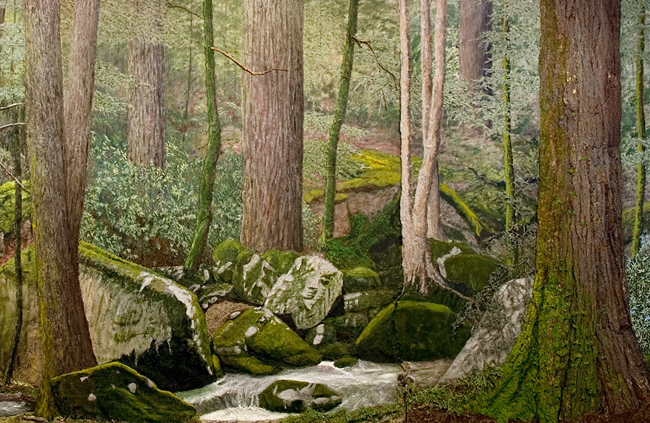
A striking new art exhibit has captured the life and death of the great eastern hemlock, bringing the plight of this threatened tree to indoor audiences.

Internationally-renowned artist Lowell Hayes, a resident of Valle Crucis, N.C., has created eleven large-scale constructed-canvas paintings that incorporate natural materials such as bark and tree limbs for a striking 3-dimensional representation.

“The exhibition is really not about the blight. [It’s] about the life of the hemlock, rather than the death of it,” Hayes said.

“The Hemlocks! The Hemlocks!” exhibit will show in the Turchin Center for the Visual Arts at Appalachian State University from December 3 through March 19, 2011.

Across the eastern seaboard, a tiny invasive bug is wiping out the mighty hemlock tree. Known as the hemlock woolly adelgid, the pest was first noticed in 1951 near Richmond, Va., and has since decimated evergreen populations from Vermont to Georgia. Unconfirmed reports place the sap-sucking adelgid as far west as Wisconsin.

“Maybe we won’t have a time here in the South when we will be [without] hemlocks, but we already have lost about half of them,” Hayes said.
Hayes has worked on the project for over four years, during which time he experienced the loss of his mother to cancer.

“There I was immersed in the loss of the hemlocks, and [my mother] had cancer and she was not getting any better,” he said. “We knew it was only a matter of time.”

“You don’t sit around and weep with your mother [while she is dying],” he said. “You might have some tears, but when you are with your mother you are trying to contribute to her having a good life so long as she has it.”
Hayes realized he did not want to focus on the death of the hemlocks, but to appreciate the tree while it lives. “What I am painting in the representations and the interpretations of hemlocks is our being with them,” Hayes said.

Hayes, now in his 70s, has been painting the Appalachian landscape and its people for 40 years, but the bas relief hemlock canvases are considered his most evocative and focused work to date. He credits the project with encouraging him to get out in the forest and relate to nature more intimately. “There have been a lot of blessings involved,” he said. “That is a tremendous life experience, and I am very privileged, grateful to be able to do that.”

The ultimate goal of the exhibit is to connect viewers spiritually and emotionally to the plight of this magnificent tree.

“It’s one thing to read about the devastation, or even to go into the field and observe it, but it’s another… to have an artist’s take on how you feel when you are with these hemlocks,” he said. “I hope this does get a chance to [create] contact between people and hemlocks, especially between people in urban situations who don’t get into the forest very much.”

Viewing the massive paintings first-hand is a study in nature itself. Tree limbs, constructed moss and rocks, and sections of real hemlock bark loom off the canvas in realistic detail. The sheer size—the largest is 9 feet high by 19 feet long—dwarfs the viewer.

During the exhibition, the art will be complimented by a range of educational materials about the woolly adelgid and the demise of the hemlocks.

A two-story exhibition hall will also house a site-specific installation by Hayes that includes a nearly 40-foot section of a dying hemlock tree.

Hayes hopes to take the show on tour after the Turchin exhibition, and is seeking venues throughout the hemlock range, from Maine to Alabama and west to Minnesota.

“The finest thing that anyone says to me about my work is, ‘After seeing your work, I saw what you mean [out] in nature,’” he said. “I like to say, ‘This is heaven, don’t miss it while you’re here.’”

Work by Lowell Hayes has been included in a touring exhibition by the National Museum of American Art and graces numerous private and public collections, including the University of North Carolina and the Tennessee State Museum.

The Turchin Center for the Visual Arts is located at 423 W. King Street, Boone, N.C., and is open Tuesday through Saturday. Admission is free.

Thems “The Breaks” – Enjoying the Unknown Beauty of Breaks Interstate Park
Monday, December 6th, 2010 - posted by jillian

Story by Daniel Hawkins

Within the coalfields, straddling the border of Southwestern Virginia and Eastern Kentucky, lies a little-known natural wonder of the Appalachian Mountains.

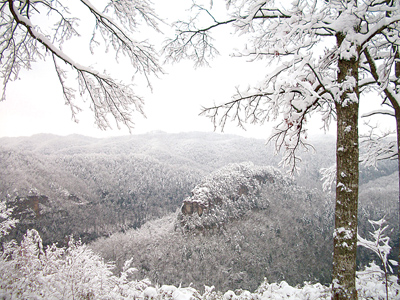
Known as the Grand Canyon of the South, Breaks Interstate Park is home to one of the deepest gorges east of the Mississippi. Over millions of years, the Russell Fork River cut a five-mile-long gorge through the Pine Mountains of Appalachia, creating a magnificent natural spectacle. With depths reaching 1,000 feet from the scenic overlooks to the river below, the gorge has attracted visitors from all over the world.

The “Breaks,” as it is called by local residents, provides visitors with breathtaking views from seven overlooks and offers an abundance of activities during spring, summer and fall. During these busier months, the park’s large amphitheatre plays host to a variety of weekly events and outdoor enthusiasts enjoy activities ranging from camping and horseback riding to mountain biking and swimming.

As the splendorous colors of fall foliage turn to brown and the abscission of leaves reveals many shades of grey bark, visitation to Breaks Interstate Park slows drastically. The few who do brave the cooler temperatures find winter is one of the best times of the year to enjoy the many wonders this seemingly dormant park has to offer.

I for one enjoy hiking the park in winter as much as any other season, and one of my favorite hikes begins on the Overlook Trail. Roughly a mile long, the trail stretches between the Clinchfield and State Line overlooks, skirting along the edge of the canyon; I can clearly hear the Russell Fork River make its rocky decent hundreds of feet below me. As I pass by the many unguarded overlooks that give the trail its name, I occasionally take a weak-kneed step out to their edge to catch amazing views of the gorge.

Once I’ve reached the State Line Overlook I link up with the Ridge Trail for a short hike through a grove of mountain ivy before intersecting with Laurel Branch Trail. Here a small crystal clear stream snakes through giant rock formations known as “The Notches.” I easily become lost in the peaceful solitude of nature as the moss covered stone walls separate me from the rest of the world.

I journey onward through thickets of mountain laurel and groves of hemlock which add a touch of green to the otherwise gray and brown hues of an Appalachian winter. My breath begins to fog as I deepen my decent below the northern side of the mountain. The crispness of the air feels refreshing and soon I can hear the water of a creek flowing rapidly. I link up with Grassy Creek Trail, perhaps one of my favorites within the park. As the trail leads me alongside the creek, I am continuously amazed with the beauty of a stream left mostly untouched by man—a rarity within the coalfields I call home.

I finally reach the river and rather than continue on River Trail I will turn around and make the ascent back to the warmth of the cabin I rented within the park. Tomorrow I may continue the journey from the Prospector Trail, but for this evening I plan on relaxing by a warm fire. Hopefully the snow that has been forecast will blanket the area, turning an already picturesque landscape into an enchanting winter wonderland.

Trail Highlights

Overlook Trail—.75 miles, difficult. Exposed cliff edges require additional caution. For amazing views of the gorge this trail is an absolute must.
Ridge Trail—.5 miles, easy then becomes difficult. Mountain Ivy and Laurel thickets make this an excellent trail for bird watchers.
Laurel Branch Trail—1.25 miles, easy then becoming difficult in the last .5 miles. Experience the natural beauty of the Appalachian mountains along with some amazing rock formations.
Grassy Creek Trail­—.5 miles, moderate. Enjoy the sounds of rushing water as Grassy Creek tumbles down this seemingly secluded hollow.

In-Park Accommodations

The Lodge & Rhododendron Restaurant—81-room hotel with 30 rooms overlooking the gorge. $60 to $90 per night.
Luxury Cabins—Two- and three-bedrooms with gas fireplaces and views of Laurel Lake. $125 to $255 per night.
Cottages—Two-room units with views of the gorge, complete with full kitchen. $90 to $125 per night.
Campground—130 available RV and tent sites. Open from April 1 through October 31. Full hookups available.

For more information or to make reservations visit www.breakspark.com or call (276) 865-4413.