Follow Us on Twitter: Appalachian Voices | iLoveMountains.org

Archive for June, 2009

72 mile record-setting run to end mountaintop removal!

Tuesday, June 30th, 2009 - posted by jeff

This is just amazing!!!! Frankly, we are speechless. While we waited in the halls of Congress for a Senate hearing to begin, our friend Will Harlan ran 72 miles along the TN-NC border to raise awareness! Thanks so much for your support, Will!

On June 25th, I completed a 72-mile, end-to-end run across Great Smoky Mountains National Park in just under 17 hours, a speed record. However, the real goal was to help bring an end to the devastating and deadly effects of mountaintop removal mining in Appalachia and to promote iLoveMountains.org. My crew distributed information about ilovemountains.org at popular trailheads during the run, and we wore iLoveMountains.org t-shirts for the entire run.

I have launched Miles for Mountains as a way to get hikers, runners, walkers, and other outdoor enthusiasts actively involved in ending mountaintop removal. The basic concept is for people to dedicate their mileage–whether it’s on a treadmill or on the trail–toward a collective goal of one million miles to end mountnaintop removal–a virtual million-mile march.

So to all you runners out there, you heard the man…. lace up and start telling the world about mountaintop removal coal mining.

PS. Will also happens to be the Editor of Blue Ridge Outdoors Magazine, the definitive guide to outdoor sports, health, and adventure travel in the Southeast and Mid-Atlantic.

US Senate Subcommittee Holds Hearing on the Impacts of Mountaintop Removal Coal Mining on Water Qual

Friday, June 26th, 2009 - posted by jeff


On Thursday, July 25, over seventy supporters of the Appalachia Restoration Act (S 696) lined up outside the door of Dirksen Senate Building for a hearing on the bill. The hearing, held by the Committee on Environment and Public Works’ Subcommittee on Water and Wildlife, was conducted by subcommittee chair Senator Ben Cardin, also a co-founder of the bill.

The Appalachian Restoration Act (S 696) is a Senate-sponsored bill to amend the Clean Water Act, outlawing the dumping of mining waste into streams. A 2002 change to the Clean Water Act by the Bush administration made it legal to dump mining waste into streams.

The bill would effectively eliminate the mountaintop removal coal mining practice of valley fills.

“Coal is important to America,” said Senator Cardin. “It is important to recognize the importance of energy needs in America. But we are talking about one type of coal mining here – mountaintop removal coal mining – and its impact on the water quality of America.”


“Saving our mountains is important to me, whether we are talking about cleaning up our streams, or ending the practice of blowing up mountaintops and dumping the waste into streams,” he said.


Two panels of witnesses provided testimony for the hearing, including EPA Region 3 Director Jon Pomponio, water quality expert Dr. Margaret Palmer from the University of Maryland, Paul Sloane, Deputy Commissioner of the Tennessee Department of Environment and Conservation, and Randy Huffman, Cabinet Secretary of the West Virginia Department of Environmental Protection.

During Dr. Palmer’s testimony, she indicated that there is “irrefutable evidence that impacts to streams from mountaintop removal [coal mining] is devastating. As headwaters are lost, cumulative effects in streams and rivers below are devastating.” When asked by the Senate panel how effective remedial programs would be to mitigate the damage, Palmer noted that there is no knowledge of an effective way to reverse the damage caused to streams, and that known impacts have been in continuance in some places for close to 50 years.

“When you take the top of a mountain off, you have fundamentally altered the hydrology of that mountain,” she said.

Paul Sloane, Deputy Commissioner of TDEC, claimed that “nearly 70% of post mining land uses is forestry reclamation.” Senator Cardin countered that he was told by a Virginia Tech professor that less than 1% of the currently 5800 valley fills in West Virginia and Kentucky had actually been reclaimed.


After the hearing, West Virginia Coal Association vice president Chris Hamilton spoke with media in attendance, saying that he was “disappointed in the way this was set up and organized. Those opposing [mountaintop mining] had four witnesses, and supporters [of coal] were virtually shut out of the process.”

“This bill [will impose] significant restrictions not only on mountaintop mining, but on surface and underground mining as well. I don’t think the answer is to abolish surface mining,” he added.

“The very concept of mountaintop removal is repugnant to me,” Senator Cardin said in an interview after the hearing. “This bill is about water quality. I’m not sure the mining companies are in the position to tell us about water quality.”

The next steps for the bill include the possibility of additional hearings in the subcommittee, followed by a vote. If the bill passes subcommittee, it will proceed to review by the full Environment and Public Works committee before passing to a full Senate vote.

To view an archived webcast of the entire hearing, visit the Senate website or click here to watch it now!

A day to shine on Capitol Hill

Friday, June 26th, 2009 - posted by jeff

Hearing chambersNews coverage of yesterdays Senate hearing on mountaintop removal coal mining:

The best headline thus far was printed before the hearing even started:
Washington City Paper – Mountaintop Coal Mining Face Off Starts Now!

As always, Ken Ward’s Coal Tattoo blog provided the most comprehensive coverage and analysis:
Mountaintop Removal: Jobs vs. Mayflies? NOT

Here’s a preliminary roundup of hearing coverage:

  1. McClatchy Newspapers – Lawmakers, activists battle over mountaintop removal coal mining
  2. Clear Skies TV – Mountaintop Removal Hearing
  3. CBS 13 WOWK, West Virginia – Mountaintop Mining Debate Reaches Capitol Hill
  4. CBS 59 WVNS – Debate Continues in Washington on Mountaintop Removal Mining
  5. ABC 3 WHSV – Environmental Official Testifies on Mountaintop Mining and Water Quality
  6. WV Metronews – Can We Really Keep Doing This?

And a few photos from the event. More can be found on our Flickr page:
http://www.flickr.com/photos/nationalmemorialforthemountains/sets/72157620455714735/

Talking across the issue part 2
Citizens for Coal discuss the mountaintop removal coal mining issue with Cody Simpkins of Kentuckians for the Commonwealth.

Senator Ben Cardin
Senator Ben Cardin, co-founder of the Appalachia Restoration Act (S 696) and chair of the Committee on Environment and Public Works’ subcommittee on Water and Wildlife, speaks to the media about the bill.

Hearing chambers
Close to two hundred people lined up for the Senate hearing on the Appalachia Restoration Act, from both sides of the mountaintop removal coal mining issue. Only about sixty were able to fit into the main Senate Committee chamber in Dirkson Senate Building; the rest were directed to an overflow room in a nearby senate building.

Waiting in Line
Close to two hundred people lined up for the Senate hearing on the Appalachia Restoration Act, from both sides of the mountaintop removal coal mining issue. The hearing was held in the Committee on Environment and Public Works’ subcommittee on Water and Wildlife. Some individuals waited in line for over three hours to secure a seat in the hearing.

Coalfield citizen statements about mountaintop removal mining:

Mickey McCoy, Kentuckians for the Commonwealth
Inez, KY – I am a 53 year old retired high school English teacher who was born and raised in Inez, Kentucky. Twenty five percent of my counties land area has been striped mined.

Our public water system in Martin County is polluted and our 100 year flood comes every 18 months. These problems are due to the coal industry and the greed of their corporate owners.

Mountain top removal continues to bomb the hell out of our mountains, our culture, and our future.

I’m here in DC to see if anybody gives a damn about the death of my land. I’m here to see if any elected officials care to stand for us against the destruction of the Appalachian Mountains. I am here for the last hope.

Cody Simpkins, Kentuckians for the Commonwealth
Morehead, KY – The people of Appalachia have struggled to find their voice for generations. Yet time after time we have been silenced buy our poverty and the overwhelming influence of the industrial forces that bring this poverty to our communities. For the first time our government is opening an ear to a main factor in the plight of Appalachia. Whether or not our voices will be heard is still left to be determined, but at least now we have a chance to open our mouths.

Matt Howard, Kentuckians for the Commonwealth
McGoffin County, KY – As a young person, born and raised in eastern Kentucky, I have many hopes and aspirations for my family and neighbors. I would like to see my people prosper, living long into their old age. In recent decades there has been an explosion in cancer rates among the human population the world over. It is obvious that we have brought this problem on ourselves. What we put into the land, air, and water, we unavoidably put into our own bodies. With Mountain Top Removal we are poisoning our water, and losing the rich soil that nourished our bodies for so long. We our selling the thing that truly sustains us, and funneling our wealth out of the region. What we are selling can never be replaced. This is the great tragedy of our time and region. I hope to see people embrace logic, and develop a thirst for knowledge. We should strive improve ourselves as individuals and as a society. This is what I want for our people.

Lorelei Scarbro—Coal River Mountain Watch
Rock Creek, WV – I am WV born and raised; in my family has been four generation of underground coal miners, including my husband who died of black lung. My home is threatened by a proposed mountaintop removal behind my home. Everything I have, including the cemetery where my husband is buried, is at risk. It’s my prayer that this committee learns the truth about how mountaintop removal is impacting the water in Appalachian communities. My biggest concern as a mother of four and as a grandmother is safe drinking water. I’m so concerned about the quality of water my granddaughter will have when she’s my age. People I know are already sick, dead, and dying because of mountaintop removal has on our water.

There is an alternative. In my community, the Coal River Valley in southwestern West Virginia, there is a 6,600 acre mountaintop removal site proposed for the mountain behind my home. Instead of this destruction, we are proposing a wind farm. Studies have shown that this would provide more jobs, more revenue for the county, and more electricity in the long run that the mountaintop removal project. This project would allow us to start re-building our community, and create safe, permanent jobs and clean energy forever. We need our government to step forward and support alternatives like the Coal River Wind project, and other investments in green jobs in communities that have been impacted by mountaintop removal.

David Beatty—Save Our Cumberland Mountains
Cumberland County, TN What I’ve been saying all along is that where I come from, so many jobs are pretty well gone, but you can still depend on tourism. If the water is messed up and the mountains are gone, we’ll lose that too. I see this mountaintop removal another threat to the economy, more than any other economic threat we face. The lawmakers need to respond, because while they may not care about our health, I know they care about the economy.

I was elected to the position of County Executive from 1998 to 2002. We focused on developing tourism because we saw that as the best economic option for our community. I see hope in this new green economy as an alternative we’ve never had before.

We used to have many jobs in underground mining – and a lot of our retired miners gave their health to the pollution inside the mine. They never dreamed they would now have to give up their land, their mountains and their lifestyle, to mountaintop removal mining.

The well water on my property was ruined by strip mining, and it is threatened by a new mountaintop removal site they are trying to put in. You used to be able to lean down and drink out of any stream, but now you don’t dare. People depend on their well water, because many don’t have access to city water. Bad water doesn’t just affect the tourist economy; it’s our health; it’s our life.

I see such an opportunity and such a serious threat. Investment in a green economy is our best opportunity to get Appalachia out of poverty, but we’ll never have that chance if we destroy our water and our health with mountaintop removal.

Jean Chealy –Save Our Cumberland Mountains
Cumberland County, TN – I am a retired school teacher and volunteer as the chair of our local chapter of SOCM. I have been to Washington to lobby against mountaintop removal before. Mountaintop removal is such an abomination, and we shouldn’t have to spend this much time and energy fighting it. The problems should be obvious to lawmakers, and they need to act to end mountaintop removal today.

In Tennessee, we now also have to fight the terrible impacts of TVA’s coal ash spill. TVA is hoping to dump huge amounts of the toxic coal ash waste onto a strip mine near my home in Cumberland County, TN. They bulldozed through our county commission and got the permits with out listening to citizen concerns. I got involved years ago because of the terrible blasting damages from this same strip mine they are now trying to dump their toxic coal ash into. So, now our health and our water are being threatened by the mining of coal and by the disposal of the toxic ash they make when they burn it.

Kathy Selvage, Southern Appalachian Mountain Stewards
Wise, VA – We have so much to share with the people who might visit us. If we could only stop blasting away our mountains and dumping them into valleys and streambeds. Mountaintop removal is destroying the land, the people, and our cultural heritage. We could make it if only our elected leaders shared our vision, one that doesn’t concentrate on destruction, but instead on construction.

News for the Marsh Fork Elementary School Rally of June 23rd, 2009

Friday, June 26th, 2009 - posted by jeff

On Tuesday, June 23, a team from Appalachian Voices joined hundreds of people gathered at an anti-mountaintop removal coal mining rally at Marsh Fork Elementary School in West Virginia to protest the continuation of the destructive practice. The local and regional residents were joined by NASA climatologist James Hansen, who spoke about the contributions of mountaintop removal coal mining and coal-fired power plants to the problem of global warming.

Activist and actress Daryl Hannah, Rainforest Action Network Executive Director Michael Brune and renowned novelist Diane Giardina also spoke during the rally.

According to Hansen, 24,000 people die each year from illnesses caused by coal-fired power plants.

Novelist Denise Giardina, author of the book “Storming Heaven” about the battle of Blair Mountain, said during her speech, “We had coal mining for 70 years before mountaintop removal mining, and blowing up the top of a mountain is not coal mining.”


Protestors were met at the scene by employees of Massey Energy – who according to one source had been given the day off with pay to attend the rally and counter the protest – and their wives. The miners were dressed in work clothes with orange “Massey stripes” and carrying signs that said “Tree Huggers Go Home” and “We Love Mountains That Produce Coal.” Some miners shouted obsenities and taunts at protestors.

“The coal that is burned here [in West Virginia] is mined somewhere else, and the coal that is mind here is burned somewhere else,” said Rock Creek, WVa native Judy Bonds. “This is America. This is everyone’s problem.”

Rally attendees then marched half of a mile down the main road to the Massey coal processing plant entrance, singing “Amazing Grace” and other gospel songs. They were met by the line of Massey workers and wives chanting “Massey, Massey” and shouting at the protestors. Twenty-nine individuals who had chosen to risk arrest then sat down in the middle of the road, and climatologist Hansen read a request to Massey Energy asking the company to help with the climate change problem by ending mountaintop removal coal mining.

The activists were subsequently arrested for obstructing traffic. “Stop mountaintop removal and create a clean energy future,” said actress Daryl Hannah as she was lead away in handcuffs.


Among the arrested included 94-year-old Ken Heckler, former U.S. congressman and Secretary of State for West Virginia; James Hansen; Michael Brune, and numerous West Virginia residents including Lorelei Scarboro, Dana Kuhnline and Larry Gibson.

In the end result, the rally was peaceful, violence was avoided, and the majority of Massey’s coal production on the mountaintop removal site above the school was shut down for a day.


Quotes from the day:

“The blood of Native Americans and West Virginians is in these hills. The spirit of Native Americans and West Virginians is in these hills. We need to honor the Scotch Irish, honor the Germans and English, honor the Native Americans and Africans whose people are buried in these mountains. This is a war of the spirit.” Matt Charmin, Dakota Blackfoot Sioux

“We think there is a way to create long-term, sustainable jobs so you can feed your families.” Steve Owen, Executive Director, Appalachian Institute for Renewable Energy, speaking directly to the Massey Energy counter-protestors

“People went to jail so we wouldn’t have to work on weekends. People went to jail so women could have the right to vote…. [some of you are risking arrest today...] You have the right to remain silent, but now is the time to stand up for what you believe is right.” Steve Owen, Executive Director, Appalachian Institute for Renewable Energy

“Don Blankenship invited me here today, when he started blowing up mountains.” Michael Brune, Executive Director, Rainforest Action Network

Flickr Photostream available at: http://www.flickr.com/photos/appvoices/sets/72157620592562274/

Supreme Court Ruling Has Implications for Mountaintop Removal

Wednesday, June 24th, 2009 - posted by jeff

This just in. Rob Perks of NRDC provides commentary on their blog, the Switchboard.

It does not bode well that the U.S. Supreme Court yesterday ruled 6-3 in favor of treating America’s waterways like dumps.  Specifically, the Court decided that the U.S. Army Corps of Engineers can legally permit the disposal of polluted wastewater from a gold mine into an Alaskan lake.  The proposed Kensington Gold Mine, in the Berners Bay region near Juneau, would discharge 210,000 gallons per day of ‘treated’ mine tailings directly into Lower Slate Lake.  Over the course of the mine’s 10-15 years of operations, that adds up to about 4.5 million tons of toxic waste that will kill all the fish and nearly all other aquatic life.   

(Photo by J. Henry Fair)

I’m no lawyer, nor do I play one on TV, so feel free to analyze the gory details of this legal travesty in this article on the decision.  You can also read the New York Times coverage of the case here.

Now, the reason the Court sided with the Corps — and contrary to the purpose of the Clean Water Act — is because of a rule change invoked by the Bush administration back in 2002 that expanded the definition of the term ‘fill material’ to include mining waste.  This is the very same regulatory dirty trick that the Corps relies on to permit massive stream ‘valley fills’ in Appalachia associated with mountaintop removal coal mining.

But this disappointing Supreme Court ruling doesn’t have to be the end of the issue.  You see, the Obama administration can save that Alaskan lake from irrevocably pollution — and all the mountains and valleys in Appalachia from destruction — simply be reversing the bad Bush ‘fill’ rule.  Recent actions by the Obama administration to crack down on mountaintop removal fall far short of actually ending mountaintop removal, which is the only solution to this abomination. 

In addition, legislation pending in both houses of Congress would also effectively put a stop to mountaintop removal by overruling the 2002 fill rule — thereby preventing the Corps from permitting waste dumps in America’s waterways. This Thursday, the Senate will hold a hearing on one of those bills, the bi-partisan Appalachia Restoration Act (S. 696), co-sponsored by Sens. Ben Cardin (D-MD) and Lamar Alexander (R-TN).

I’ll be live blogging the Senate hearing.  Meantime, you can help by urging your Senators to support this bill.       

(Photo by J. Henry Fair)


A Backyard Vegetable Garden

Tuesday, June 23rd, 2009 - posted by meghan

The Ultimate Shovel-Ready Project

Story by Kathleen McFadden

According to the National Gardening Association estimates, a well-maintained food garden yields about a $500 return. Some folks are keeping small gardens just to save money on growing food bills, and an expanding number of people are growing larger gardens to sell the surplus, while others simply enjoy easier access to homegrown organic produce. Photos by Kent Kessinger.

Talk about a shovel-ready project! Federal legislators may not have had home gardens in mind when they crafted the American Recovery and Reinvestment Act to provide funding for ready-to-go infrastructure projects, but First Lady Michelle Obama certainly did. Less than a month after the President signed the legislation, the First Lady was out on the White House lawn in her tennis shoes, helping to break ground for an organic vegetable garden and making Roger Doiron a very happy man.

The founder of Kitchen Gardeners International, Doiron launched the EatTheView.org campaign during the presidential campaign between Barack Obama and John McCain to urge whoever was elected president to lead by example and plant a garden at the White House. More than 100,000 people signed Doiron’s White House Victory Garden petition, and the Obamas responded.

Michelle Obama’s foray into edible landscaping is not the first time a First Lady has set such an example. In 1943, Eleanor Roosevelt planted a victory garden at the White House to inspire Americans to do the same. They responded. At the peak of the victory garden movement, nearly 20 million gardening Americans produced an estimated 40 percent of the nation’s fresh fruits and vegetables.

Although we live in a very different America today, the devastating impact of the recession on family budgets, rapidly growing environmental concerns, increasing worry about genetically altered crops and a back-to-basics mindset have all contributed to a resurgence of interest in home-grown food. The victory gardens of the 1940s have been reborn in the recession gardens of the 2000s.

Even before the full impact of the recession hit American families, food gardening was on the rise. According to the National Gardening Association, 2008 saw a 10 percent increase in vegetable gardening compared to 2007, and gardeners spent $2.5 billion that year to purchase seeds, plants, fertilizer, tools and other gardening items.

In 2009, an estimated 7 million more households will swell the gardening ranks—a 19 percent increase and nearly double the 10 percent growth from 2007 to 2008. As a result, seed companies are reporting double-digit increases in sales this year over last and are even selling out of some popular varieties.

Doubtlessly, much of this spike in interest is economic. According to the U.S. Department of Labor, grocery store food prices rose 6.6 percent in 2008, the largest annual increase in nearly 30 years. This year, with many family breadwinners out of work and struggling, the idea of offsetting the total on the grocery store receipt with some outside work and a few seed packets has been an attractive proposition—and a financially solid one. According to National Gardening Association estimates, a well-maintained food garden yields about a $500 return, taking into account a typical gardener’s investment and the market price of produce.

But it’s not all about money. Just ask the head of one of the country’s largest home-market seed suppliers.
“Gardens inspire the kind of optimism the American public is craving right now,” said George Ball, chair and CEO of the 133-year-old W. Atlee Burpee & Co. seed company. “Children growing up during this renaissance in vegetable gardening will learn valuable lessons about nutrition, nature, self-sufficiency and respecting the earth by gardening alongside their parents. The state of the economy has certainly played a role in the increased interest in edible gardening, but folks are not going to let their vegetable plots go fallow when the economy heads north,” Ball continued. “People have an innate desire to take control of our own destinies, and vegetable gardening allows us to do this.”

Dr. Marion Simon agrees that the interest in home vegetable gardening isn’t just about the potential savings on the family food bill. Simon, the state specialist for small farms and part-time farmers at Kentucky State University, said one of the top reasons people are turning to home food production is their personal health. Many people have told her, she said, that their doctors have recommended home gardens as a good way to help control diabetes and to tackle weight problems.

Simon’s department holds sustainable agriculture workshops on the third Thursday of every month for people who want to grow small “truck gardens” that will feed their families and even yield some surplus to sell. The popular program attracts about 1,200 people each year, and its popularity is growing. “A lot of people are looking at gardens that haven’t looked at them before to save money on their food,” Simon said.

But several other motivators besides personal health and economics are attracting everyone from high school students to young married couples to farmers in their 70s to the monthly workshops. Among those motivators, Simon said, are the growing interests in eating locally grown foods, in using organic methods and in protecting wells and groundwater from contamination.

Home gardens can produce a significant community effect, Simon explained. She knows of neighbors who sell their extra harvest to neighbors, a factory worker who sells fresh produce to his co-workers and a number of growers who sell their surplus on the side of the road—all growing the local market movement, distributing healthy food and making a little extra money at the same time.

But the best thing about an organic home garden? Kentucky farmer Dana Lear smiled and said, “You can just pick a snack, wipe if off on your shirttail and eat it.”

Volunteers Put New Trail On The Map

Tuesday, June 23rd, 2009 - posted by meghan

Story and photo by Sarah Vig

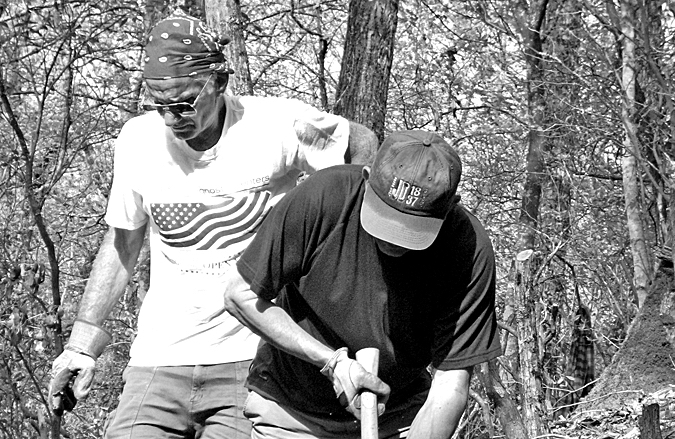
Volunteers with the Carolina Mountain Club help to build new trail in the mountains of North Carolina, bringing the Mountains to Sea Trail nearer to completion. In its completed form, the trail will span 1000 miles across the state.

The Mountains to Sea Trail is halfway home.

With over 500 of its 1000 miles completed, the ambitious project is well on its way to spanning the entire length of the state of North Carolina.

The Mountains to the Sea Trail (called the MST) owes its start, and continued to existence, to volunteers.
Perhaps it is because it is so ambitious that it took 20 years for the trail to go from proposal to possibility. But its allure, and the hard work of hundreds of volunteers across the state are keeping the dream alive and bringing the project steadily closer to completion.

According to Kate Dixon, Executive Director of Friends of the Mountain to Sea Trail (FMST), the idea of the MST was first proposed by Howard Lee in 1977 at a trails conference. At that time, Lee served as the secretary of the North Carolina Department of Natural Resources. 20 years later, trail expert Alan DeHart, “essentially got tired of waiting,” says Dixon. She says DeHart sat down with a map and figured out how to use existing trail systems in the state, back roads and bike paths to complete the statewide trek. DeHart founded FMST and he and a friend became the trail’s first thruhikers.

Since the inaugural hike, enthusiasm and support for the trail has only grown. “There is a romance to the idea of walking across the state,” Dixon says of the enduring place the MST holds in the hearts of North Carolina hikers. “ It represents for a lot of people what they most love about North Carolina.”

Currently the trail has more than 500 miles of completed footpath and a nearly equal length of temporary trail connectors. The goal, however, is to move the trail entirely off the roads, and volunteer task forces across the state are helping it to move closer to that goal.

Breaking Ground
In 2008, the Mountains to Sea trail had around 500 volunteer trail builders and maintainers. Many of these volunteers came from hiking clubs across the state including the Carolina Mountain Club (CMC), the Saura Town Trails Association and the Carteret County Wildlife Club.

CMC has three crews that go out each Monday, Wednesday and Friday, plus a bi-weekly Saturday crew. By virtue of their size (usually between 10 and 15 people come out on any given Friday), it is the Friday crew that most frequently builds new trail, say Piet Demhorst, who has headed the crew with another experienced trail builder, Skip, for nine years.

Trail building is multi-step process. After the trail is “blazed” by a team of experienced volunteers, the route is approved by the federal or state officials as well as a biologist and an archaeologist to ensure that no ecologically fragile or archaeologically important sites are being compromised. When the route is approved, a small team of people with the required certifications uses chainsaws to remove the large obstacles in the trail-to-be. A second team uses a hoist to pull the stumps out of the ground, often with the help of a two-sided tool called a polaski, which looks like an axe on one side and a pickaxe on the other. A third and final team takes up the rear, using hazel hoes and loppers to cut the trail into the ground and remove roots and smaller trees and plants.

The act of trail building with its chainsaws, ripping stumps out of the earth, and cutting into the hillside can at times seem almost violent. However, Dixon and Demhorst both emphasize that a well-built and consciously placed trail protects the land. “We want people to be able to enjoy public land,” Dixon explains, ”trails are the best way to do that.”

Alan, part of the hoisting crew, has been going out with the Friday trail crew for more than six years. “My wife and I strongly believe in volunteer work,” he explains to me. “I’m giving a gift. This is going to last forever.”

Coming Together
Dixon indicates that the trail is “getting close to completion in the mountains,” meaning that from the trail’s starting point at Clingmans Dome in the Great Smokies to Stone Mountain State Park in Roaring Gap, N.C., one will soon be able to hike without ever touching the road. In addition, there are two task forces building large sections of trail in other areas: one between Blowing Rock and Wilkesboro, the other between the Triad and the Triangle. These segments are expected to be finished within the next 5 years.

These three areas have been easiest to complete because of the availability of state and federal land. In other areas, such as between Raleigh and New Bern on the coastal plain, or between Stone Mountain and the Triad, public land is much harder to come by. FMST is working with land trusts to encourage donations of easements, and with the state to encourage the purchase of key tracts of land. Recently, the state of North Carolina followed the group’s urgings and purchased $8.5 million in land for the project in Beaufort, Alamance, Orange and Johnson counties.

As the trail is under ongoing construction, the FMST encourages hikers who are planning trips to contact them for updated trail information. “Things like camping haven’t been worked out yet,” Dixon says. FMST also sends out an e-mail to its listserv every six weeks or so with updates on the newest developments. Interested individuals can sign up for the listserv at the group’s website, ncmst.org.

The Modest Mayapple

Tuesday, June 23rd, 2009 - posted by meghan

Story by Alison Singer

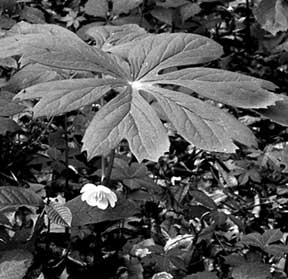
Large leaves of the mayapple shelter a single white blossom, which later yields the plant’s fruit. Photo by Rick Mark

Large leaves of the mayapple shelter a single white blossom, which later yields the plant’s fruit. Photo by Rick Mark

What first caught my eye was the tightly wound green bundle atop the stem. They looked like closed umbrellas. “What are those?” I asked, pointing. “It’s Jack-in-the-Pulpit,” my friend told me, and I let the name slide over my tongue. I pictured a preacher clasping his hands in front of his congregation, his head bowed. “It’s bloodroot,” my father contradicted, and I imagined piercing the thick stem with a needle and watching red liquid ooze out of it.

What I’d seen, and was so enthralled with, was neither Jack-in-the-Pulpit, nor bloodroot, but Podophyllum peltatum, commonly known as the mayapple. Within a matter of days, the leaves had unfurled, spanning several inches, looking even more umbrella-like. They took over the ground, preventing me from seeing anything beneath their foliage. My favorite part of the mayapple is the flower peeping out from beneath the leaves, hidden from above, different from the typical flowering plants whose color bursts forth atop their stems.

Mayapples are different. Each May, all over the eastern United States and Canada, their flowers bloom. The plants are either one or two-leaved, and only the two-leaved plants produce flowers. If you look beneath the unfurled leaves, a delicate bloom emerges from the crotched stem (Peltatum is Latin for “shield-like,” an apt term for the broad leaves that shield the flowers from view). The petals are milky white and about two inches across with a yellow center, making the blossom look something like an egg.

While the flower blooms in May, the fruit which gives the plant its common name, does not appear until later in the summer. The “apple” is a yellowish fruit one to two inches long, and is the only part of the plant that is not poisonous (ed. note: unripe fruit are toxic like the rest of the plant, ripe fruit are described as soft, yellowish and have a cloyingly sweet smell). Though I have never tried one, the apple is described as tasting anywhere from completely tasteless to lemony.

Though the plant is poisonous, and classified by the FDA as “unsafe,” there are many purported medicinal uses, most of which I fortunately have no need for. Native American tribes used to gather and dry the rhizome (the underground stem which can grow up to six feet in length), grinding it into a powder. They brewed the powder like a tea, and drank it as a laxative and cure for intestinal worms. In modern medicine, extracts from the plant are used to treat genital warts and skin cancer.

While not one to blithely disregard cancer treatments, my fascination with the mayapple stems primarily from its physically dramatic entrance. The initial sight: an aerodynamic structure, like a missile aimed towards the sky. Then the leaf, or leaves, slowly unwinds from the stem and fans out, arching over the ground. Were I tiny, I would happily grab the nearest mayapple leaf to cover myself with in a sudden rain squall. Not being Lilliputian, and thankfully not suffering from skin cancer or warts, the only use mayapple has for me is its beauty and uniqueness, which luckily is enough.

When I returned to the first spot I had found them, I was amazed to see how the small, bundled plant had grown into a giant (relatively – the stems average 15 to 20 inches tall, and the leaves span 10 to 15 inches) umbrella. Because of their long rhizomes, mayapples tend to grow in clusters, and they can be seen throughout the region, blanketing forest floors.

The flower that bows its head beneath the great leaves reminds me of a supplicant, which in turn reminds me of my own relationship with nature. While most flowers struggle to attract pollinators with their bright colors open to the sky, the bashful mayapple seems to hide. In the same way, I am hidden as I walk beneath the canopy of trees. I find peace and solitude in the woods, away from “pollinators,” from people wanting my attention, needing me for something.

In the mayapple’s unusual flower, I have found a metaphor for myself. And more than just a metaphor. A reminder of how I want to approach the mayapple’s forested world – humble, shy, non-intrusive. Nothing more than a supplicant bowing my head as I search for peace beneath the dappled greenery.

Former Appalachian Voices Director Mary-Anne Hitt Recognized by Alma Mater

Tuesday, June 23rd, 2009 - posted by meghan

Mary Anne Hitt, who served as Appalachian Voices’ Executive Director from spring 2004 until November, 2008, recently received the University of Tennessee’s Notable Woman award.

The award, given every year since 1995 by the University of Tennessee Commission for Women, honors “a woman whose accomplishments bring distinction to the university.” Margaret Crawford, who serves as chair of the commission, says they were drawn to Hitt because she “exemplified a person who was committed to the type of work that she was doing as an undergraduate.”

Hitt’s thesis for UT’s College Scholars program, entitled “The Greening of the Big Orange,” examined campus policies concerning recycling, energy use and waste disposal, and has since become the framework for the campus’ sustainability agenda. She also founded the campus’ first environmental group, SPEAK, or Students Promoting Environmental Action in Knoxville. The group continues to make an impact on the campus today.

Since graduating from UT in 1997, Hitt has worked tirelessly to end mountaintop removal in Appalachia. While at Appalachian Voices she spearheaded the partnership with Google Earth Outreach to use satellite images and the Google Earth tool to show the devastating effects of mountaintop removal mining in Appalachia. She now serves as the deputy director of the National Coal Campaign for the Sierra Club.

Appalachian Voices’ Attorney Puts Duke CEO Jim Rogers in The Hot Seat

Tuesday, June 23rd, 2009 - posted by meghan

While several dozen people were outside Duke Energy headquarters protesting CEO Jim Rogers’ decision to construct new coal-fired power plants in North Carolina and Indiana, Scott Gollwitzer, Appalachian Voices’ In-house Counsel, was inside asking questions at the annual shareholders’ meeting.

When it was his turn, Gollwitzer briefly described the devastating social and environmental impacts of mountaintop removal coal mining for those present. According to Gollwitzer, approximately 50 percent of Duke’s coal is extracted by mountaintop removal process because it is allegedly less expensive than other Central Appalachian coal.

Then Gollwitzer mused, “I think everyone in this room would agree that just because something is legal, say slavery, doesn’t make it moral. I ask you then—and this is a yes or no question—just because mountaintop removal is legal, is it moral to burn it to maximize profits when alternative sources of central Appalachian coal are available at comparable prices?”

Rogers answered that “Duke will be looking to move away from mountaintop removal coal mining as its existing coal purchasing contracts expire.” He also expects “increased regulation of mountaintop removal from Washington, D.C.”

“So it’s neither moral or immoral?” pressed Gollwitzer. “It was a yes or no question.”

“For us it’s a little bit of a balancing act, but I think you’re on the right side of this issue,” replied Rogers. “It’s not sustainable.”

“Jim Rogers has all but admitted that burning mountaintop removal coal is immoral. This is a huge step in ending the destruction of the people, communities and ecosystems of central Appalachia,” said Gollwitzer after the meeting. “Honestly, I was flummoxed by his candor because Duke has been working to scuttle state legislation that would prohibit the purchase of mountaintop removal coal.”

The legislation Gollwitzer refers to, the Appalachian Mountains Preservation Act, would prohibit North Carolina’s investor-owned utilities from renewing their contracts for mountaintop removal-mined coal.